
Renew Rebuild Hawaii’s Blog
current events, green initiatives, and hot topics
CARB FIX Technology and Direct Air Capture

Power plant in Iceland
By Michael Markrich copyright 2022
What if you could get rid of the air pollution from the smoke stack of a power plant? Not just reduce its impact with a chemical scrubber as is done now. But take it completely out of the atmosphere and sequester it forever below the ground in stone? This may sound like science fiction but this is currently what is happening in Iceland. Soon it may be taking place all over the world. The process can be viewed here. https://www.carbfix.com/how-it-works
Some consider this carbon sequestration process called CARB FIX the only way to put a cap on the green house gases that are steadily increasing in the upper atmosphere. The problem has been more carbon dioxide is being released into the earth’s atmosphere than is being removed. While world leaders generally acknowledge this, there is no political consensus among nations to reduce carbon emissions. in a timely manner.
Some scientists believe that if the world’s nations continue to emit greenhouse gases into the upper atmosphere at the present rate, so great will be the effects of global warming that more than 20% of the earths surface will be uninhabitable within 50 years. It will just be too hot and there won’t be enough water.
During the early 2000s some scientists in Iceland began looking at a technological rather than a political solution using geochemistry. They reasoned there were two ways to take carbon out of the atmosphere - from the carbon infused smoke plumes from generating plants or through a process known as Direct Air Capture (DAC) whereby the carbon is essentially filtered out of the air and turned into a gas. The question then became if one could remove carbon from the air and turn it into a gas, where would you store it.
In 2006 a group of engineers in Iceland began to look at the natural process by which carbon dioxide dissolves in water and turns to limestone as a solution. In nature, when there is forest fire caused by lightning for example, vast plumes of carbon smoke enter the atmosphere. When it rains the carbon dissolves into the water, and the carbonized water sinks into the earth. In some areas where there are particular kinds of stones such as basalt which is common in Hawaii and Iceland, a chemical reaction ensues and the carbon is stabilized in the rock formation as limestone.
What the scientists wanted to know was whether this naturally occurring process could be done in a controlled way. They wondered specifically if carbon could be turned into limestone if it was taken from the plume of a generating plant, mixed with water and then injected deep into a basalt rock formation.
In 2007 what had started as a scientific paper became an organized experiment to work on the first experiment of this kind in the world.
The scientists included Holmfridur Sigurdottir, Dr. Sigurdur Gislason and Dr. Eric Oelkers. Grants were written and funds were obtained from Reykjavik Energy, the University of Iceland, The Centre National de la Recherche in Toulouse, France and The Earth Institute of Columbia University in New York.
After six years of experiment and having obtained proper permits, they began the first trial injections of carbon infused water into rock at a pilot project site in Iceland. In 2012, between January to March, 175 tons of pure CO2 was dissolved and injected to about 1500 feet of depth at a temperature of 95 Farhenheit and from June to August 73 tons of 75% CO2 – 25% H2S gas mixture (the plume from the power plant there) were injected under the same conditions.
To the great pleasure of the scientists it was found that the injected water carbon dioxide mixture did not leak out of the porous basalt rock into the atmosphere but instead when combined with naturally occurring magnesium, calcium and iron - turned into limestone within two years. The success of these experiments led to more funding from the European Union and approval to work directly on the waste stream at the 303 MW Hellisheidi power plant.
The work at the 303 MW Hellisheidi power plant involved capturing approximately 10,000 tons of waste carbon dioxide (about 1/3 of the total) by filtering it out of the hot plume of steam and carbon, then after mixing it with water- injecting it into basaltic rock, 550 feet below the surface. Over a two year period the carbon dioxide and acid mixture combined naturally with calcium and magnesium into limestone.
The work they did at the generating plant; the second largest geothermal power plant in the world which powers seven generators, was very challenging. The water and hydrogen sulfide proved difficult to handle. Once in the ground the carbon dioxide mix had to be monitored as it turned into limestone,
The project has been so successful that the engineers who created the program developed a company to reproduce this technology in power plants throughout the world. Their company name is called CARB Fix.
The current carbon dioxide of the plant is 34,000 tons and this year, 2022, after 15 years of experimentation the plan is to remove all the carbon dioxide from the plume and inject it in the ground. The intention is to create a plant that is completely self sufficient, and will remove 10% of carbon emissions from Iceland.
It is hoped that this process will become a model for power plants all over the world as well for steel and other kinds of plants that use large amounts of heat and release large amounts of carbon dioxide. The developers of this process believe that Iceland is an ideal place for a model plant of this kind because, like Hawaii, it is 90% basalt which is ideal for carbon storage.
Direct Air Capture (DAC)
(DAC) is based on the premise that it is likely that the world is not going to be able to reduce the amount of carbon dioxide in the atmosphere significantly by any other means but technology. The other solutions such as planting trees as a way of sequestering carbon or restoring the health of soils take a long time.
For this reason many policy makers and scientists believe it is better just to develop the technological means to remove carbon dioxide from the air. Direct Air Capture is now considered a completely novel and new technology. But it may one day become the norm.
In 2017 Carb Fix began working with a Swiss Company called Climeworks which develops technology to filter carbon dioxide directly out of the air. Their facility is currently able to remove 50 tons Carbon Dioxide per year about the same equivalent as 2000 trees. However in order to combat global warming many millions of tons of Carbon Dioxide will need to be removed from the atmosphere.
Carb Fix is working with Clime Works to turn that recovered Carbon Dioxide into stone. It is a hugely ambitious experiment - on which some think the future of the world may depend.
Carbon Capture and Storage Utilization in Hawaii Agriculture In a New Era
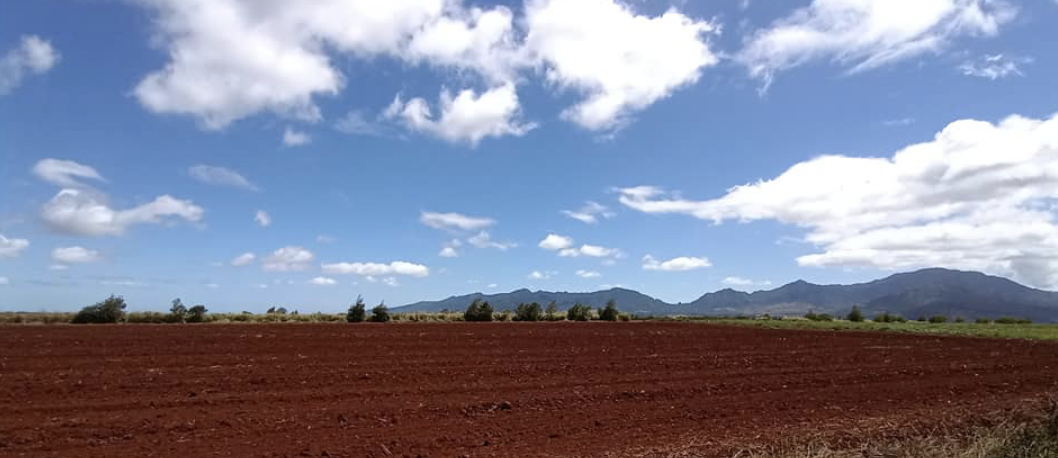
Thousands of acres of farm land in Hawaii might one day benefit from carbon capture - photo - Scotty Wong
By Michael Markrich Copyright 2022
Scotty Wong is clear when he speaks about the future of carbon capture in agriculture in Hawaii. Wong is the CEO of Ohana Hui Ventures, which is at the forefront of the pioneering use of carbon capture as a means to fertilize and grow crops in Hawaii. It is his hope that his carbon capture plan will not only provide a new means to incentivize agriculture in Hawaii but help fight climate change - by removing hundreds of tons of carbon dioxide (CO2) from Hawaii’s air at the same time.
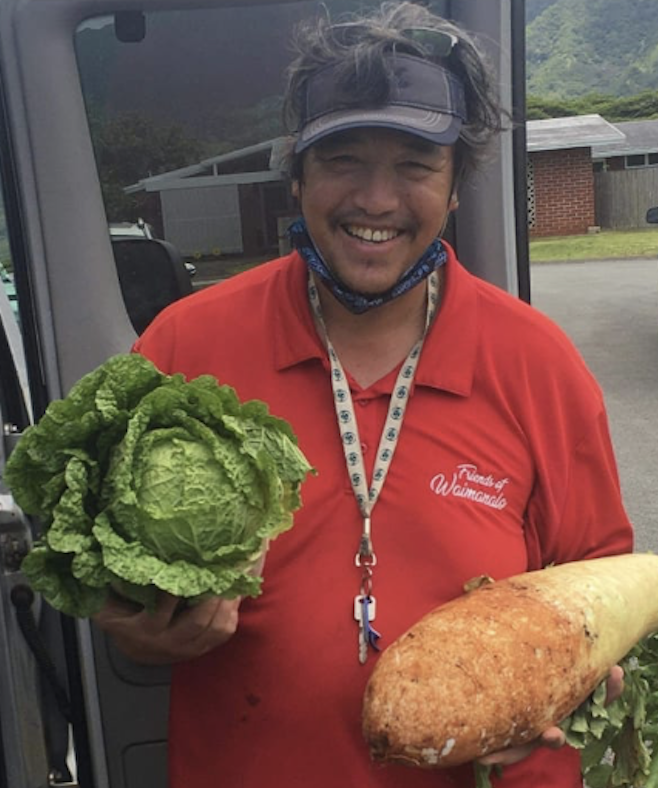
Scotty Wong CEO of Ohana Hui Ventures
The process takes locally produced waste product Carbon Dioxide (CO2) associated with refineries and electric generation and transforms it through a technological process into Liquid Carbon Dioxide (LCO2), a commercially valuable “food grade” CO2 (the highest standard) used for things such as agriculture (fertilizer) and dry ice for things such as refrigeration, cleaning by the US Navy, airline food service and bottling plants.
Hawaii agriculture, since the time of the plantations has been limited by the high cost of imported fertilizers and other inputs. But this may be changing as Scotty and his partners Scotty Reis- Moniz, Friends of Waimanalo, Sidney Higa, Alika Watts of Ho’oulu Holdings and Keoni Ford of Dibs Hawaii, use new technologies, aimed at utilizing waste carbon emissions which when scrubbed to food grade liquid carbon dioxide (LCO2) can be turned into commercially valuable sources of dry ice and perhaps one day, even jet fuel!
Prior to the Russian invasion of the Ukraine, the prices of Nitrogen for farming had already increased significantly. The ongoing war has now exacerbated the costs of using Nitrogen fertilizer in Hawaii- which has long been dependent on Russian imports. For a number of years there has been a serious shortage of dry ice available in Hawaii for industrial purposes. This is where the opportunity exists.
Ford explains, “The problem for Hawaii is that 100 years of plantation agriculture, growing pineapple and sugar on an industrial scale and then shipping them to the Mainland stripped our soil of nutrients. The only way we can grow things now is by importing NPK Nitrogen, phosphorus and potassium and spreading it on the land. It is very wasteful and counter productive.”
He and his colleagues plan to initially import food grade LCO2 from California and then store it in specialty tanks, (pressurized vessels), at agriculture commercial sites. Following that a virtual terminal of 20 foot containers will be built on site to store the LCO2 - needed to make high density dry ice on demand. The dry ice is to be used for refrigerants and other purposes through outlets he envisions as being “carbon dioxide filling stations.’
The surplus carbon dioxide emission from process used to make the dry ice will be not be leaked into the atmosphere. It will be dissolved and infused into nutrient rich water and poured into the ground. The surrounding agricultural fields will then be revitalized with carbon enriched water.
Through this process CO2 which would otherwise be released into the atmosphere and would contribute to global warming instead will be sequestered in the soil through the planting of hemp. As the hemp grows it will revitalize the soil on many fields by returning nutrients and taking out harmful toxins and metals. The harvested hemp in turn will be used for the creation of building materials and for the creation of biomass.
Ford intends to also use the hemp biomass to power a process that will enable him to produce LCO2 locally on site that they will be able to sell for commercial dry ice. It is after they are able to produce their own LCO2 with the locally produced biomass, that the venture will become profitable.
Ford calls this Hawaii's Carbon Capture Storage and Utilization platform. (CCSU).
The Hawaii CCSU technology is similar in intent but different from carbon capture technology promoted by Canadian company ‘CO2Gro’. The company developed a technology ten years ago using CO2 taken algae and pumping it into greenhouses. It has been known for many years that this technique increases productivity by 30%. But there were always problems with it; during periods of hot weather the CO2 leaked into the atmosphere. It generally was only cost efficient when energy prices were extraordinarily high as in 2008 when oil reached $147 per barrel.
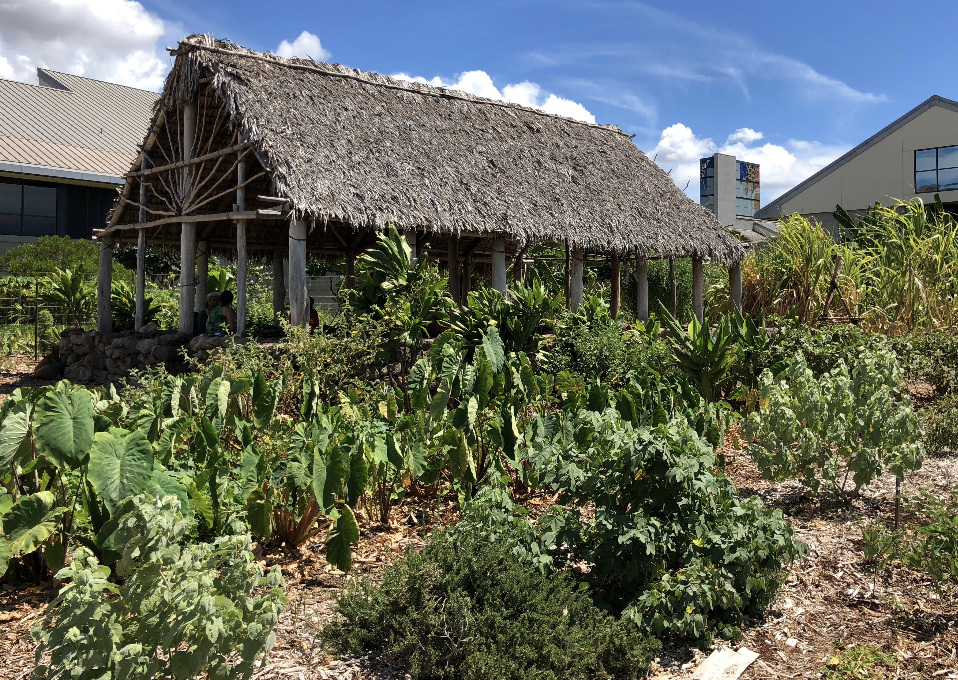
CCSU hopes to develop a new era in Hawaii agriculture growing high value niche crops fertilized using advanced carbon capture techniques - Photo Scotty Wong
The combination of the gas leakage and the fall in oil prices during the late 2000’s caused the business to lose customers until the company developed a new technology that instead of gas used carbon infused water in controlled bursts sprayed gently in a fine mist on the leaves of high value marijuana plants. The process uses 5% of the carbon dioxide emitted by gas spraying and gets 30% percent more productivity. The technology is said to have the added benefit for farmers of not having to apply expensive herbicides because the carbon mist alters the pH level of plant leaves by making them more acidic. This makes the plants better able to resist mold, E.Coli and powdery mildew
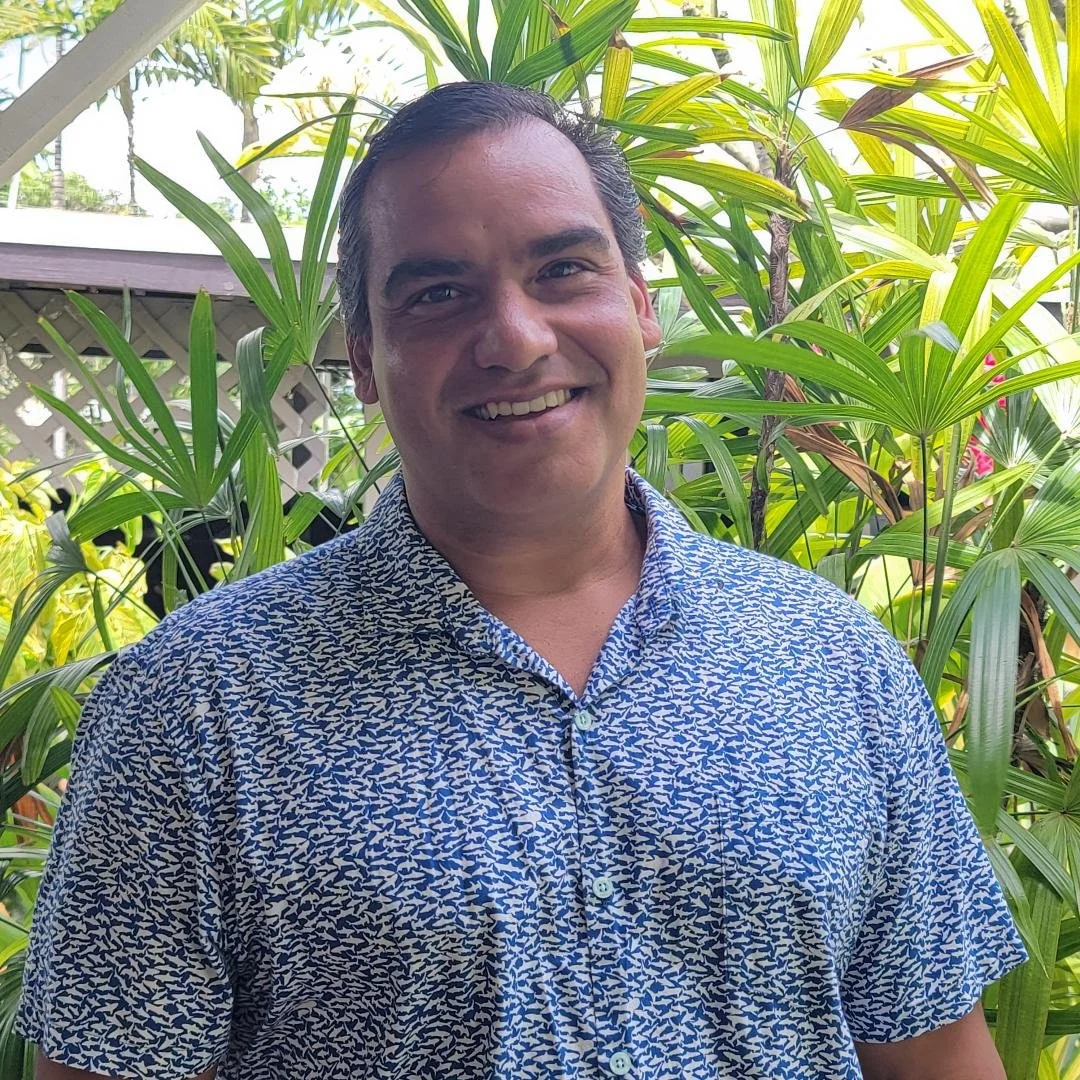
Keoni Ford
Background
Ford who is the visionary behind the project began thinking about this project in 2009 while doing industrial cleaning of luxury homes and buildings on the Island of Hawai’i. There he found himself using toxic solvents for cleaning - which he had to use and dispose of safely. On doing research he found dry ice blasting was a better alternative. It is currently used for cleaning and inspection of metal surfaces by NASA. The advantage to the dry ice blasting is not only that there is no use of toxic chemicals but there is also no secondary waste stream of polluting greasy residue. The dry ice blasting reduces the oil and grime and corrosion to a fine dirt like powder, easily contained in a paper mat that can be disposed of.
“That’s the big plus with- cryogenic cleaning is that cleaning without creating another waste stream. As soon as we are finished it is ready for inspection.”
“Think of it. When I used 15,000 pounds of sand to sandblast something, it left 15,000 pounds of sand and waste that I had to dispose of. Now, with dry ice, it’s just dirt and residue in a paper mat. I thought, if this was good enough for the Space Shuttle what else can it be used for?”
He discovered the US Navy has a requirement for using dry ice for cleaning ventilation systems, air ducts, and galleys and in their ships. This became a new line of business for him. Unfortunately, he soon found Hawaii lacked enough food grade LCO2 for anything other than using it for carbonation in fizzy drinks like Coca Cola. “We were in the absurd situation of importing LCO2 in 20 foot containers on ships. Even the Navy didn’t have enough carbon dioxide for dry ice production and the airline catering business was forced to import carbon dioxide to chill food for flight. It came to me that we had to find a way to make our own.”
He thought the answer might be in agriculture which since the end of the Hawaii plantation era in the 1980s never really recovered economically. Ford put together a coalition with Wong, Reis, Moniz and others to produce a farm that would create enough food grade LCO2 to supply the Navy’s dry ice cleaning needs and at the same time grow everything from Asian vegetables to hemp.
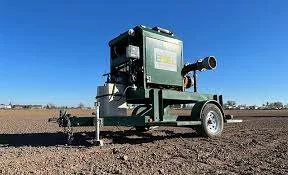
This is a special generator powered by exhaust fuel. Courtesy E Fuel.
To create the energy to create the LCO2 on agricultural fields he turned to innovative new power generators developed by Tom Quinn of E fuel. Quinn, a former tech entrepreneur, developed a method of producing electricity from the gas waste of plants. This is a special generator powered by renewable ethanol fuel. There is sugar in the hemp that when treated turns to ethanol. The ethanol powers the generator which then uses the carbon dioxide emissions to create the commercially valuable LCO2 which will be stored and sold on site. There is no need for gasoline or diesel fuel to make this happen. Its all done through a process Ford describes as Net Zero Energy - where locally produced plants create the power source and clean water is the waste product.
The carbon dioxide emissions are recovered into a wet scrubber to create CO2 enriched irrigation water. This water is then put back into the soil to grow hemp. The hemp crop that results enables them to produce more LCO2 for dry ice and the profitable cycle continues. Everything that can be produced on the land can be used as an input closing the loop on the power needed to develop it.
The valuable LCO2 will be stored in pressurized containers as part of a virtual supply chain that can be used for everything from dry ice for cold chain logistics support to cryogenic cleaning. He already has customers for the “food grade” dry ice he intends to produce. The pressurized containers containing the LCO2 can be shipped by barge to customers on other islands.
Because of the cut off of Russian oil to Hawaii, the timing may be opportune. The new entity they have created makes use of the 400 acres of farmland and 18,000 feet of warehouse space at Hawaii State Agribusiness Development Corporation ag park known as Whitmore Village. Ohana Hui Ventures, holds the lease to the ag park. They plan to target many different kinds of crops with the liquid fertilizer.
The land will be divided with 40% of the land being used for food crops that use CO2 sprayed on the land, 40% for industrial hemp to be used for building materials products by the local building industry as a low cost alternative to imported products such as plywood or concrete. Excess CO2 will be sequestered in the hemp building materials. Two homes on Maui have been built with Hemp boards and “Hemp crete”.
The remaining 20% of the agricultural land is to be used as training areas to encourage local farmers.
“Our business plan for Ohana Hui Ventures is to partner with other Kanaka entities, non-profit organizations and enhance traditional practices with innovative ideas and business development. We will provide the lands, the kanaka farmers, the bio feed, utilize the carbon that’s sequestered like C02 water and then we produce smart climate commodities such as enriched food crops, hemp building materials, ethanol and dry ice. This is an example of the partnerships we want to enhance with local farmers and landowners.”
“Its a simple process. We are basically doing photosynthesis. We are doing what nature has always done in Hawaii, taking CO2 out of the air and putting it into the ground so we can produce food crops and other things.”
With funding they hope to raise from private, state and federal sources, they plan to generate revenue from LCO2 in markets as diverse as Navy ships and local bottling plants. 75% of their production is to be used by Hawaii agriculture and energy and the remainder by the Department of Defense. By reducing substantially the cost of fertilizers and pesticides they intend to make farming more profitable in Hawaii.
Wong explained “What we plan to accomplish is to be part of producing climate smart commodities for our communities. We want to be a living example of how traditions and future technologies can work together harmoniously and at the same time reduce green house gases, create renewable fuels and dry ice. All this one day will be powered by net zero energy.”
RUSSIAN INVASION OF UKRAINE INCREASES NEED FOR CARBON CAPTURE

This represents estimates of carbon dioxide in the atmosphere - taken from Maunakea. NOAA
The recent Russian Invasion of the Ukraine has created the greatest demand for fossil fuels in more than 20 years. Not for nothing, is it called a “Fossil Fuel War”. The current world use of oil is estimated at 100 million barrels per day and rising. The price of gas has gone up 50% since a year ago and because of the decision to cut off the importation of Russian oil may go even higher. Jennifer Granholm, the US Secretary of Energy said the US is on a “war footing”, and has called American oil and gas producers to produce more fuel. Despite great efforts to encourage renewable energy technology by the Biden Administration , gas prices are at record highs. The US government is currently negotiating with Saudi Arabia and Venezuela to import more oil, to make up for the ban on Russian oil imports. At the moment Russia, Iran and other other oil producers benefit from high fuel prices.
So what has this have to do with Carbon Capture? Everything! There seems no other way at present to reach the goal of the world significantly reducing the carbon dioxide in the air by 2050 through international agreements on the reduction of fossil fuel use if the world is a war and some countries depend on high oil prices to benefit their economies. In addition its not likely with surging demand for fuels in the post pandemic period, that there is a workable alternative plan to remove large amounts of carbon out of the atmosphere. Carbon Capture which involves taking carbon dioxide out of the air, turning it into stone and putting it in the ground has its skeptics. But there seem to be few other good choices. The world finds itself in a dilemma.
The Guardian quoted Jonathan Elkind, an energy expert at Columbia University and a former energy adviser to Barack Obama’s administration saying this. “It’s an undeniable reality that Russia gets a significant share of its revenues from oil and gas and that America’s gasoline habit contributes towards the global demand for 100m barrels of oil each day.
“Do we want to find ourselves 10 years from now where we’ve bent the curve on oil consumption and emissions towards decarbonization, or do we want to sit there and think ‘where did the last 10 years go?’ If the US isn’t a part of the solution we will put in peril our influence on the world stage and the fate of everyone, both here and around the globe.”
On April 28 RENEW REBUILD HAWAII will sponsor our next ZOOM forum on Carbon Capture with experts from around the world.
The New Space Economy

Satellite in Space - NASA
A recent interview with Lockheed Space specialist Joe Landon describes the new space economy. In the interview, he explains how the space industry is evolving from one that emphasize launches –space -to-earth - in which government agencies or private businesses launch satellites etc. which sell services to earth, to the space -to-space economy ; getting to space in order to support completely new businesses - earth colonies on the moon, to grow food, harvest asteroids and maybe work in factories that can take advantage of weightlessness.
The transition from space-to -earth to space-to-space businesses is an important one and the world is now in a transitional stage. There are already treaties dividing up unknown worlds and countries and individual companies are fighting for advantage.
Although the space race started in the 1960’s, the world of commercial space exploration began in the early 2000s when entrepreneurs like Elon Musk figured out that the main cost of getting into space between was rocket launches, that much of the technology came from World War II . and that with the advanced computer technology from Silicon Valley they could launch rockets for a fraction of the price of huge old fashioned government bureauracracies like NASA and make huge amounts of money in the process,
As NASA and other government space agencies began contracting out launches and other space related services for satellites and space stations, the race was on for commercial enterprises to develop new pathways to space.
Today, there are four major US commercial space companies, the space industry is a $447 billion dollar is a year business and 95% remains in the space-to -earth sector. The four largest space companies, Space X, Boeing, Blue Origin, and Virgin Galactic are competing to put people and things in orbit. This is where Hawaii companies like Privateer Space see their advantage; they are able to provide key information on space debris, that companies need to identify obstacles and avoid them
The entrepreneurs know that the longer they can keep people in space the more they can produce in the way of space services.
Landon said “ We need to develop the technology to support a long-term presence in space and long-duration space flights. We also need the consumables required to support life for long periods. We’re working on and investing in the propulsion technology required to make trips in space faster. The shorter the trip is, the easier it is to keep the crew comfortable. We’re also working on artificial-intelligence systems to help crews manage their time in space and work alongside their spacecraft with limited help from Earth. “
As the race to find inexpensive launch sites continues, Hawaii’s role as a space center because of its prime location - as one of the shortest paths to orbit become more important. It already has a number of successful space businesses. HI-SEAS is a training center for crews going into space, there are plans for a lunar park for space businesses on the Island of Hawaii and various small businesses attached to the astronomy centers on Oahu, Maui and Hawai’i.
A recent Harvard Business Review article on the space economy (The Commercial Space Age is Here) made the point that because of the regulatory and social impacts of space technology that state and national governments have to become involved. The authors look at three areas of significance;
Enabling private individuals and companies to take greater risk
Encouraging policies that foster the development of space flight and technologies
Moving beyond inter-government geo political rivalries
In Hawaii, there is a fourth and also significant area, that of earning the trust of the Native Hawaiian people that space exploration can be done from Hawaii without detrimental social or environmental impacts.
Sources
(https://www.mckinsey.com/industries/aerospace-and-defense/our-insights/lockheed-martins-joe-landon-on-the-emerging-space-economyrefers)
https://hbr.org/2021/02/the-commercial-space-age-is-here
Space Technology and Tourism - Hawaii's New Industry

Space is Hawaii’s new business and technology frontier
Economists who have studied Hawaii’s past have commented that every fifty years there is a dramatic change that propels the islands and its peoples into a totally different direction. It may be that we are on the cusp of a new era that will replace tourism: space technology; Hundreds of launches may take place from Hawaii or in Hawaiian waters over the next few years as Privateer Space and other space companies begin using Hawaii’s strategic location as a commercial and administrative hub for future flights.
According to Privateer Space president and CEO Alex Fielding, whose first launch PONO 1 is scheduled for later this year, his company’s goal is to send several hundred flights containing satellites into space; these satellites would be mapping the space debris that is now so extensive in space that it is damaging expensive space satellites and even threatening the very existence of the international space station - which was damaged and had a mechanical arm disabled by a .5 mm hole from a collision with a random space object.
Fielding (co-founder of Privateer Space) who started his first space business in 2001 described the urgency of the situation this way: “When we started... half of the stuff in space… was trash,” Fielding said. The situation has only gotten more dire since. “You’re in a world with many, many, many more things [in orbit], of which those many more things are far more dangerous, they’re almost all in low orbits, they’re moving very, very fast, and they’re not well tracked or understood for the most part.” If things are not changed soon he warns there may be human space fatalities due to collisions with space debris in lower orbits.

Privateer Space, which is based on Maui, has as its goal becoming “The Google Maps of space”. It plans to supplement the work of the US Space Force Space Surveillance Network, and is contracting with them, to monitor objects from debris to satellites in space. This is becoming important because current Space Force technology is not precise enough to pick up the small objects drifting in orbit and there are numerous collisions - such as which happened to the International Space Station which was struck by a small particle in low earth orbit that nearly ruined a mechanical arm.
Privateer plans to map the debris like nautical charts and sell it to governments and private space companies. Due to the increasing demand for satellites, it has been estimated that the Space Industry is now valued at 447 billion dollars world wide. The big players in the US are Elon Musk of Space X and Steve Bezos of Blue Origin, a space tourism company.
Fielding cofounded Privateer Space with his friend and fellow visionary, Steve Wozniak who is well known as co-founder of Apple with Steve Jobs. 20 years ago they became aware of the extent of the space debris problem and founded ‘Wheels of Zeus’ as a company to chart loose space hardware. After numerous trips to Maui to attend and participate in the Advanced Maui Optical And Space Surveillance Technology (AMOS) conference Fielding decided to start Privateer Space a means of taking space surveillance to another level by actively tracking the debris with satellites. The AMOS conference grew from the Institute of Astronomy of the University of Hawaii Haleakala Observatory, one of the worlds premier observatories. One of the tenants there is the Air Force Maui Optical and Super Computing Observatory.
It was the confluence of the observatory and the Air Force space research that led to the AMOS conferences and then to the idea for developing a company based on Maui that would help scientists track space debris the way that the first maps were made to help sailing boat captains avoid coral reefs.
Fielding sees Maui “as a hub for launches related to ADR missions as well as on-orbit servicing such as refueling, tug/tow, ADR, etc where Privateer assists on orbit optimization, maneuver planning, and essentially helping our customers get on target using our Pono class satellites.” He already has a number of customers.
The first satellite PONO 1 will stay up for four months and will soon be followed by PONO 2 in April. The satellites will vaporize on re-entering the earths atmosphere. To make sure that their own satellites don’t cause a problem Privateer has contracted with Astroscale - a space company that has produced a space debris removal satellite.
The fact that Fielding is here, has the technology for launch and is starting its next launch in February indicates that the space age transformation of Hawaii’s economy is no longer a dream. It is happening now.
Electric Vehicles are here: But the 2-5 minute charger is what drivers really want.

EV chargers in Kailua, Hawaii
For the past ten years there has been a steady growth of EV vehicles in Hawaii. From being curiosities twenty years ago, as of last August they are increasingly becoming the norm. There were an estimated 14,000 electrical vehicles in Hawaii according to Hawaiian Electric. According to the numbers put forth by HECO’s Aki Marceau that is 1.4% of the 1.4 million electric cars on the road.
Demand is such that 7 x more chargers are needed than in 2019.However, growth in electric vehicles has been limited by the number of public chargers available. They are too few and too slow. The average wait time to fill a gasoline car at a pump is 2 minutes. To charge an electric car even the fastest chargers take between 15 and 40 minutes. One can only imagine how long it will take to go to a large public charging station like Cost co where there are hundreds of cars waiting to charge up at one time.
According to federal estimates there are presently only 361 EV charging stations state wide with a total a total of 739 charging outlets or ports in private homes or condos. Only some 25 are said to be fast chargers. The fewer the fast chargers the less the appetite for electric vehicles.
If the state plans to reach its goal of 500,000 EV by 2045 –It will need to be able to install faster chargers or face nearly continuous grid-lock at charging stations.
This grid lock on electric chargers at public gas stations is already predicted on the Mainland later in 2022 when the first electric Ford F-150 arrive in March. The F-150 is the largest selling truck in America. In 2023 this will be followed by the electric GM Silverado. These trucks will have to be charged as needed and there will not be enough chargers in place to accommodate everyone.
In Hawaii, this grid lock will likely come later because the top selling truck in Hawaii is not the F-150 but the Nissan Frontier. When the Nissan Frontiers and Toyota Tacomas arrive the problems of servicing all the EVs in Hawaii will become acute.
According to an article in the Detroit Free Press the principle limitation to the time it takes to charge electric vehicles is that their electric charger cables tend to overheat as electricity flows through them; the greater the amount of power, the faster the charge, the greater the heat and the greater the threat of fire.Typically because of the heat transfer problem most home charger cables can deliver fewer than 150 Amperes and fast chargers are 1,400 Amps. However the Purdue project, with a self cooling electric cable is still under going testing . The researched hope it will be the game changer that can deliver a charger with 2,400 Amps and a full vehicle charge in only 5 minutes.
They better hurry up because demand for electric vehicles are growing but the chargers are still too slow.
Ocean Thermal Energy Conversion (OTEC) Bridge to 2050 Carbon-Neutral Goals by Luis Vega. PhD

Kona OTEC plant photo from SOEST
Imagine a source of energy that is completely natural and could be used to generate as much as half the energy consumed by humanity. It has no smokestack discharge into the atmosphere, does not interfere with the world’s fisheries, or prime agricultural land. And unlike solar and wind has been demonstrated to generate electricity 24/7/365.
This source of energy has been known for nearly 150 years since the publication of “Twenty Thousand Leagues under the Sea” by Jules Verne. Ocean thermal energy conversion (OTEC) technology uses the temperature difference between surface warmer water and deeper colder water encountered in tropical oceans as the source of thermal energy. There are two OTEC cycles, closed and open, whose technology has been proven and for which all required equipment is available. The first concept uses the relatively warm (24°C–30°C) surface water of tropical oceans to vaporize pressurized ammonia through an evaporator. The resulting vapor is then employed to drive a turbine generator. The cold ocean water transported to the surface from 800–1,000 m depths, with temperatures ranging from 8°C–4°C, condenses the ammonia vapor through a condenser. Because the ammonia circulates in a closed loop, this concept has been named closed-cycle OTEC (CC-OTEC). The CC-OTEC concept was demonstrated in 1979, when Hawaii and a consortium of United States companies provided more than 50 kW of power from a small plant mounted on a barge off Hawaii. Subsequently, a 100 kW land-based plant was operated in Nauru by a consortium of Japanese companies. These plants were operated for a few months to demonstrate the concept, and they were too small to be scaled to commercial-sized systems.
Alternatively, the second cycle uses ocean water as the working fluid. The surface water is flash evaporated in a vacuum chamber. The resulting low-pressure steam is used to drive a turbine generator, and the relatively colder deep seawater is used to condense the steam after it has passed through the turbine. This cycle can, therefore, be configured to produce desalinated water as well as electricity. This cycle is referred to as open-cycle OTEC (OC-OTEC), because the working fluid flows once through the system. The concept was demonstrated in Hawaii in the 1990s with a 210 kW plant.
It was also determined that, excluding the cost of environmental pollution due to the generation of electricity with fossil fuel plants, for OTEC there is a marked economy-of-scale such that plants of about 100 MW (say 100 times bigger that the experimental plants) are required to be cost competitive. For example, 10 of these 100 MW plants deployed in the ocean around Oahu would satisfy all residential, land transportation (with electric vehicles) and industrial energy requirements. However, as important as the experimental plants have been in demonstration the technology there are too small to extrapolate costs. A pre-commercial plant sized at about 5 MW and requiring a budget of as much as $500 million must be operated in situ and for at least one continuous year to obtain the records required to evaluate what is considered to be commercial sized plantships that could be deployed world-wide. This argument excluded niche markets in small-island-developing states (SIDS) wherein land-based plants sized at a few MW could be cost-effective.
Ninety-eight nations with access to the required ocean thermal resources within their 200-nautical mile exclusive economic zone (EEZ) have been identified. There is also a market for industrialized economies that could manufacture and supply the equipment required for OTEC plants, even if they do not have the required ocean thermal resources within their EEZs. The worldwide resource is equivalent to more than 7 Terawatts (i.e., equivalent to 70,000 plants with 100 MW capacity). Each 100 MW plant requires a capital investment of about $750 million, so the ultimate market, in a few decades, would be valued in the trillions of dollars.
Unfortunately, by the middle of the 1980’s USA government funding was curtailed before an OTEC plant of significant size was operated. This was due to the abundance of relatively cheap oil. This is relatively because costs due to the environmental effects of generating energy with fossil fuels were not accounted for. It has been estimated that currently accounting for this pollution would be equivalent to at least doubling the cost of a barrel of fuel.
Currently three relatively small experimental plants (20 to 100 kW) are operational in Hawaii, Okinawa and South Korea. These are extremely important as teaching tools and as the common refrain goes: 1 experimental plant is worth 1000 reports.
The major challenge, however, continues to be: How to finance relatively high capital investments that must be balanced by the expected yet to be demonstrated low operational costs?
Perhaps a lesson can be learned from the successful commercialization of Wind Energy due to consistent government funding of pre-commercial projects that led to appropriate and realistic determination of technical requirements and operational costs in Germany, Denmark and Spain. In this context, by commercialization we mean that equipment can be financed under terms that yield cost competitive electricity. This of course depends on specific conditions at each site.
Given that it takes decades for new energy technologies to reach maturity, it seems sensible to once more consider the ocean thermal resource as a renewable energy for the future. OTEC plantships providing electricity and desalinated water to shore stations would be implemented. In addition, OTEC plantships deployed along equatorial international waters could produce energy carriers, like ammonia and hydrogen, to support the post-fossil fuels era.
Perhaps the time has finally arrived for OTEC commercialization
Ken Aramaki of Hawaiian Electric on Resilience and Microgrids
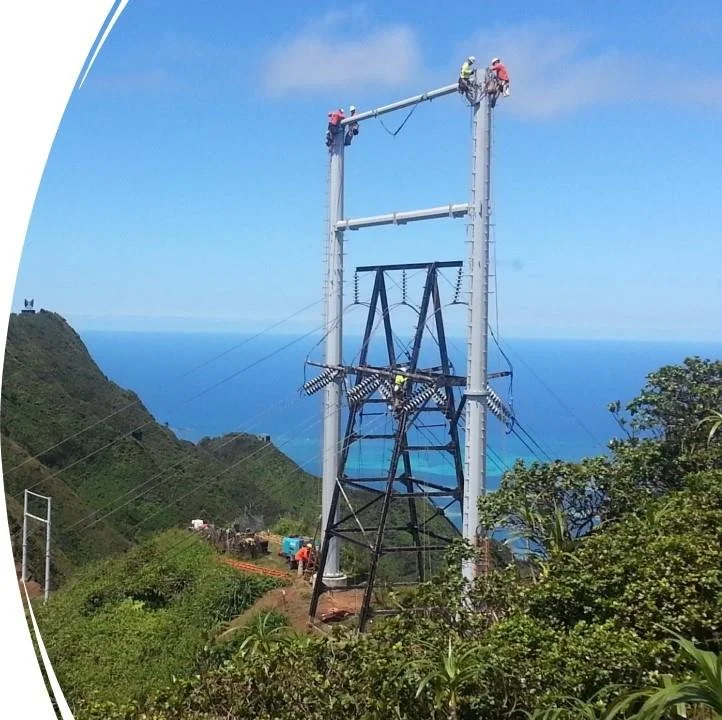
Courtesy of Hawaiian Electric. Lineman servicing replacing an old wooden distribution line support structure in a remote location with a new hardened steel structure to better withstand extreme weather conditions. These remote structures carry some of the most important lines but take huge a beating from tougher weather. This is an example of HECO’s ongoing resilience program.
Ken Aramaki is the Director of Transmission, Distribution and Interconnection Planning for Hawaiian Electric. His primary job is to plan for reliable power delivery, incorporating various considerations such as the ability to withstand short-term problems or significant extreme weather events like hurricanes. The planning and strategy involved in ensuring Hawaiian Electric can continue to serve its 468,000 customers in good times and bad is called resilience. He defines resilience as “the ability of a system or its components to adapt to changing conditions and withstand and rapidly recover from disruptions.”
Ken explained there is a difference between reliability and resilience. In general terms, planning for a reliable electric system entails ensuring system stability, managing and balancing resources, planning for and maintaining transmission and distribution assets, ensuring there are adequate generating resources, and taking other actions to provide electric service during the vast majority of days/hours. Resilience planning, on the other hand, looks at high-impact but less frequent events.
What can those disruptions entail? The main resilience challenges Ken identifies are hurricanes, storms, earthquakes, wildfires, tsunamis, flooding, lava flows and “other extreme events.” Cybersecurity raises another level of resilience challenges.
Hawaiian Electric employs a multi-faceted approach to addressing and planning for such events. They include infrastructure, cybersecurity, emergency response training, mutual aid agreements with other utilities and organization, and inventory management which include carrying strategic spare equipment.
It’s a complex task that must align with the commitment of Hawaiian Electric and State to reach 100% renewable energy by 2045, even though all the technology and infrastructure needed is not yet in place to completely support this transition. Hawaiian Electric believes that part of the solution involves microgrids – locations with independent, self-generation attached to the traditional grid network - that will continue supplying power to limited numbers of customers even if traditional grid does not.
One of the particular challenges faced by Hawaiian Electric is planning resilience programs for communities on five islands with no interconnections among them. Maui, Lanai, Molokai, Oahu and Hawaii islands each has separate challenging geographies. Each requires a distinct and studied approach. Customers on these islands make up 95% of Hawaii’s population.
Hawaiian Electric is proud that 35% of the power used by customers is generated from rooftop solar and other renewable resources. In 2007, it had 370 rooftop systems on its grids. As of 2021 there are over 91,000. However, in the case of disaster, renewables alone cannot guarantee resilience as PV panels and equipment may sustain damage, and there is not enough energy storage to meet the entire islands’ needs. Further, to ensure resilience, the grid infrastructure – lines, poles, equipment must also be planned, designed, and constructed to withstand the disaster.
Hawaiian Electric categorizes resilience investments based on solutions to prevent outages or damage, or solutions that can either reduce the impact of a failure or facilitate recovery of the failure to reduce the consequences of an event. Both types of solutions are complementary and needed to improve resilience.

Hawaiian Electric - resilience by cutting back vegetation on transmission lines
The following are solutions to prevent outages or damage:
· Transmission hardening
· Hardening critical circuits
· Pole and Line Relocation
· Wildfire prevention by keeping undergrowth clear of wires that could generate sparks
· Substation flood mitigation
· Vegetation management
· Undergrounding
The following are that can either reduce the impact of a failure or facilitate recovery of the failure to reduce the consequences of an event:
· Microgrids/Minigrids
· Critical Customer Hubs
· Customer resources
· Backup generators & distribution ties
· New transmission lines
· Emergency response and restoration

Schofield Generating Station - Microgrid in Hawaii
Microgrids in particular provide the following.
· They can help make sure that critical customers or areas such as hospitals and water pumping stations always have power.
· They depend on customer resources like rooftop solar and batteries, backup generators and distribution ties
· They can assist in emergency response and restoration
Hawaiian Electric is that working with the Federal Department of Energy Transitions Partnership Programs to develop a map of areas on Oahu that may be developed as hybrid (full, partial and feeder) microgrids.
In conclusion, preparing for resilience is an ongoing process rather than a particular task and microgrids can play a role in the event of an outage due to an unforeseen natural or human-caused event. This is the nature of resilience planning.
Allan Schurr Chief Commercial Officer of Enchanted Rock spoke on November 16

Snowstorm in Texas
During the last decade extreme weather events such as floods, hurricanes, floods have resulted in grid outages throughout the world. In 2019 according to the National Oceanic and Atmospheric Association (NOAA) there were 14 climate events that caused $ 1 billion dollars in damage. The inability of large scale city grid operators, mostly with aging equipment and infrastructure, to respond to overwhelming events that knock out key generating units, transmission and distribution points has created space in the electrical energy market for a new generation of microgrid companies
These companies work on the basis that most grids in the US are old and are unable to respond to the sudden impact of extreme weather emergencies with like snow ice and flooding as they did in the past.
Enchanted Rock, based in Houston, is a company that provides turnkey microgrids as solutions to the need for resilient power. Since 2009 it has helped develop 200 microgrids ranging in size from 1 to 50 MW per site. The total amount of power produced is 463 MW. The company has worked under extreme weather conditions from hurricanes and flooding to sub zero temperatures. Their mission is to provide power for essential service and provide a resilient back up power option for utilities.
According to Enchanted Rock Chief Commercial Office Alan Schuur, who spoke at the RRH Zoom forum on November 16, self contained microgrids provide power in emergencies to data centers, grocery and distribution centers, healthcare centers, critical infrastructure like water, manufacturing and utilities. . Enchanted Rock uses natural gas to power its back up micrgrids because it is significantly cleaner and quieter than diesel.
Some examples from Texas;
In 2020 during Hurricane Hanna in 2020 in the Rio Grande Valley of Texas Enchanted Rock operated 29 microgrids for 49 hours, supporting grocery stores and refueling centers.
In 2021 as a result of Hurricane Uri, in the Southern Plains Enchanted Rock operated 206 microgrids, 142 on sites without power for up to 3 days. They were supporting water, healthcare, manufacturing and groceries. Their other mission was to provide essential grid support services.
Enchanted Rock is moving towards a transition providing full renewable energy but at the present time they have found that a hybrid solution works best; they primarily make use of natural gas because renewable energy from solar and other sources is not reliable 100%.
Hurricanes and Resilience in Hawaii

On November 16, RRH had its forum in Microgrids and Resilience. According to information provided by State Economist Eugene Tian, since 1950 there have been 14 hurricanes in Hawaii Roughly once every five years. They ranged in damage from next to nothing, to 3.5 billion dollars. Hurricanes Iwa (1983) and Iniki (1992) resulted in the loss of nearly 1,000 hotel rooms in 1983 and 3,000 9 years later. It would take Kauai 4 years to recover. What’s the probability of the next disaster striking Hawaii and causing power lines to come down within 5 years? 100% said Tian.
Hurricanes, Microgrids and Reslience
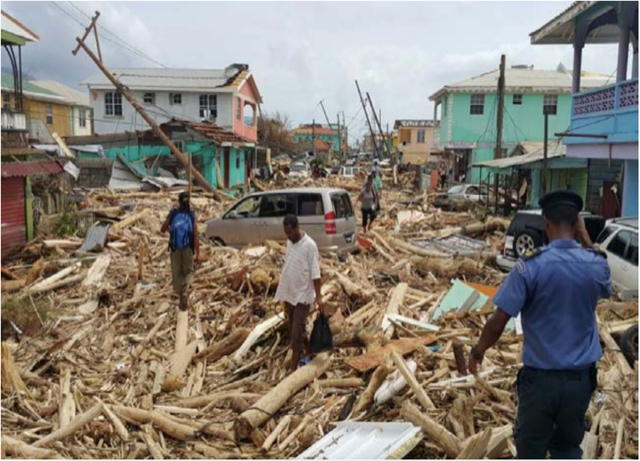
In the Caribbean, according to Rocky Mountain Institute Engineer, Kaitlyn Bunker, hurricanes that cause disaster are such regular occurrences that local planners take them into account. Most of the damage is done to distribution and transmission lines. This is what occurred on the Island of Dominica after Hurricane Maria hit the island in 2017. She showed this slide as an example of the destructive power of Category 3 and Category 4 storms.
The damage was so over whelming that lights in the entire region went dark.
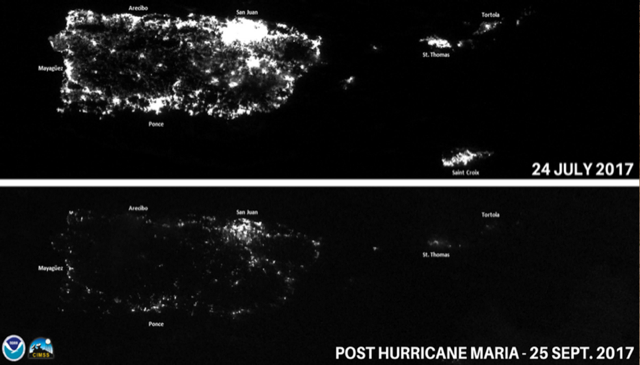
In the British Virgin Islands the 11 islands are linked by through undersea power cables to a central generating plant. It was found that just being dependent on one central Power Plant left the people on the islands too vulnerable. Instead they opted to build microgrids on many of the islands. Over half of Carribbean Islands now have solar PV and many have batteries for spinning reserves.
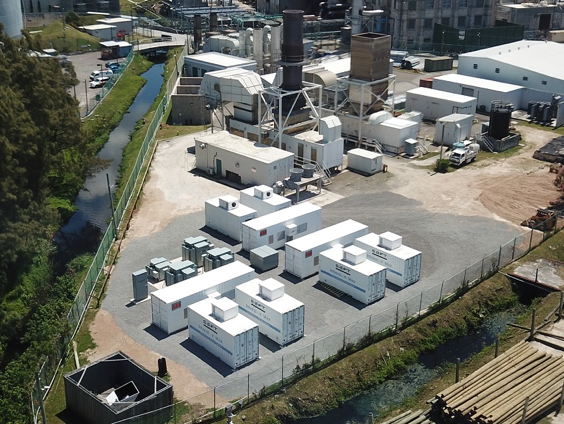
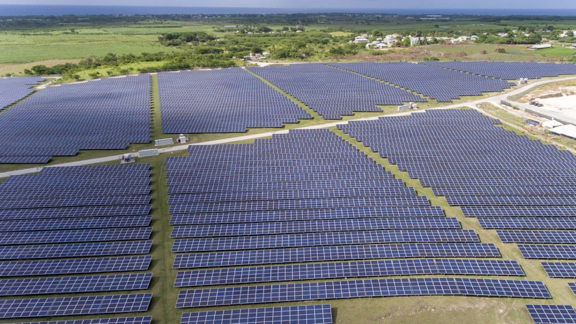
Despite estimated wind gusts of 180 -190 miles an hour in 2017, many solar PV systems in the British Virgin Islands, Turks and Caicos Islands, Puerto Rico and St. Eustatius survived.
“In contrast other PV systems suffered major damage or complete failure with airborne solar modules,broken equipment and twisted metal racking.” Solar Under Storm page 9.
Those In Puerto Rico, the US Virgin Islands and Barbuda suffered critical damage
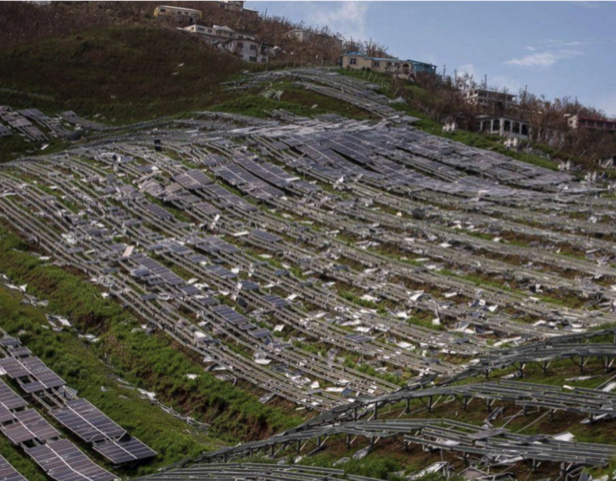
Because of variability in wind speed and geography it is not possible to determine all the reasons for failure.
However specialists from the Rocky Mountain Institute commissioned a study which said the failed sites shared these common characteristics during Hurricanes Irma and Maria
1) Top down or T clamp modules
2) Undersized Racks
3) Lack of lateral side racking supports
4) Undersized bolts
5) Under torqued biolts
6) Lack of vibration resistant connewctions
7) PV module design too low for environment
8) Use of self tapping screws instead of bolting
Surviving attributes for solar fields include
1) Dual post piers
2) Through bolting of solar modules
3) Lateral racking supports
4) Structural calculations on record
5) Owners engineer of record recorded
6) Vibration resistant module bolted connections
(Solar under Storm Part One Summary)
Organization and methodology has led to the resilience of microgrids during Category 3, and 4 hurricanes. The Rocky Mountain Institute has helped the different island power companies coordinate the needs of their people. Despite the fact that they represent different countries, political systems and languages, theses island nations have developed decentralized power systems that help them survive destructive hurricanes.
Creating Networks of Microgrid Resilience


For microgrid activist Devin De Wulf, resilience is not an abstract concept to be taken care of by a utility or by anonymous government officials; its something the people of every neighborhood have to practice in preparation for a storm driven by climate change that will inevitably disrupt their lives. When Hurricane Ida hit New Orleans with 150 mile per hour winds on August 29, 2021,Devin De Wulf made sure he was prepared. It was not just a process of taping windows and stocking extra food but making certain that the solar panels on his home were connected to two batteries instead of one. This would insure that when the storm hit and the power went out in New Orleans which he was sure it would and the temperature reached 100 degree, he could be certain that; his electric stove, his refrigerator, the power to recharge his phone and above all his air conditioning would still work. Once his own personal microgrid was prepared, he was ready to help his neighbors.
“I had seen what happened when category 4 storms hit solar panels; the solar panels generally were undamaged but if they needed to be connected to the main grid, they were useless.” When the power goes out and there are suddenly more than 400,000 people living in their neighborhoods the city agencies don’t have enough resources to help everyone who needs it. People have to find ways to help each other”.
Devin De Wulf is a. citizen activist who believes in the power of concerned neighbors turning their communities into microgrids . He is the founder of the Krewe of Red Beans and also, Feed the Second Line.
Devin is a stay-at-home dad of two, an artist, and parade organizer based in New OrleansIt was just not the disaster that was worrying, Devin has two children. He wondered how they would be able to cope if there were more storms. “The scariest part, the dark thought I kept from my young children - is that we still have two more months of hurricane season.”
Devin lives in the neighborhood of Bywater in the 9th ward, one of the 27 districts that make up the City. of New Orleans. The city’s population of 990,000 is approximately that of Honolulu. The 9th ward is a low lying part of the city. It has often been devastated by flooding This was what happened during Hurricane Katrina in August 2005 when parts of the protective seawall around the city known as the levee collapsed.
The levee did not break during Hurricane Ida, However the power went our August 29 and would not go on again until Sept 8. During those days everybody in the neighborhood had to make do. Those without power suffered. 8 people died of heatstroke.
“When there’s the hurricane most of the affluent people leave the city. This leaves behind those who can’t easily leave; the poor and the elderly.”
One of the first things Devin, did was make his home accessible to those in need.
“ On my block I helped Mr. Roy plug in his oxygen machine when he needed to. Mr. Joe and his partner hooked up their fridge to our system during daylight hours. We had a cellphone charging station on my front porch supplying power for people’s only means of communication with the outside world” More than 200 people a day came to his porch to charge their phones.
People ate what they could but their food soon spoiled. Feeding stations had been set up by the city at rec centers churches and other places but the heat was so bad it was dangerous for people to walk to where the food was. As for driving, the gas stations were closed and people didn’t have enough fuel to get to food.
So what did the people eat when the power was out and they couldn’t get to the feeding stations? Generally the food that was available to them from fridges and freezers that were no longer plugged in.
Then something happened that changed Devins ideas on how his neighbors could be helped. Because he had worked as a middle school history teacher and the organizer of a neighborhood parade, he was known to restaurant owners in his neighborhood as a community organizer. In New Orleans it’s a tradition for individual streets to plan parades in their neighborhood to celebrate Mardi Gras. He began getting calls asking him to take food before it spoiled so that it could be used to feed people.
To give an idea of how much was food was on offer in a city famous for its restaurants, Devin said that at a single restaurant might need to dispose of $10,000 worth of meat, cheese and produce. The problem is not just the waste, the hungry people it’s the methane generated by hundreds of restaurants all at once.
To deal with the problem of waste he organized a means for local residents to cook food for local residents. In new Orelans the common dish for working class is red beans and rice. The approximate equivalent in Hawaii would be something like vegetables with saimin or chili with rice.
The success of his interim feeding program led him to his current idea he calls “Get lit stay lit”. Instead of leaving things as they are and having to improvise each time he thought that special efforts coud be made to help finance and provide solar panels and lithium batteries for restaurants that were in the area. They would be able to feed the people the government couldn’t and in return they would receive a permanent reduction in their energy bills.
He did the math. In an emergency a small restaurant might feed 300 people per day. A midsized restaurant 1000 per day and a large restaurant 3,000 per day. The installation of the solar panels and batteries would save the restaurant owners significantly on their electricity during normal periods and during hurricanes would keep the freezers and refrigerators going. The significant saving that would come from being off grid compared to what they would have to pay if they were grid connected would enable the people of Bywater to easily finance and pay for their solar panels.
He wrote that envisioned :
“In the storms aftermath, restaurants storm-proofed with solar panels and batteries would serve as hubs providing food cooling stations, ice and charging stations for their neighbors – a decentralized network of resilience, giving each block, a better chance to survive – Particularly in our most impoverished neighborhoods – these climate hardened restaurants could provide communities with healing and sustenance on their worst days”. Devin will be speaking at the RRH Forum on November 16. For more information about his work go to http://redbeansparade.com/
The Lessons of Microgrids

Part of a microgrid - courtesy NREL
Michael Markrich
Microgrids, freestanding electric circuits that produce and store their own electricity and then can distribute it at will, are part of a new movement in grid management. Instead of one large vast electrical grid built on a system of generators that boost electric power and send it out to the far reaches of a community through transmission lines, micro grids enable grid managers to hold some electrical production in reserve and use it when they need it. As climate change has increased the number of hurricanes, floods and wild fires that can take out entire electrical grids for weeks and even months at a time as happened in Puerto Rico- micro grids provide electric power producers and their customers advantages in resilient self sustaining power they never had before .
For example, in Santa Rosa California , the owner of a Chick Fil- A franchise is building his own microgrid. His restaurant is one of only 3 of the 2,700 Atlanta based fast food installing a microgrid but feels he has no alternative. There were 6 power shut offs in California in 2020 as a result of the raging wild fires burning through California more this year. Each year Pacific Gas and Electric is giving “red flag” warnings that outages to protect the grid are going to occur. 2021 looks like it will be even worse. See. https://www.northbaybusinessjournal.com/article/article/solar-energy-upgrades-heat-up-with-chick-fil-a-santa-rosas-microgrid/
Approximately 1/3 of PG and E lines are found in areas with high risk for fires, this includes 5,500 miles of electric lines and 25,500 line miles of distribution assets. When the power goes out it can last for between 19 – 37 hours and affects between 600 - 350,000 customers. https://www.pge.com/pge_global/common/pdfs/safety/emergency-preparedness/natural-disaster/wildfires/wildfire-mitigation-plan/2021-Wildfire-Safety-Plan.pdf page 846.
The reason for the microgrids in California stores according to Stephanie Armistead, a manager for Chick-fil-A’s corporate sustainability program is: “At a moment’s notice, Chick-fil-A operators might have to lock the freezers, purchase dry ice and decide if they need to shut the restaurant down when high winds damage power lines or a heat wave puts too much stress on the existing grid.”
In the past utility managers have not favored microgrids because of the difficulty of integrating power from independent power producers on to their electric power grids. The other reason is economic. As the developer of microgrids- who are also called independent power producers - leave the grid, they take paying customers with them leaving the rest of the grid often to be paid for by the poorest rate payers.
There are still strong and diverging opinions on microgrids. Utility microgrids on small islands in the Caribbean have been able to operate them without the need for fossil fuels, depending just on solar panels and batteries according to the Rocky Mountain Institute. However, larger utilities in cities like New Orleans or Houston require the use of fossil fuel driven natural gas either in microgrids or on their power distribution networks to ensure reliability.
Reliability during natural disasters is important not just to fast food operators but to citizens in individual neighborhoods who fear being without electricity for days if they don’t have their own solar panels. One of those needs is for air conditioning which is power intensive and as the world become hotter ever more important for comfort and health.
The US Army and Navy are developing microgrids. They are becoming a new reality of life in Hawaii and plans are underway to develop them. The lessons of microgrids and resilience will be the subject of the RENEW REBUILD HAWAII ZOOM FORUM on November 16, 2021.
A Future with Hydrogen

Paul Ponthieux of H2 Energy with Stan Osserman’s newly delivered 2017 Hydrogen Mirai
Stan Osserman has a number in mind when he thinks about the price of Hydrogen; $2 per gallon. Osserman, the chief information officer for H2 Energy – a Big Island hydrogen energy start up, is convinced that hydrogen cars will one day in the not distant future become as common place as gasoline and battery powered cars on the island.
Hydrogen cars have a number of advantages over other electric vehicles; they charge quickly, the fuel they use comes from a renewable source, there are no batteries to dispose of and the waste product is water. But perhaps most important is that the power needed to power Hydrogen car does not involve the Big Island grid having to double its capacity.
“Hydrogen energy has huge advantages in transportation because its lightweight and has high energy density,” said Osserman in an interview with Hawaii Business News adding “Hydrogen is also a desirable long term energy storage for electric grid applications.. We predict that hydrogen will play a huge role in making Hawaii c20 2045lean and energy self sufficient by 2045.”
Critics of hydrogen as a future fuel say it is too expensive, that Fuel Cell Electric Vehicles (FCEVs) require three times as much energy to run than as battery powered electric vehicles. The other problem is that the making of hydrogen requires the use of methane and blue LNG to make hydrogen through electrolysis. These are all dirty fuels. The only way to get 100% clean green hydrogen is to produce it from renewable sources and that is probably too expensive.
But Osserman believes that is a misunderstanding. He explains: “Here's what most folks miss; hydrogen made from methane is cheap because it's a byproduct of oil and LNG processing. They have to "flair methane" so they don't release it as a GHG. As fossil fuel production drops that "byproduct" it get's more expensive. At the same time, Solar and wind are ramping up, but they are forced to shut down grid input when the grid is over powered, it's called "curtailed" when the grid doesn't need the power. So as oil and gas slow, "Blue hydrogen" gets more expensive and as Solar and wind are more prevalent on the grid, power to make "green hydrogen" drops to almost nothing (because it's better to use the wasted electricity to make hydrogen, even at 2 cents per kWh than to shut down turbines or dump solar).
“We are currently negotiating with independent power producers that will sell us power at a firm fixed price of less than 10 cents per kWh, and some may give it to us FREE. At 10 cents kWh hydrogen costs about $7 per kg and that is equal to about $3.50 a gallon of gas. The biggest benefit is that if you can stabilize the cost of the power you can keep costs of hydrogen low and stable over the years.
The other benefit in Hawaii is that if Hawaii was able to harness the geo-thermal heat from the volcanoes it would be possible to make 100% green hydrogen for next to nothing. This would be a significant game changer.
As for the hydrogen car itself a used 2017 Mirai, Osserman says he is happy with it.
“I have several hours driving hydrogen vehicles (Mirai, Clarity, Tuscon, 4 Runner, Mercedes etc). All electric cars accelerate well, but with the lighter weight, hydrogen fuel cell electric cars are quicker off the line and accelerate faster (for equal power). Handling is better in my opinion because the weight is ..less which reduces the lateral "G" forces in cornering (compared to battery vehicles).”
How Can We Make Electric Cars Work In Hawaii?
Boston like Honolulu has a population of approximately 1 million people. Both cities are grappling with the means to develop their electric car markets so as to reduce the impact of fossil fuels in their transportation sectors by 2035. The people in both cities recognize that without substantially reducing the number of gasoline powered cars all of their other efforts to reduce climate change will not make any substantial difference in air quality.
Politicians in both cities set ambitious goals to transition from gasoline to electric power.
In 2014, then Massachusetts Governor Deval Patrick pledged that the state would have 300,000 electric cars on the road by 2025. As of 2021 there were only 21,000 registered. The present Governor Charlie Baker pledged that by 2035 all new cars in Massachusetts should be powered by electricity.
In 2018 Hawaii Governor David Ige as part of the states ongoing Hawaii Clean Energy Initiative (HCEI) pledged that all million fossil fuel cars on Hawaii roads be be powered by renewable energy sources by 2045.
The primary issue in both states and cities is how to pay for and provide enough charging stations to make that happen.
Since it takes at least 8 -12 hours to charge an electric car, using a conventional level 1 charger, 8 hours for a level 2 charger and at least 30 minutes for a level 3 charger there is a significant difference in where and how and for much it will cost to charge hundreds of thousands of electric cars. Level 1 and level 2 chargers cost $300- $500, while level 3 chargers cost $20,000 or more. The level 1 and level 2 chargers will easily be installed in solar powered home charging stations while level 3 need to be in areas where the cars can be parked easily
It is believed that initially the mass of electric cars will be limited primarily to home owners who have solar panels on their roofs and can charge their cars accordingly. This means essentially that every parking stall for a homeowner will have an electric charger built in.
It is assumed that 18,000 chargers will be needed for 300,000 cars. In Boston it was estimated that the cost to accommodate 500,000 cars with chargers and infrastructure upgrades to reach the target by 2035 would take $3 billion dollars In Hawaii, because everything costs nearly double to construct, the costs would more likely be $6 billion.
There is another point. As more people charge their cars, electric utilities will have to produce more power.
The National Renewable Energy Laboratory estimates that nationally power plants will have to double their output to by 2050 meet the demand for electrified vehicles. In Hawaii this will mean an increase in rate costs even as the utility is encouraging people to leave the grid with solar panels and batteries.
So this is the problem; how to increase the capacity of the HECO grid within a short period of time, how to do that economically when the number of people on the grid willing to pay for it are decreasing and how to pay for all the electric chargers needed to make the system work.
In Boston and Honolulu, figuring out how to make electric cars work is going to be very complicated.
https://www.bostonglobe.com/2021/08/12/business/despite-all-hype-electric-cars-are-no-easy-fix-climate-crisis-heres-why/
Electric Cars for Hawaii
Environmental planners in Hawaii believe that electric cars will make a significant difference in their effort to fight climate change.
The problem is how to get the number of Hawaii drivers to give up their gasoline powered vehicles and move to electric ones.
At the present time 1.5 out of 100 cars on Hawaiis roads are electric - 15,000 out of the estimated one million. This represents significant growth. To give some idea of the rapid growth of electric cars in Hawaii, there were only 311 electric cars on Hawaii in 2011. After, California Hawaii has the highest number of electric cars per capita in the US. The future seems bright.
Why not? There are significant incentives: $7,500 is offered in Federal tax credits, there is freedom to use the carpool lane even with one person., there are nearly 100 different electric car models. In addition, electric cars are significantly cheaper to maintain and operate than conventional gasoline ones. Electric cars now offer range of 258 miles so there is less worry about breaking down.
HECO has expressed in documents that it is entirely reasonable for the state of Hawaii to anticipate 500,000 electric cars on Hawaii’s roads by 2050.
Hawaiian Electric is preparing to create 3,600 charging stations to help accommodate them in 2030. On August 5 2021 , President Joe Biden signed an executive order that would encourage 50% of the cars sold in the US to be electric vehicles by the year 2030.
However, there is a problem; the cars have to be charged. There are three basic kinds of chargers, the level 1 and 2 that can take 6 to 20 hours and the level 3 that can take 30 - 45 minutes. It is estimated that to accommodate 500,000 cars it would take spending of $2.9 billion dollars to purchase and put in the chargers and double the existing HECO grid capacity to take the sudden charging load.
This would mean $150 million per year in capital improvement funds for HECOs relatively small grid over the next 20 years. In 2020 HECO spent $335 million on all other kinds of improvements.
Is this reasonable? HECO seems to think so. It put out this strategic plan
https://www.hawaiianelectric.com/documents/clean_energy_hawaii/electrification_of_transportation/201803_eot_roadmap.pdf
.
Methanol-from Hydrogen to power container ships
According to a news announcement, Maersk Shipping Line intends to use methanol made from green hydrogen to power its ships. The change of fuels and new ships reported in the Daily Telegraph could likely affect Hawaii. Bunker fuel and diesel is what powers all of the large ships moving to and from the Islands.
Maersk is the worlds biggest container fleet company. It is investing $1.4 billion in an in initial order of 8 new ships powered by the new fuel from Hyundai Heavy Industries. It has an option for four more ships.
Pollution from diesel powered ships represents 3 percent of man made carbon dioxide emissions in the atmosphere. According to company estimates, the replacement of older vessels with these new ships will save an estimated 1 million tons per year of carbon dioxide going into the atmosphere.
The International Maritime Organization (IMO) has set a target of reducing international maritime emissions to 60% of their 2008 levels by 2030.
The new ships will be powered by methanol made by sustainably sourced hydrogen and carbon dioxide. The shipping are making these changes at significant expense because their customers are asking for this change. Costs are inspected to increase 15% as a result of the new fuel.
Does this new source of fuel represent an opportunity for Hawaii? Very likely. Hawaii could source hydrogen using sustainably using the heat from its volcanos. This may be one of the opportunities for Hawaii’s future.
RENEWABLE ENERGY AND SOCIAL EQUITY FORUM WITH MAYOR BLANGIARDI
Questions for Mayor Blangiardi
Thank you very much for scheduling the meeting with Mayor Blangiardi, Councilman Say, MD Formby and the members of RENEW REBUILD HAWAII.
These are the questions that we will be asking during the 30 minute meeting on August 24 at 10 am.
We wil be sending you the ZOOM link.
Questions will be asked by Stan Osserman and Ida Taylor. We anticipate approximately 50 people dialing in.
Please let me know if you need more information.
Mahalo
Michael Markrich
President
RENEW REBUILD HAWAII
Q1) Mr. Mayor, what are your top ten priorities for expending Federal ARPA funding?
Q2) Mayor Roth from the Big Island indicated a new building permit system called EPIC coming online to solve the ever-growing delays caused by the permitting process. What is your plan for Honolulu regarding expediting building permits and other county-related permitting?
Q3) Mr. Mayor, with the upcoming shutdown of the AES Coal-burning power plant, what additional actions are you taking to reduce the City’s energy consumption beyond the Climate Action Plan?
Q4) We know that the City & County has been looking at plug-in electric buses. What is the current status, and are you also considering Fuel Cell Electric (Hydrogen) buses for longer routes and steep terrain?
Low Income Electricity Tax Credits
Beginning in 1976 the State of Hawaii began offering solar tax credits to help the State reduce its dependence on oil. This was very far seeing for its time and at first few people, despite this tax incentive, were interested in spending the money to install solar hot water or solar panels on their homes. But interest among Hawaii homeowners increased significantly after 2006 when the Federal government offered a matching tax credit.
The purpose of the tax credit was purely renewable energy goals (100% by 2045). Access to energy or energy fairness was never a consideration.
Between 1990 and 2018 largely as a result of these efforts the amount of petroleum generated electricity fell 22% from 8736 GWH to 6749 GWH in Hawaii. It is a remarkable achievement in the effort to battle green house gases and climate change.
However, an unexpected consequence of this policy was that most of the financial benefit went to Hawaii’s wealthiest citizens. The tax credit incentives for renewable energy - generally $10,000 were necessary because it is generally assumed that for most people, without the tax credits, the cost of installing renewable energy upgrades would be unaffordable.
Those able to take advantage of the Net Energy Metering (NEM) Program (some 60,000 people) after an initial investment received low cost electricity for life, at a token cost of approximately $18 per month. But for renters and others who could not take advantage of this program - costs soared especially as temperatures have grown hotter and air conditioning has become more important.
On Oahu where the cost of electricity is .29 per kWh, approximately 37 percent of residential homeowners have installed residential solar panels. Because Hawaii has the highest electricity costs in the nation this has had significant social impact on energy fairness. For while it reduced the cost 99% for home owners the electricity burden remained high for renters.
Typically those who own assets that enable to qualify for tax credits for renewable energy pay 1-2% of their income for electricity while renters and low income householders who don’t qualify for bank credit because they lack assets pay 5-6 % as much as 15% of their income or more. In Hawaii generally those with the lowest annual income pay 20% more for electricity than the wealthy.
If Hawaii state subsidies in the form of tax credits have been partially responsible for this problem why not use state subsidies to fix it. Tax credits can be implemented quickly and are far more certain than the other considerations considered to make access to affordable energy more fair.
There are for example, alternatives such as community based renewable solar energy (CBRE ) in which groups of people without access are encouraged as a group to invest in a solar farm. But theses generally only save participants 10% per month on their electric bill. Not enough to make a difference for the very poor. They take a long time because of permitting and other issues to implement. Their main goal is to provide more fossil free renewable energy but, as has been stated, that is a different goal than energy equity. Energy equity should be immediate and separated from energy efficiency efforts or the efforts to make Hawaii fossil fuel free by 2045.
Why not instead mandate that those people absolutely unable to pay their electricity for reasons for health or unemployment receive a $2,000 annual energy tax credit. This amount is the average annual bill ($177 per month) of those who earn 100-140% of the Area Median Income (AMI) in Hawaii. This will increase energy equity – free renters and low income households of the crippling cost of energy, and provide them with access to air conditioning. Generally it would be a more fair and decent thing to do. Whats more it can be done swiftly and without the need for permits for CBRE or energy efficiency which take considerable amounts of time and effort. Those efforts should still be ongoing but should be made separate from trying to relieve low income residents of Hawaii from their energy burden. State tax credits have lifted the electricity burden from the wealthy. Its time to make it accessible to everyone.
One might ask why help the poor and those with low income? Maybe, because the benefits of government should be for everyone. Energy equity should also be a goal of Hawaii’s state energy policy.
Electric Commuter planes in Hawaii by 2024?

(Above rendering of electric commuter plane by Eviation)
Although it was once believed that it would take many years to develop electric powered airplanes – new technologies are changing that perception fast. In an article in the Seattle Times, Eviation a Seattle start up has announced that they expect be flying electric powered commuter airplanes this year and hope to put them into service by 2024. https://www.seattletimes.com/business/boeing-aerospace/all-electric-commuter-plane-will-fly-this-year-arlington-based-startup-says
They will be flying specially designed lithium battery powered aircraft with electric engines made by MagniX; an electric plane engine start-up company. The planes will have a crew of two and be capable of flying 9 passengers a range of 500 miles. If this is to be the case this would be a great energy saver for feeder airlines in Hawaii and regional carriers throughout the US.
They are said to have a commitment from Cape Air which flies between Cape Cod and Nantucket and other nearby locations.
The costs of running their airplane are estimated to be about $200 per flight as opposed to $1000 per flight by turboprops. The planes will take longer to get to their destinations. They are estimated to have a cruising speed of 276 mph about half the speed of conventional airplane fuel powered airplanes.