
Renew Rebuild Hawaii’s Blog
current events, green initiatives, and hot topics
Can People in Hawaii be persuaded to get rid of the old cars they love? : Lessons from China By Mike Markrich
Replacing Hawaiʻi’s Old Cars: A Strategy for Energy Security and Resilience
In Hawaii a conservative estimate is that 300,000 cars on our road are 15 years old or older. One sees them everywhere- sometimes immaculately painted, jacked up with large wheels and restored with pride. But also dinged, damaged, repaired with bondo and belching white smoke from long ago blown head gaskets. Like most old cars in Hawaii they are driven approximately 11,000 miles per year. (Based Federal Highway Administration estimates).
Why do people keep them going? Well first of all they what most people can afford and second in Hawaii many of the vintage cars are Japanese Toyotas,Nissans and Hondas and have the potential for long lifespans for over 300,000 miles. Why is this an issue? Because large numbers of the cars people like to keep are old SUVS, and trucks that use a lot of gasoline. (est 16 mpg with the air conditioning running.) This works out to 475,000,000 gallons per year . The old cars represent 25% of the total car transportation in Hawaii but are significantly less fuel efficient. Hawaii can not reduce its growing petroleum dependence without reducing their numbers. Another issue is that many people simply love their old cars and don’t want to part with them for an electric vehicle.
China provides a useful example of what electrification can accomplish. According to the International Energy Agency (IEA), electric vehicles EV’s displaced approximately 1 million barrels of oil per day in China in 2025.
This transition did not happen automatically. China invested in electric cars and trucks, battery manufacturing, charging networks, and battery-swapping technology. Government incentives and vehicle-replacement programs also helped accelerate the transition. They also make it clear that old cars that do not pass their strict inspection rules for air pollution and other things cannot be repaired. They must be scrapped. They are not sentimental. For them less cars that use fuel means more energy independence for the country. It also means cleaner air.
The lesson for Hawaiʻi is not that it should copy China's policies exactly, but that replacing gasoline-powered transportation with electric alternatives can substantially reduce oil demand.
Hawaiʻi faces a different challeng.
According to the U.S. Energy Information Administration, Hawaiʻi had approximately 28,900 battery-electric light-duty vehicles and 8,400 plug-in hybrids in 2024, out of approximately 997,000 light-duty vehicles. Together, these vehicles represented about 3.7% of the fleet.
The principal federal tax credits for purchasing new and used clean vehicles ended for vehicles acquired after September 30, 2025, making the affordability challenge more significant.
Hawaiʻi also has a substantial opportunity to connect transportation electrification with renewable energy. Hawaiian Electric reported in 2026 that half of its Oʻahu customers in single-family homes had rooftop solar. For those who have purchased EVs, charging at home can be convenient and reduces their fuel costs significantly.
However, the benefits are not equally accessible. There’s a reason that only 4% of the cars on the road are electric vehicles. Renters and many condominium residents cannot independently install rooftop solar or private charging equipment. They may need shared charging facilities, workplace charging, public charging stations, or assistance with electrical upgrades.
Why transportation electrification matters during emergencies
Hawaiʻi's dependence on imported petroleum makes transportation vulnerable to oil-price shocks and disruptions to fuel deliveries. As hurricanes and other disasters become more frequent along with power outages, it will become harder for drivers to get the gasoline they need to drive.
An electric vehicle with a charged battery may make the difference between driving where ever you want of sitting for hours in long lines for gasoline to run your car.
In addition to the need to save fuel, for reasons of basic survival during emergencies, Hawaiʻi should develop a program to help residents replace aging gasoline vehicles with electric vehicles and practical transportation alternatives.
A measurable goal for 203
One possible goal for the future would be a program to replace 100,000 old gasoline vehicles, 15 years and over, with EVs by 2035. This would be an ambitious target requiring sustained incentives, affordable vehicles, accessible charging, and participation from households across income levels.
Reducing gasoline consumption by old would lower Hawaiʻi's exposure to oil-price shocks and reduce the amount of fuel needed to keep road transportation operating. It would also reduce tailpipe emissions and improve local air quality.
A transportation strategy that also improves resilience
Hawaiʻi should consider three complementary initiatives.
1. Expand affordable electric-vehicle ownership.
Targeted assistance for qualifying low-income households and seniors could help residents purchase affordable new or used EVs. The state could also support shared charging facilities and electrical upgrades at apartment buildings and condominiums.
2. Connect solar energy with emergency preparedness.
Solar panels, batteries, and appropriately equipped EVs can help provide electricity during some power outages. Hawaiʻi could support community charging and resilience hubs that combine solar generation, battery storage, and compatible charging equipment.
A well-designed network of emergency charging locations could help residents maintain mobility during prolonged outages and disruptions to fuel distribution.
3. Provide electric community shuttles.
Reliable, affordable shuttles would be particularly valuable for seniors and residents who have difficulty driving or maintaining a car. They could reduce household transportation expenses and allow some residents to give up their vehicles without losing access to essential services.
.
Conclusion
Hawaiʻi has an opportunity to address several problems at once: an aging gas guzzling vehicle fleet, high transportation costs, dependence on imported petroleum, and vulnerability due to climate change.
The objective should not simply be to put more electric vehicles on the road. It should be to give residents practical, affordable alternatives .
1. The estmate for the number of old used cars on the road are based on Automotive data firms like S&P Global Mobility.
Nationally and regionally, vehicles aged 15 years and older make up roughly 25% to 28% of all active registrations. So I used 30% as the estimate of Hawaiis 1.2 million cars . The Federal Highway Administration's 2022 National Household Travel Survey reported approximately 14% of vehicles were 15–19 years old, 7% were 20–24 years old, and 5% were 25 years or older. That gives a combined national share of 26% aged 15 or older.
Federal Highway Administration
Using the preliminary estimate of 1,204,856 taxable vehicle registrations in Hawaiʻi:
Calculation
Estimate
Taxable registrations
1,204,856
National share aged 15+
26%-30%
Estimated vehicles aged 15 in Hawaii. But it may be greater. - further research needs to be done
313,263 - I used 300,000 as my bench mark
This assumes Hawaiʻi has the same age distribution as the national fleet and treats taxable registrations as a proxy for operating vehicles. Neither assumption has been verified. However I think the number may be greater.
The estimate of 16 mpg for old SUVs with the AC running is an estimate based on gas mileage of vehicles from 2000-2011 and then estimating a 20 to 30 percent decline in mileage due to age.
11,000 Hawai Federal Highway Administration (FHWA) data, divided by licensed drivers, puts Hawaii at 10,980 miles per driver. An older FHWA-based figure said Hawaiians put about 11,104 miles per year on their vehicles. But some place the number as low as 8,000 because Hawaii drivers drive shorter distances than other state
475 million gallons per year is from the 2024 state data book
Is it time to rethink Hawaii’s Energy Strategy?
This is generated with AI assistance - calculations available below
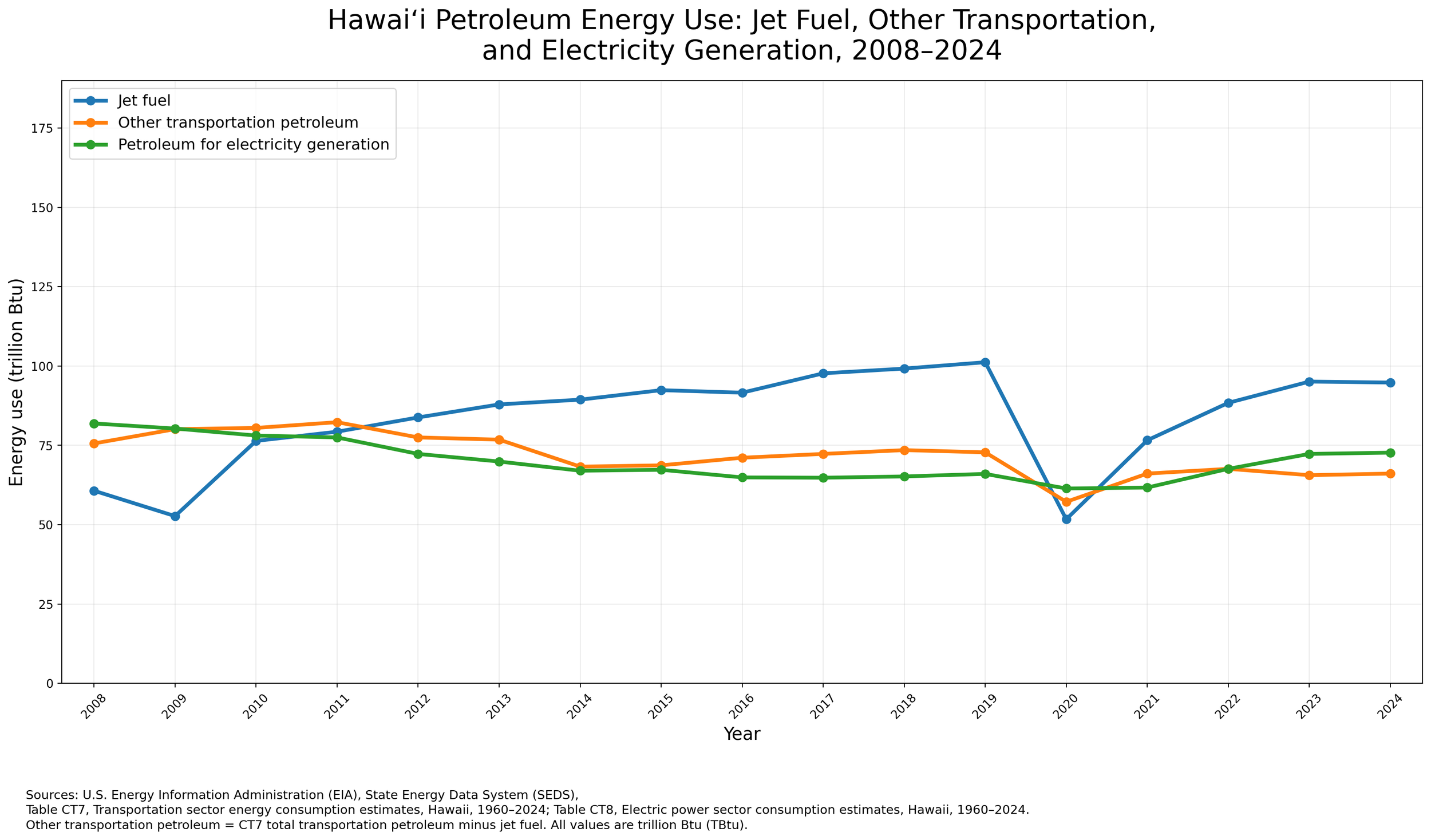
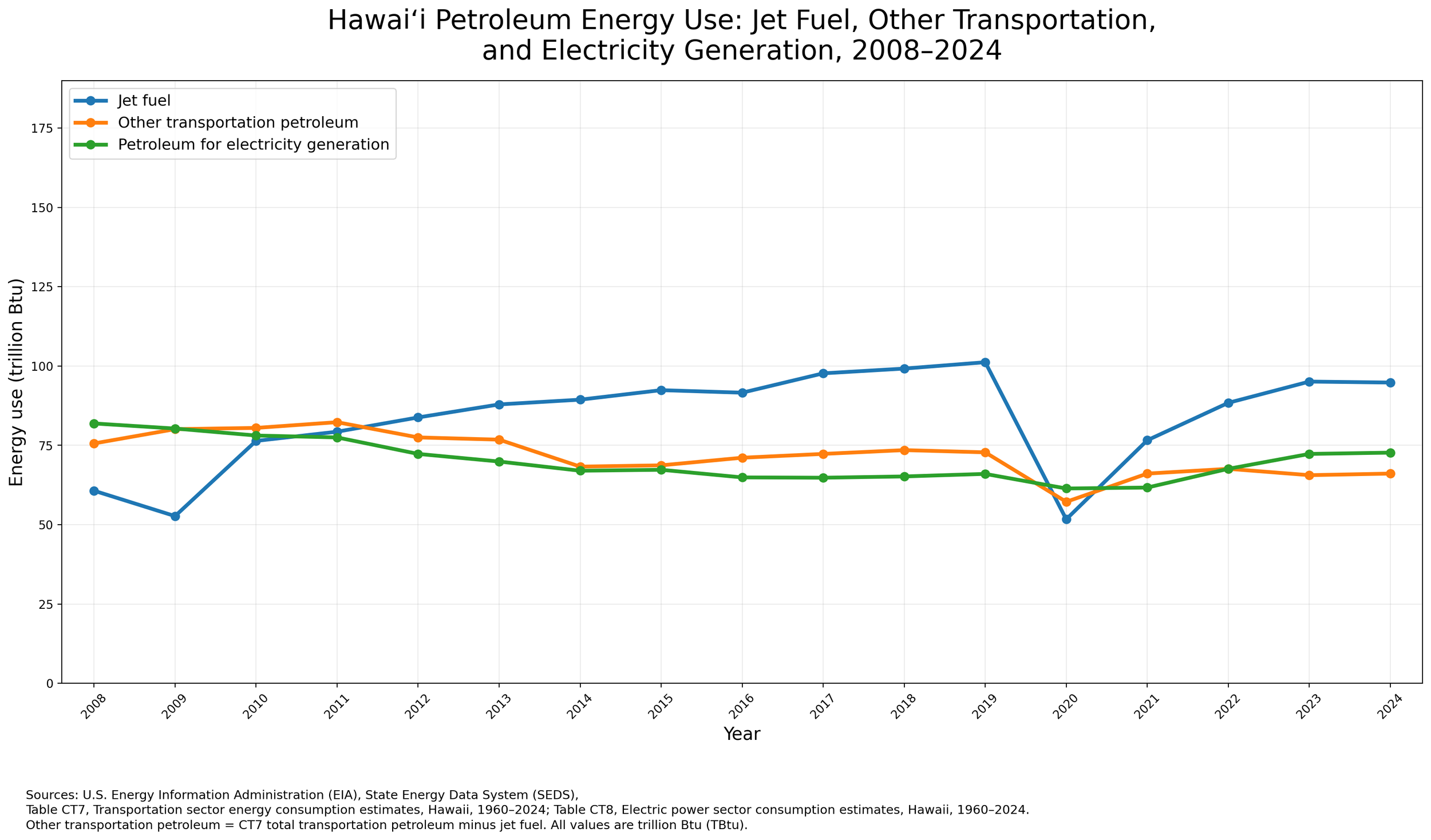
Hawaiʻi used more petroleum in 2024 than we did in 2008.
Is it time for a re-set in our thinking? by Mike Markrich
In 2008, Governor Linda Lingle and the U.S. Department of Energy launched the Hawaii Clean Energy Initiative (HCEI) The initiative established an ambitious goal of achieving 70% clean energy by 2030 - 40% from renewable energy and 30% through energy efficiency.
HCEI was so broad in scope and so widely publicized it helped establish Hawaiʻi as a national and international model for reducing dependence on fossil fuels. Over the following years, successive Governors and Hawaii State Legislators supported renewable-energy development through policies and incentives that encouraged the deployment of wind turbines, solar photovoltaic systems, solar water heaters and other clean-energy technologies. Environmental organizations came to Hawaii to learn about our bold actions and success.
Hawaiʻi subsequently made substantial progress in reducing the use of petroleum and coal. In 2008, these two fossil fuels together accounted for more than 90% of Hawaiʻi's electricity generation. By 2024, this percent had dropped to 64 % with renewable energy supplying approximately 36% of the state's electricity generation. By contrast at the peak of Hawaii’s plantation 143 year era, the burning of sugar cane waste generated a significant amount of electricity on Neighbor Islands such as Kauaim Maui and the Island of Hawaai’. This was lost when the last plantation, HC&S, closed on Maui in 2016. Statewide the estimate was about 10% of the electricity was created by burning sugar cane bagasses. Replacing that with renewable energy that generates 36% of our electricity has been a considerable achievement.
Without those efforts, the loss of the sugar plantation produced electricity would have been felt to a greater degree.
In 2015, Hawaiʻi went further by establishing a statutory 100% renewable portfolio standard (RPS) for electricity by 2045.
But despite nearly two decades of clean-energy investment and millions of dollars in spending and tax credits. Hawaiʻi's overall petroleum consumption has actually grown.
In 2008, Hawaiʻi consumed approximately 42.397 millions of barrels of oil. By 2024, consumption had risen to approximately 44.971 million barrels of oil - an increase of about 6%.
The increase in the demand for jet fuel, needed by the tourism industry- offset progress in renewable energy
Hawaiʻi consumed approximately 1.34 barrels of petroleum per second in 2008. By 2024, that had increased to approximately 1.42 barrels per second. (These figures are calculated from the U.S. Energy Information Administration's annual petroleum-consumption totals using 365 days per year.)
The numbers reveal an important shift within Hawaiʻi's energy system.
Petroleum consumption for electricity generation declined from 13.209 million barrels in 2008 to 11.794 million barrels in 2024 a reduction of 10.7%
But jet fuel consumption rose 56% from 10.7 0 million barrels in 2008 to 16.72 million barrels in 2024.
At the same time the number of cars, trucks, vessels, boats and ships increased.
No matter what was done to reduce the consumption of oil for electricity, the overall demands of oil for transportation offset them.
The challenge facing Hawaiʻi has therefore changed.
The state can no longer focus on trying to reduce the use of oil to generate electricity. It must address the continued consumption of petroleum in aviation and all other forms of transportation to succeed.
Bold new ideas are needed
Sources 1. U.S. Department of Energy — Hawaiʻi Clean Energy Initiative, 2008
Documents the 2008 DOE–Hawaiʻi partnership and the original HCEI goals.
U.S. Department of Energy — 2008 HCEI timeline
2. Hawaiʻi State Energy Office — Hawaiʻi Clean Energy Initiative
Background on HCEI and Hawaiʻi's clean-energy policies.
Hawaiʻi State Energy Office — Hawaiʻi Clean Energy Initiative
3. Hawaiʻi Public Utilities Commission — Renewable Energy and Energy Efficiency Policies
Documents the original HCEI target of 70% clean energy by 2030.
Hawaiʻi PUC — Renewable Energy and Energy Efficiency Policies
4. Hawaiʻi Legislature — Act 97 (2015)
Establishes Hawaiʻi's statutory 100% renewable portfolio standard by 2045.
Hawaiʻi Legislature — Renewable Portfolio Standard legislation
5. Hawaiʻi DBEDT — Hawaiʻi Petroleum Consumption
Source for the 2008 petroleum-consumption figures, including total petroleum, transportation and electric-power consumption.
Hawaiʻi DBEDT — Petroleum Consumption Report
6. U.S. Energy Information Administration — Hawaiʻi State Energy Data
Source for the 2024 petroleum-consumption figures.
EIA — Hawaiʻi State Energy Data
7. U.S. Energy Information Administration — Jet Fuel Consumption
Source for the 2008 and 2024 jet-fuel figures.
EIA — Jet Fuel Consumption Data
8. U.S. Energy Information Administration — Hawaiʻi Electricity Generation
Source for the historical dependence on petroleum and coal for electricity generation.
EIA — Hawaiʻi Electricity Generation
9. Hawaiʻi State Energy Office — 2025 Annual Report
Source for the 2024 renewable share of electricity generation.
Hawaiʻi State Energy Office — 2025 Annual Report
10. Hawaiʻi Department of Taxation — Renewable Energy Technologies Income Tax Credit
Source documenting Hawaiʻi's renewable-energy tax incentives.
Hawaiʻi Department of Taxation — Renewable Energy Technologies Income Tax Credit
From Lava to Legacy: What ʻŌhiʻa Lehua Can Teach Us About Building Fire-Resilient Communities in Hawaiʻi by Sage Murakami
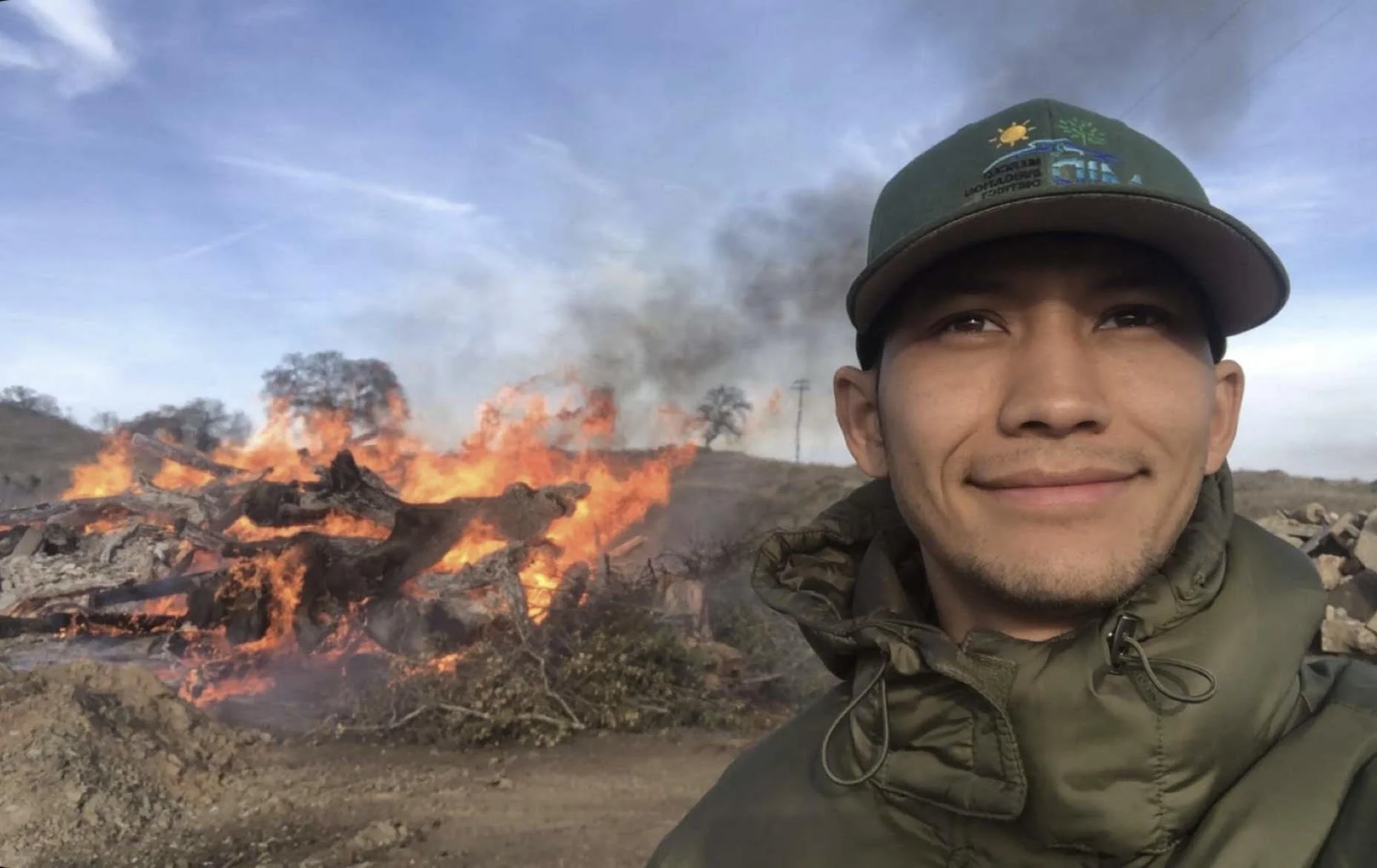
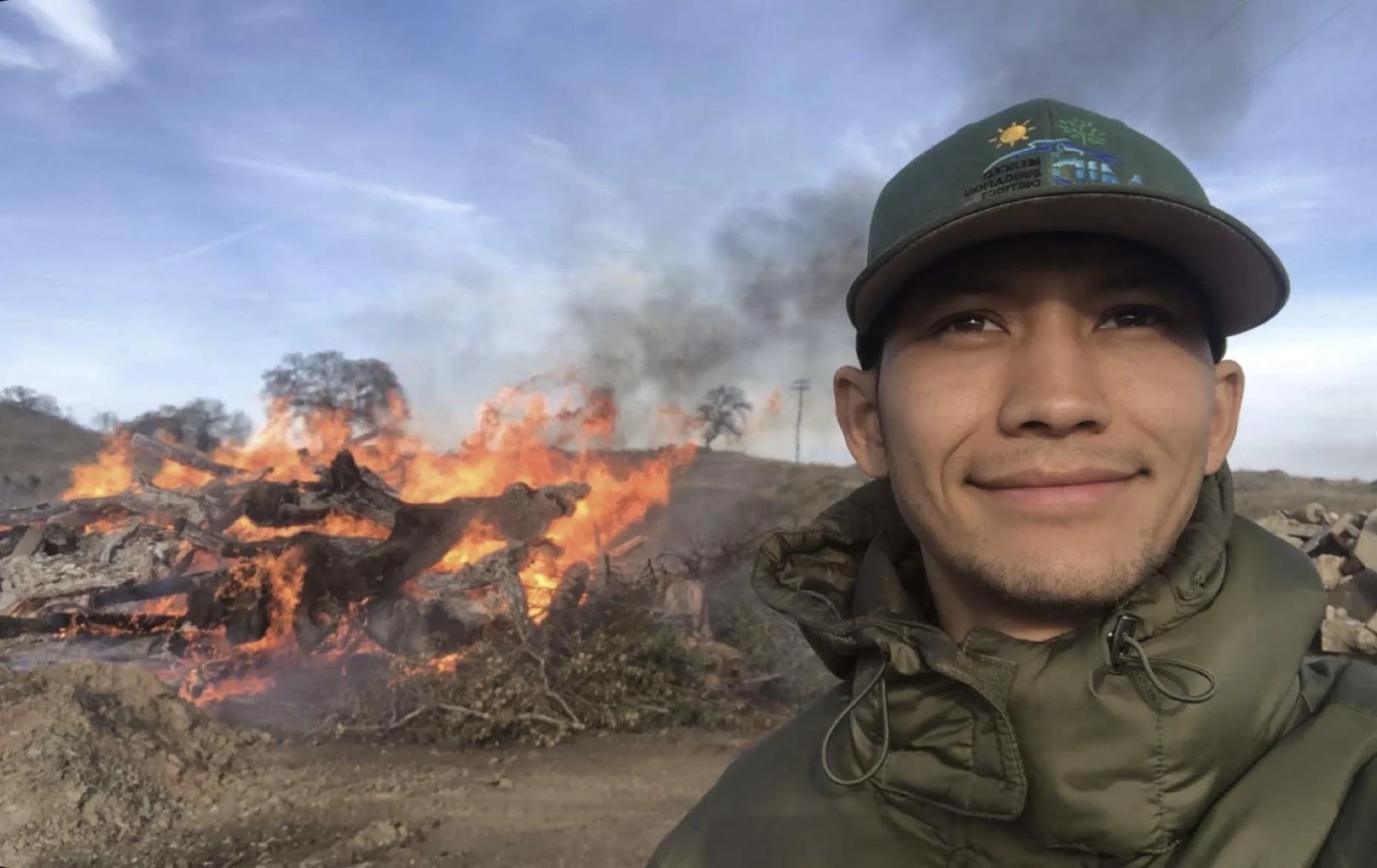
Sage Murakami at Mariposa County, just south of Yosemite national park. “This wasn’t a wildfire but one of our prescribed (controlled) burns. During fire season we collected brush and dead wood from around the parks, the. Burned those fuel piles during the wet season under controlled conditions. The goal was to reduce fuels and help lower risk and intensity of future wildfires.”
I was born and raised in California, but Hawaiʻi has always been an important part of who I am. My family has called these islands home for generations, and throughout my childhood I spent months here each year learning from the people, landscapes, and cultural traditions that have shaped Hawaiʻi for centuries. As I became more involved in sustainability, environmental restoration, and community resilience, I began to see Hawaiʻi not only as a place of incredible natural beauty but also as a place that faces unique environmental challenges requiring thoughtful, long-term solutions.
Those perspectives became even more meaningful during my time working as a park ranger in California's Sierra Nevada from 2020 to 2022. Wildfire was no longer something I read about in the news, it became part of everyday life.
During several major fire events, I watched helicopters repeatedly draw water from Lake McClure and Lake McSwain to support aerial firefighting operations. The constant rhythm of aircraft carrying thousands of gallons of water illustrated both the incredible dedication of emergency responders and the immense resources required once a wildfire escapes initial containment. Every flight represented communities already in danger.
Within that same year, another memory remains impossible to forget. While driving north on Interstate 5, I found myself stopped in traffic only a few miles from the Silverado Fire in Southern California. Emergency alerts began sounding on my phone warning that I was dangerously close to the active fire. Looking toward the horizon, the afternoon sky had transformed into an eerie pumpkin-orange glow as smoke filtered the sunlight. It was beautiful in a haunting way, yet deeply unsettling. Sitting motionless while wildfire advanced nearby demonstrated just how quickly ordinary moments can become emergencies.
Those experiences changed the way I think about disaster preparedness. More importantly, they changed the questions I began asking.
“How do communities prepare before the helicopters arrive?
How do we design neighborhoods that are less vulnerable to wildfire?
How do we proactively reduce risk instead of simply responding to it?”
Today, those questions have become increasingly relevant in Hawaiʻi.
For many years, people viewed Hawaiʻi as being relatively protected from catastrophic wildfire because of its tropical climate. However, changing rainfall patterns, prolonged drought, invasive grasses (guinea & fountain grass), expanding development, and warming microclimates have dramatically altered that reality. The tragic Lahaina wildfire demonstrated that wildfire is no longer simply a mainland problem, but it is now one of Hawaiʻi's greatest resilience challenges.
As our communities continue to grow along the wildland-urban interface, we must begin thinking differently about how we design landscapes. Rather than relying solely on emergency response after ignition, we have an opportunity to invest in prevention through urban forestry, ecological restoration, firewise planning, and community education.
Urban forestry is often misunderstood as simply planting more trees. In reality, it is the intentional planning, management, and stewardship of trees and green spaces to improve environmental, social, and community resilience. A well-designed urban forest can reduce urban heat, improve air quality, stabilize soils, reduce flooding, increase biodiversity, provide shade during extreme heat events, and contribute to both physical and mental health.
When integrated into wildfire planning, urban forestry becomes even more powerful.
Tree selection, species diversity, spacing, pruning, fuel management, irrigation planning, and landscape design all influence how fire behaves. Native species that are adapted to Hawaiʻi's ecosystems can become part of a larger strategy that reduces wildfire intensity while restoring ecological function. Removing invasive grasses that create continuous fuel loads, increasing canopy diversity, maintaining defensible space around homes, and strategically restoring native vegetation can help slow fire spread while improving ecosystem health.
Among Hawaiʻi's native trees, none better represents resilience than the ʻōhiʻa lehua (Metrosideros polymorpha).
The ʻōhiʻa lehua is one of the first trees to establish itself on newly formed lava flows after volcanic eruptions. Where fresh basalt appears lifeless and inhospitable, ʻōhiʻa begins the slow process of ecological succession. Its roots penetrate cracks in hardened lava, helping break down rock into soil while capturing organic material and moisture. Over decades, this gradual process creates conditions that allow mosses, ferns, shrubs, insects, birds, and eventually entire native forests to flourish.
Ecologists refer to species like ʻōhiʻa as primary successional species because they begin the long process of ecosystem development where virtually nothing existed before.
That role carries an important lesson beyond ecology.
Resilience is not simply the ability to survive difficult circumstances. True resilience means creating opportunities for others to succeed after you.
The ʻōhiʻa does not grow because conditions are easy. It grows because difficult conditions require a species capable of preparing the landscape for everything that follows.
Communities can embrace that same philosophy.
Every native tree planted today, every invasive grass removed, every firewise neighborhood created, every emergency evacuation route improved, and every resilience hub established becomes an investment that future generations inherit.
Like ʻōhiʻa, we may never see the full forest that grows from today's efforts.
Yet those efforts matter.
The ecological importance of ʻōhiʻa extends far beyond its role as a pioneer species. It serves as the foundation of many Hawaiian forest ecosystems, providing habitat for countless native insects and supplying nectar for endangered Hawaiian honeycreepers such as the ʻiʻiwi and ʻapapane. For generations, Native Hawaiians have used ʻōhiʻa in traditional medicine, carving, house construction, and cultural practices. The tree appears throughout Hawaiian moʻolelo, chants, and hula, symbolizing strength, love, and the enduring relationship between people and ʻāina.
Today, however, this remarkable tree faces significant challenges. Rapid ʻŌhiʻa Death (ROD), caused by fungal pathogens, has killed millions of ʻōhiʻa trees throughout Hawaiʻi. Climate change, habitat fragmentation, invasive species, and increasing wildfire risk continue placing additional pressure on native forests that have evolved over thousands of years.
Protecting ʻōhiʻa therefore means protecting far more than a single species.
Healthy native forests regulate water supplies, reduce erosion, stabilize soil structure, support biodiversity, capture carbon, cool surrounding landscapes, and provide cultural spaces that connect communities with ʻāina. Every healthy forest strengthens Hawaiʻi's overall resilience.
Urban forestry offers an opportunity to connect these ecological benefits directly with community planning. Municipal governments, neighborhood organizations, schools, businesses, and residents can work together to create greener communities that are both environmentally healthy and wildfire resilient.
This planning may include expanding native tree planting programs, replacing highly flammable invasive vegetation with lower-risk native landscapes, creating shaded parks that double as community gathering spaces during emergencies, and integrating urban forests into resilience hub planning. Community volunteers can participate in restoration efforts, remove invasive species, monitor forest health, and support long-term stewardship projects that strengthen neighborhoods while restoring ecosystems.
Firewise planning complements these efforts by encouraging homeowners and communities to think proactively about wildfire before an emergency occurs. Creating defensible space around structures, maintaining vegetation, using fire-resistant landscaping, developing neighborhood evacuation plans, improving emergency communication systems, and educating residents all contribute to reducing wildfire risk.
No single strategy eliminates wildfire.
But together, these actions create communities that are better prepared, more connected, and more resilient.
As Hawaiʻi continues adapting to a changing climate, we have a unique opportunity to learn from both science and community ‘ike (knowledge). We can draw upon modern urban forestry practices while honoring Indigenous stewardship principles that have sustained these islands for generations. We can recognize that healthy forests are not simply scenic backdrops but living infrastructure that supports water, biodiversity, climate adaptation, cultural identity, and community safety.
The story of the ʻōhiʻa lehua reminds us that resilience begins long before disaster strikes. It begins with thoughtful planning, patient stewardship, and the willingness to invest in a future we may never fully witness ourselves.
Like the ʻōhiʻa taking root in fresh lava, we have the opportunity today to lay the foundation for stronger communities tomorrow.
Renewing and rebuilding Hawaiʻi is not simply about recovering after disaster. It is about cultivating landscapes, neighborhoods, and relationships that allow future generations to flourish long before the next wildfire begins.
Works Cited:
Hawaiʻi Wildfire Management Organization. (2025). Ready, set, go! Your personal Hawaiʻi wildland fire action guide (Rev. ed.). Hawaiʻi Wildfire Management Organization.
M. Markrich, personal communication, June 2026
B. Deis M.S., personal communication, June 2026
Loope, L., Hughes, R. F., Keith, L. M., Harrington, T., Hauff, R., Friday, J. B., et al. (2016). Guidance document for Rapid ʻŌhiʻa Death: Background for the 2017–2019 ROD Strategic Response Plan. University of Hawaiʻi College of Tropical Agriculture and Human Resources
A Brief History of Resilience Hubs In Hawai’i by Mike Markrich
One of the great differences between 1973 and 2026 is that when there was a natural disaster neighborhoods were largely on their own. People depended on government or businesses such as plantations or churches but there was no organized systematic means for people to get help and help each other. Today we have Resilience Hubs which will be the subject of a special forum on July 30 at the Foreign Trade Zone Auditorium sponsored by RENEW REBUILD HAWAII the American Planners Association Hawaii Chapter and the Hawaii Green Infrastructure Authority
The concept of Resilience Hubs emerged in the United States during the 2010s in Baltimore after a combination of mass power outages coincided with an extreme heat wave that caused deaths and heat strokes in numbers that overwhelmed the local government. From that point forward rather than relying solely on government emergency response, resilience hubs emerged that help neighborhoods prepare before disasters, respond during emergencies, and recover afterward.
In Hawaiʻi, the idea took hold following a series of major crises, including the 2018 Kīlauea eruption on Hawaiʻi Island and the COVID-19 pandemic beginning in 2020. These events brought forth local leaders who in the absence of centralized direction created their own responses to help their communities.
One of those leaders was Janice Ikeda, who seeing the chaos and disruption that occurred following the COVID - Pandemic, became the state's leading grassroots organizer writing grants and developing resilience hubs. During the pandemic, Ikeda raised funds, organized neighborhood-based hubs that coordinated food distribution, volunteer networks, emergency communications, mental health support, and assistance for vulnerable residents. Rather than creating new government facilities, Vibrant Hawaiʻi built on existing schools, churches, community centers, and local organizations, creating a network of trusted community gathering places.
At the same time, the City and County of Honolulu Office of Climate Change, Sustainability and Resiliency incorporated resilience hubs into its Ola: Oʻahu Resilience Strategy through Action 15, which called for creating a network of community resilience hubs across Oʻahu. Beginning in 2022, the City partnered with the Center for Resilient Neighborhoods (CERENE) to conduct extensive public engagement, identifying potential hub locations and developing a Hawaiʻi-specific definition of resilience hubs based on community priorities. More than 3,000 residents participated in surveys and workshops during the Action 15 project.
Funding for Hawaiʻi's resilience hub movement has come from a combination of philanthropic organizations, government grants, private companies, and nonprofit partners. Organizations such as Hawaiian Electric, State Farm, local foundations, federal disaster programs, and county governments have supported various training, planning, and community preparedness initiatives. The approach emphasizes investing in people, local leadership, and trusted relationships rather than constructing expensive new facilities.
Today, Hawaiʻi's resilience hub network continues to expand. Hawaiʻi Island now has a network of approximately 20 community hubs, while Oʻahu is developing regional hub networks such as the Koʻolau Resilience Hub Network. Modern resilience hubs provide emergency preparedness training, communications, food security programs, first aid, psychological support, volunteer coordination, and neighborhood planning year-round—not just during disasters.
The long-term vision is that resilience hubs become an essential complement to Civil Defense and emergency management. Rather than replacing government agencies, they strengthen neighborhood self-reliance, improve communication between communities and emergency responders, and help Hawaiʻi recover more quickly from hurricanes, wildfires, tsunamis, volcanic eruptions, pandemics, and other future emergencies.
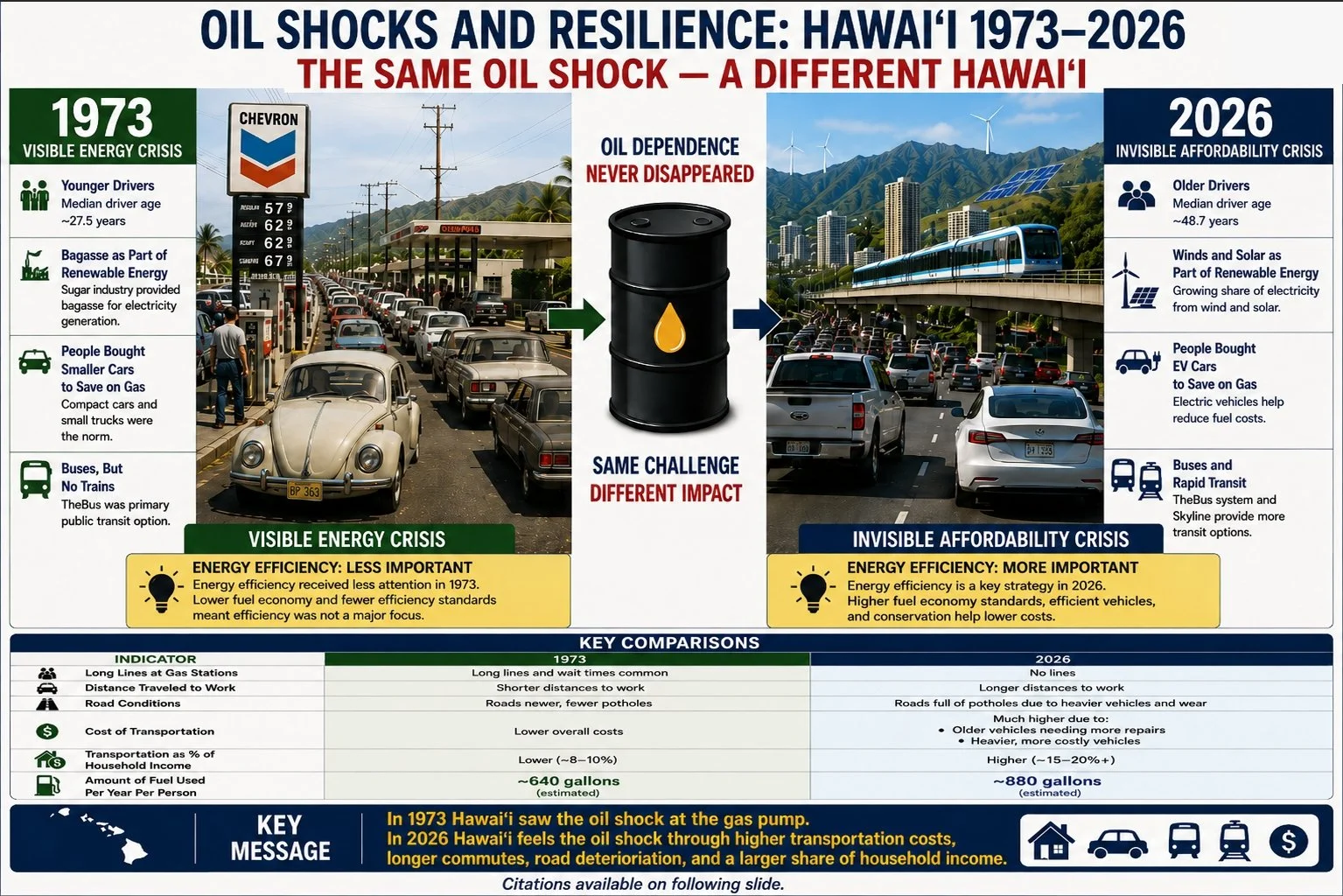
Oil Shock And Resiliency; 1973-2026 - What has changed? By Mike Markrich Copyright 2026
In 1973, a war in the Middle East caused Hawaii to come to a standstill. There was suddenly a lack of gasoline in a state heavily dependent on imported fossil fuels. People sat in long lines for gasoline. Fishermen were unable to take their boats out, and tourism came to a standstill as prices spiked. High prices affected everything from toilet paper to food. Large numbers of people in the visitor industry found themselves unemployed.
In 2026, we are in the midst of another oil shock resulting from politics in the Middle East. There are no long lines for gasoline, but high electricity prices are causing record numbers of people to fall behind on their electric bills. We are still not sure what the full impacts of this oil shock will be, but if rising jet fuel costs cause significant drops in tourism, the effects could be even greater because Hawaii is more dependent on tourism for tax revenue and employment than it was 50 years ago.
What Has Changed?
Hawaii remains heavily dependent on imported fossil fuel. In the 1970s, approximately 20% of Hawaii’s electricity came from renewable sources such as bagasse, the fibrous residue left over from sugar production. Today, renewable electricity generation has risen substantially and is increasingly driven by solar energy. Yet transportation — including cars, trucks, aircraft, and shipping — still consumes most of the state’s petroleum. Electric vehicles account for roughly 4% of registered vehicles in Hawaii, one of the highest rates in the nation, but their impact has not yet substantially reduced household energy pressures.
Fewer Buildings / More People
Over the past 50 years, Hawaii’s population has nearly doubled, while affordable housing has failed to keep pace. When flooding occurred recently, it was not unusual to see 15 people displaced from a single home. Successive state and county governments have been more developer-oriented than people-oriented. Developers sought permits and financing for investment properties and second homes, while government favored the tax revenue generated by higher-priced units. Low- and moderate-income households were forced to make do.
Another issue is resiliency during storms. Because affordable housing construction has lagged behind population growth, more people are concentrated in smaller and denser living spaces. When power outages occur, the impacts are magnified. A single outage can affect large extended families living under one roof. Hawaii’s housing shortage has also become a disaster-resiliency problem, making communities more vulnerable during floods, storms, and prolonged electrical outages.
This has resulted in more families crammed into smaller spaces and unable to pay their bills. The World War II generation, shaped by plantation labor and wartime suffering, understood the need to help others. Today, efforts to reduce costs for struggling families are often met with resistance and disdain. An effort to expand assistance for low-income households through the H-HEAP energy assistance program failed in the legislature this session.
The difference between 1973 and today is that, while Hawaii remains isolated and vulnerable to global energy shocks, its people have struggled to unite around a shared response. The problem today is not just an oil crisis; it is also a weakening belief in the aloha spirit — the idea that life should be made better and more affordable for everyone, not just the fortunate few.
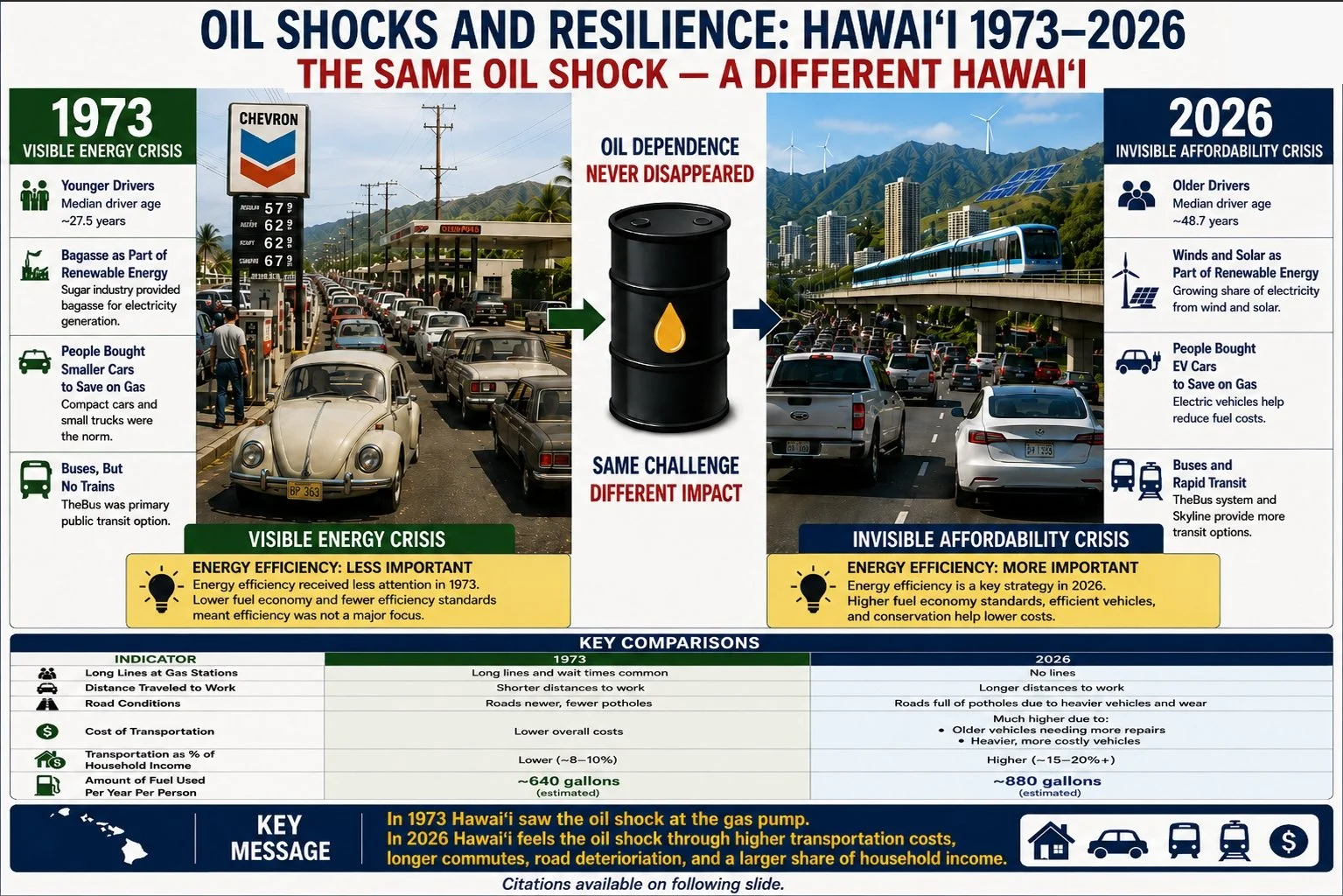
Compariing the oil shocks in 1973 and 2026 There are more people crowded together now in fewer living spaces in Hawaii. People use more power for everything from phones to refrigerators to video streaming. This increases their vulnerability when power outages occur and the need for resilience hubs
NEW OIL SHOCKS MEAN NEW NEED FOR RESILIENCE HUBS IN HAWAII
In 1973, a war in the Middle East caused Hawaii to come to a standstill. Arab nations belonging to the Organization of Oil Exporting Countries (OPEC) imposed an embargo on shipping oil to the United States. Even though the US was the number 2 oil producing nation in the world that year there was a supply chain disruption. This had an immediate impact on Hawaii. There was suddenly a scarcity of gasoline and people at every level of society felt it.
People sat in long lines at gas stations. Fishermen were unable to take their boats out, and tourism came to a standstill as prices spiked. High prices affected everything from toilet paper to food. Large numbers of people in the visitor industry found themselves unemployed and had their power cut off. Democratic Governor John A Burns directed state government - to help working class families and to promote energy conservation.
HERE WE ARE AGAIN
In 2026, we are in the midst of another oil shock resulting from politics in the Middle East. There are no long lines for gasoline and the US is now the number 1 producer of oil in the world. However, supply chain issues are still prevalent and because of our small isolated electrical grids cause Hawaii to have the highest electricity prices in the US. This is causing record numbers of households to fall behind on their electric bills affecting thousands of people. 80,000 people are considered energy burden with 48,000 in critical need. (https://www.staradvertiser.com/2025/08/06/editorial/our-view/editorial-find-relief-for-isles-energy-burdened/) This is based on Hawaii Public Utilities Calculations.
Because of a lack of affordable housing, more people live concentrated in fewer living units. Although there is more renewable energy available, it is found primarily in upper middle class neighborhoods.
Those people who cannot afford the renewable energy installations for the food in their refrigerators or for air conditioning are perhaps even more vultnerable than people in the same situation would have been 50 years ago. We are still not sure what the full impacts of this oil shock will be But the effects could be even greater than in 1973 because -Hawaii is more dependent on tourism for tax revenue and employment than before. To make matters worse, climate change has increased our needs for air conditioning. In addition fear of wild fires has increased the vulnerability of our grids.
What Has Changed?
Hawaii remains heavily dependent on imported fossil fuel. In the 1970s, approximately 20% of Hawaii’s electricity came from renewable sources such as bagasse, the fibrous residue left over from sugar production. But Hawaii is still dependent 80 percent on fossil fuel for overall energy - for the generators that provide electricity and for the fuel needed for transportation. When power goes down, people lose not only the food in their refrigerators, but the ability to cook their food and stay in touch with the outside world.
Available Housing units haven’t keep pace with population
Over the past 50 years, Hawaii’s population has nearly doubled, (from 852,000-1.4 million) while the number of available affordable units has failed to keep pace. The reason is that most homes are priced out of affordable limits of the the local rental or ownership market. Although the actual number of units has also increased from 220,000 to 522,000- few are in a price range local families can afford. Many are off the market because they are occupied by out-of-state investors, rented for military housing that is subsidized by the federal government or are used as vacation rentals
The result is fewer and more expensive homes and apartments that are priced higher. - While in 1973 it took 3 x an annual family income to purchase a home in Hawaii, that today that number is 9 X an annual family income. As a consequence, few local families qualify for affordable home projects. This has resulted in more extended families living in fewer homes and condos.
MORE PEOPLE IN FEWER PROPERTIES - MANY IN POOR CONDITION
When power outages occur, whether due to grid problems, hurricanes or earthquakes - the impacts are magnified to a degree that did not exist in 1973. People no longer have land lines so they can’t charge their phones. They lose the food in their freezers and refrigerators that they buy in bulk. A single outage therefore causes a ripple effect that like, falling dominos ,affect large extended families living under one roof. making communities more vulnerable for food and power during fire, floods, storms, and prolonged electrical outages.
NEED FOR RESILIENCY HUBS
Resiliency hubs are means of strategically placing electrical power in the form of micro-grids, batteries in places where people need them. The resiliency hubs provide accessible services - like providing food or places to charge their batteries or air conditioned shelters- to people when they are cut off from the power grid. Planners look at the population of people in particular neighborhoods and map out how certain areas can provide energy and services to nearby residents in case of an emergency. In the past there were Civil Defense shelters in schools and other areas that provide some essential emergency services . But nore more services like phone charging are asked for and the needs - because of the increase in population are greater than ever
FROM 1973 to 2026 - A change in Mind Set.
The World War II generation, shaped by plantation labor and wartime suffering, understood the need to help low income people and young families. Today, efforts to reduce costs for struggling families, are unfortunately sometimes met met with the idea “It can’t be helped.” The idea of resiliency hubs is a means to counter this philosophy of fatalism and helplessness.
One example of the reluctance to help low income residents was seen in this years legislature. An effort to expand electric bill assistance for low-income households, the HI-HEAP energy assistance program. Despite the fact that Hawaii has the most expensive electricity prices in the country and there are almost 240,000 ( there is an average of 3 people per household in Hawaii) people who live in households considered energy burdened in Hawaii - there was simply not enough interest among Hawaii state senators or representatives to pass the bill.
The difference between 1973 and today is that, while still Hawaii remains isolated and vulnerable to global energy shocks, its people have struggled to unite around a shared response. The safety net of unions, churches, families and Democratic politicians is no longer able to manage the strain of helping those who cannot afford to pay their bills. When storms, fires or oil shocks happen this magnifies the problem because it puts the already straining local community safety net to its breaking point. We need resilience hubs more than ever.
With Oil approaching $100 per barrel does Hawaii have to think differently?
Community opposition to expand geothermal energy has once again divided the Big Island . A recent community outreach effort by the University of Hawaii has lead to anger at public meetings where geothermal energy was discussed. https://www.civilbeat.org/2025/08/hawaiis-high-priced-geothermal-consultants-are-getting-heat/
For many people the very thought of geothermal energy makes them angry. “Stop pushing geothermal” wrote a recent visitor to our website. Our purpose is not to jpush geothermal but s to inform the public of the pluses and minuses of different renewable energy options. But is the answer to just continue burning fossil fuel?
Inexpensive geothermal energy is a fact of life in places such as the Philippines, New Zealand, Indonesia, Iceland, Kenya and California In the Philippines, which first began developing geothermal energy in the 1970’s, entire island communities that once depended on expensive oil to be transshipped in small lots by inter-island barge are now 100% powered by hot steam that comes from the islands themselves. Undersea cables ship excess power to other islands.
This would presently not be possible in Hawaii. So strong is the opposition, that a recent effort to obtain funding from the Hawaii State Legislature to furtther explore the geothermal power in the Kilauea’s East Rift Zone (KERZ) went nowhere; despite months of carefully preparation by UH geologists and communication experts. Faced with this opposition, state energy experts are once again publicly considering nuclear power - which is banned by the Hawaii State Constituion. Others believe that some combination of the two is an answer. - https://www.civilbeat.org/2025/08/hawaii-needs-nuclear-geothermal-power-meet-renewables-mandate/. In addiion, there is interest in natural gas.
Problems with war in the middle east, the after affects of the Maui wildfire, increasing demand from China and new Trump administration policies ending the renewable energy tax credits f - all point to increased costs for energy in Hawaii. I thought it might be interesting to look at the opposition to geothermal on different grounds.
. Help came from geologist of Eric Peterson, founder and managing director of Honua Resources, a geo thermal start-up on the Big Island.
* Why not use large solar fields, wind and batteries to power Hawaii? Haven’t they advanced to the level where they can cover most grid issues?
“Yes, it is true that solar and battery technology has advanced rapidly, and costs have come down significantly—this is one of the best clean energy success stories of the last decade. In many cases, distributed solar-plus-battery systems are already cheaper than utility power in Hawaii, and the price trend is still moving in the right direction. But even as costs drop, there’s a difference between what’s affordable for an individual home or business and what’s needed to reliably power an entire island grid, 24/7, through all conditions. Batteries can typically store hours, sometimes a day’s worth of power, but not several days in a row when the weather turns cloudy or during a major storm. That’s when we need a renewable source that doesn’t depend on the weather—geothermal fills that gap.”
Are there places on the grid where battery power will not be enough.
“Yes Even with falling battery prices, there will always be sectors that need unbroken, high-capacity power: airports, seaports, water treatment plants, hospitals, and large-scale industry. These critical facilities can’t risk extended outages and can’t rely solely on battery reserves. Geothermal, combined with solar and storage, ensures that we have firm, on-island power that can run continuously. This isn’t about replacing solar—it’s about complementing it so Hawaii can fully eliminate imported oil and still keep the lights on everywhere, all the time. Public investment should reflect that reality: support rooftop and community solar with storage, but also maintain funding for geothermal so that the whole system—residential, commercial, and critical infrastructure—remains clean, resilient, and affordable in the long run.”
”Product lifecycle of batteries”
“It’s also important to look at the full lifecycle of any technology. Solar panels, batteries, and wind turbines all require mining, often overseas, and energy-intensive manufacturing—frequently in places like China—before they’re shipped here. At the end of life, disposal or recycling can be challenging. No energy source is completely impact-free, which is why we need to weigh all options based on their total environmental footprint over time.
People often look at health issues as a problem with geothermal - citing issues connected to emissions that they say came out of the ground. How do you address these issues?
“Geothermal in Hawaii has had challenges in the past, particularly with community trust. Today, equipment can be designed with advanced silencers and enclosed systems that dramatically reduce noise. As for emissions, geothermal plants in Hawaii must meet strict DOH and EPA air quality standards. Hydrogen sulfide, the main gas released, is continuously monitored, and modern plants can capture and reinject nearly all of it back underground—avoiding harm to surrounding communities. The lubricants and drilling fluids used are also regulated and, when reinjected, are done so under EPA Underground Injection Control (UIC) permits to ensure groundwater safety.”
As pointed out, solar and wind are critical to our future, and reducing electricity demand is wise. But for 24/7 clean power, especially during storms or extended cloudy periods, pairing those intermittent sources with firm, on- sland renewables like geothermal is important. The goal isn’t to replace solar and wind—it’s to make sure all renewable sources work together for both affordability and resilience.”dss
Conclusion
Peterson said there are social benefits as well as geothermal “can help lower-income residents by reducing energy costs, creating good local jobs, and generating tax revenue that can be reinvested in housing, schools, and infrastructure.”
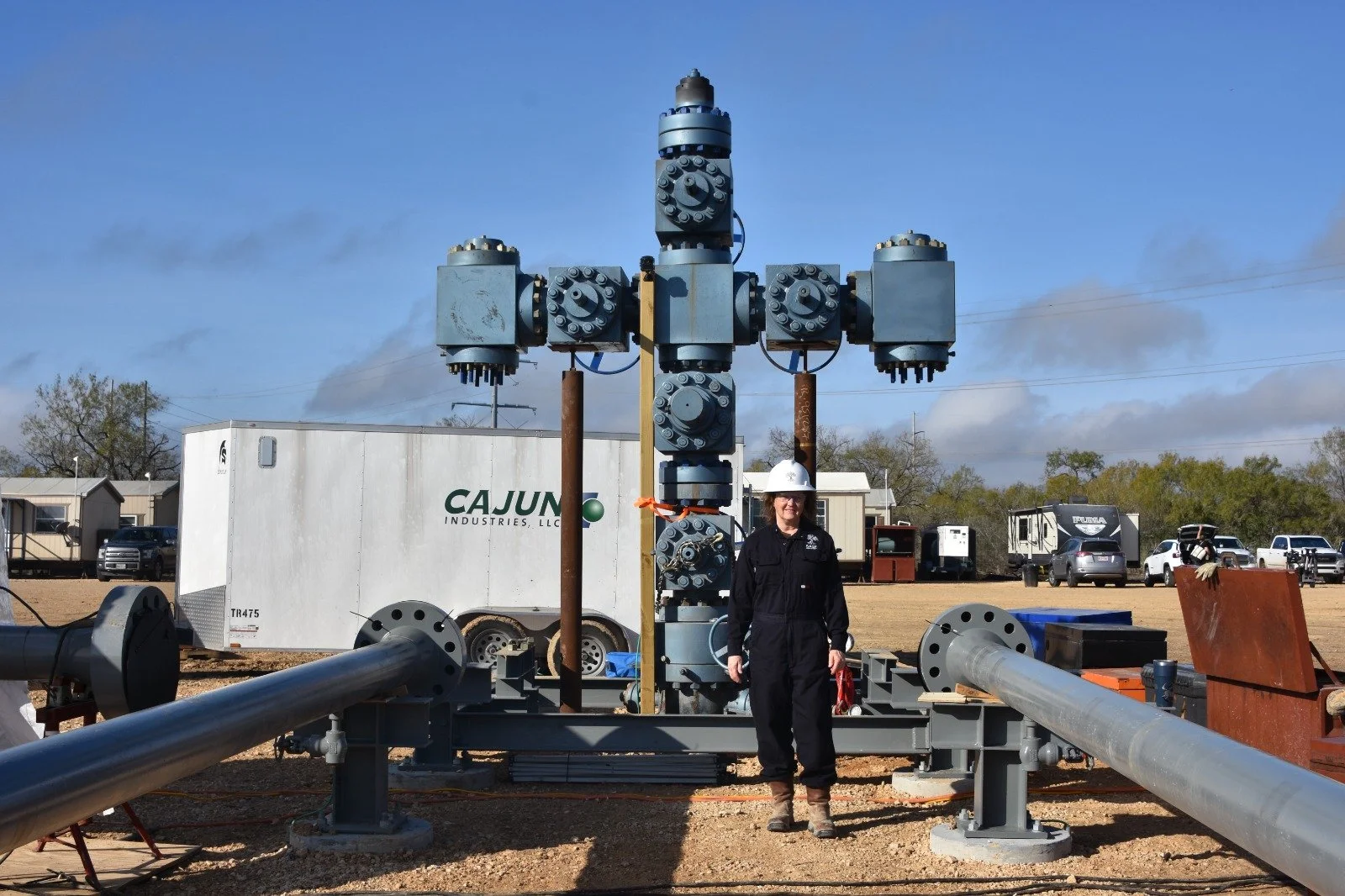
A Conversation with Cindy Taff, CEO of Sage Geosystems - A Dramatic New Energy System with plans to provide power in Hawaii
Cindy Taff Sage Geosystems CEO
Cindy Taff explains Sage Geosystems:
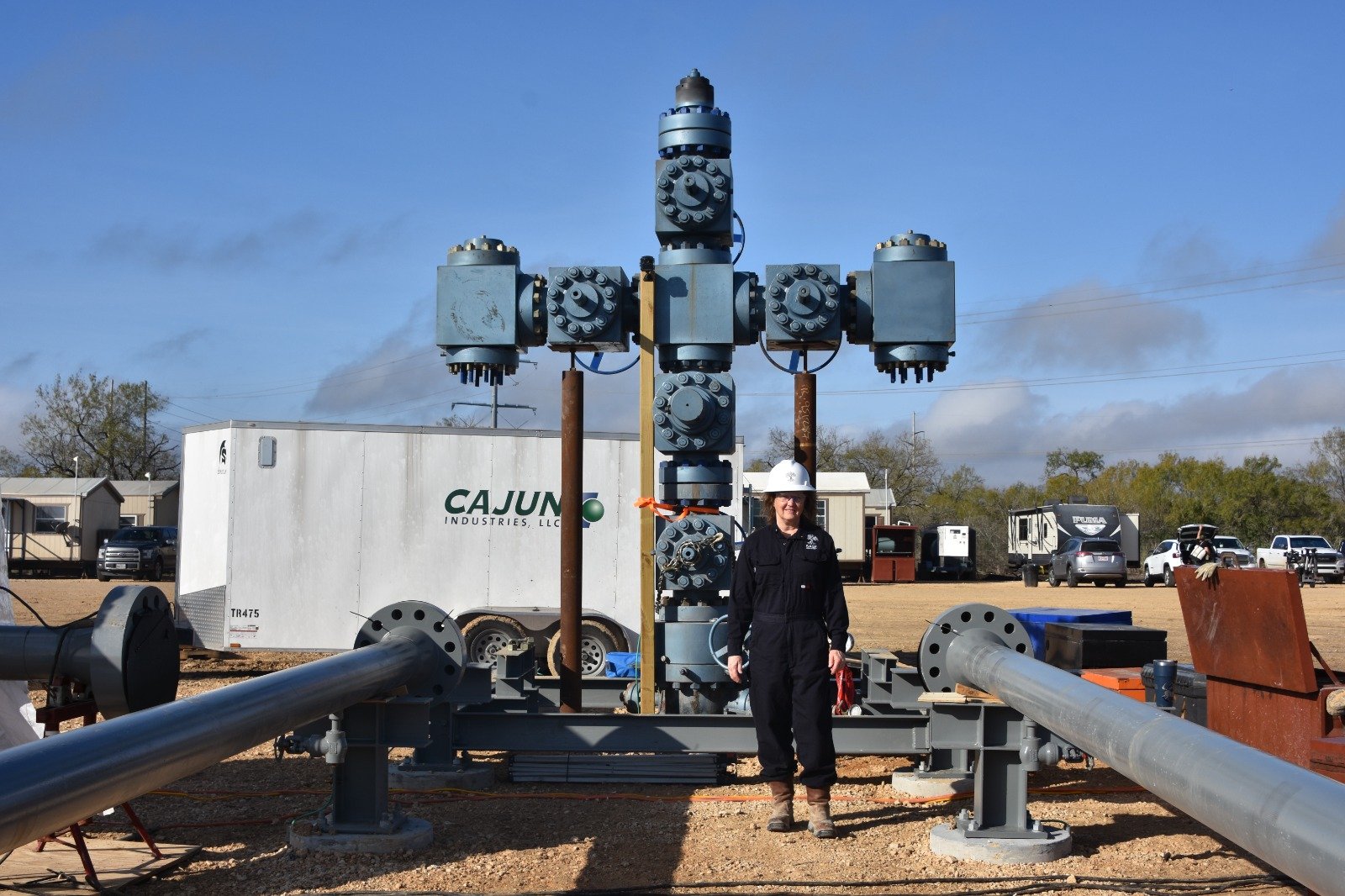
Cindy Taff CEO of SAGE Geosystems
“Sage Geosystems (Sage) is a leader in the next-generation geothermal industry, pioneering the use of Pressure Geothermal, which leverages both the heat and the pressure of the earth to enable three applications: energy storage, power generation, and district heating. Pressure Geothermal also broadly expands where geothermal can be applied, allowing it to be deployed globally.
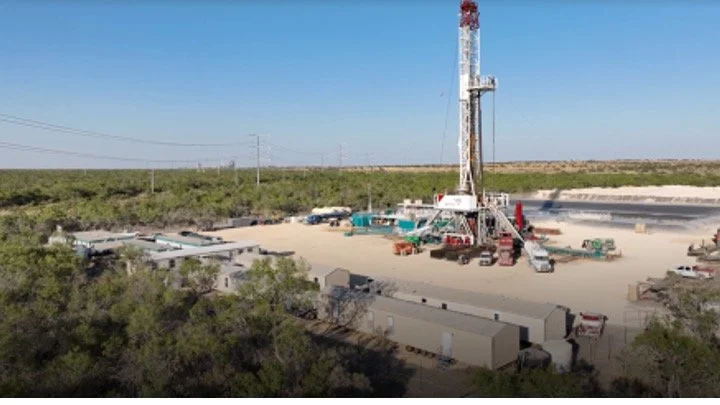
This is the Sage Geothermal Exploratory well on St. Vincent, an Island in the Caribbean. Cindy believes there is a large potential market for geothermal energy in island states.
1. What are your goals in developing geothermal on islands like the Big Island of Hawaii or St. Vincent in the Caribbean. This is very different from prospecting on the Mainland or Asia. Do you see Island nations as new markets
Given the very high costs of electricity on islands or from microgrid power around the world, including in Hawaii, Sage's Pressure Geothermal technology can offer unique alternatives for energy storage and geothermal power generation that are low-cost, especially compared to the current diesel sources. Direct heat is another application of Pressure Geothermal. Hawaii's unique geothermal resources and their need for energy storage to pair with wind and solar, give Sage a clear opening. The comparatively small footprint of Sage's facilities and resource usage (such as a smaller impact on local water supplies, even compared to existing traditional hydrothermal geothermal operations) makes Sage a more environmentally friendly option. Energy security for local communities and military installations can also provide an important resiliency factor.
2. I read through your very interesting slide deck presentation and wonder how Sage Geosystems developed its patented cycling - Pressure geothermal technology as it is different from the others. What is its background history? Is its technology related to the Fenton Hill Project of 1972? => Sage went to the field quickly to test our geothermal fracturing technologies and while operating the fracture, we saw the same challenges that EGS experienced as reported by the U.S. DOE Fenton Hill project and seen even today. We therefore decided to leverage the "huff-and-puff" method of the O&G industry, which was the cyclic method that evolved into our Pressure Geothermal. With that being said, the scientists on our team, Lance Cook and Lev Ring, read all the Fenton Hill reports and books, especially those involving Don Brown. We have learned from these U.S. DOE reports, both what to do and what not to do in the subsurface! Sage's in-house expertise in both modeling and Managed Pressure Drilling (MPD) operations helped encourage our Pressure Geothermal technology.
3. Have you always been in the energy business? How did you start in Shell Oil? What was your first job in the energy field? Did you aspire to be a CEO? => Cindy Taff has always been in the energy business. She started at Shell in 1985 as a Production Engineer after receiving a BSc in Mechanical Engineering. Cindy's last job at Shell was VP over Shell's global Wells & Logistics operations, managing a $1 billion annual budget, with operations in Canada, the U.S., South America, China, and Ukraine. Cindy had the opportunity to leave Shell after 35 years and start Sage Geosystems, and she never looked back. She started at Sage in 2021 at Chief Operating Officer (COO), and moved to CEO the next year, and has never looked back!
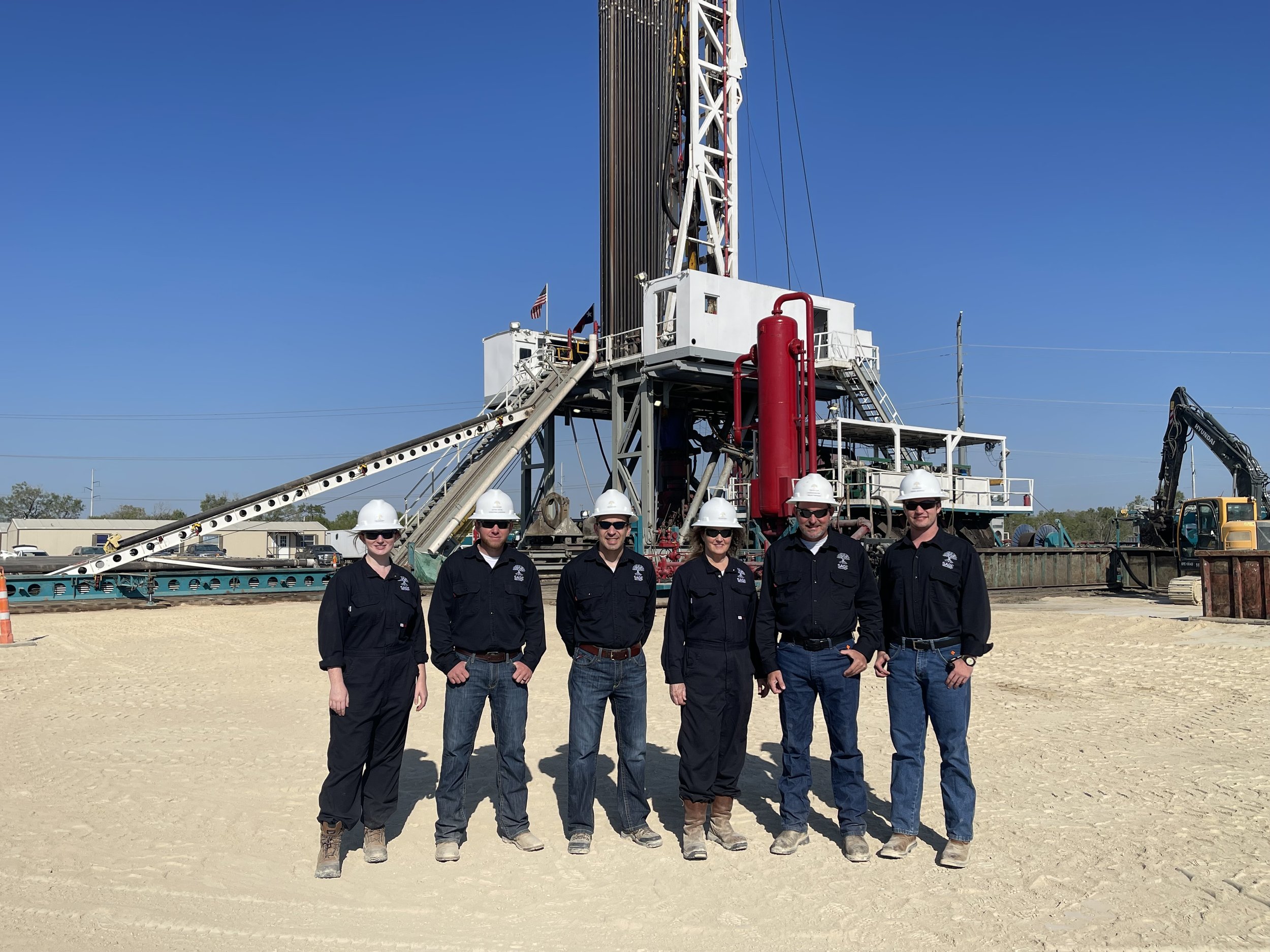
Cindy in the center with her field crew. Sage Geosystems Team - [Left to Right] Brianna Byrd, Dayton Trichel, Jason Peart, Cindy Taff, Shannon Bolton, Parker Anderson
4. Energy is largely considered a man's field. However, there are many women involved in this field in Hawaii. Was it difficult for you to enter the energy engineering profession? => It was not difficult at all. When Cindy was younger, she was always curious about how things work, and worked on bikes and cars, so studying Mechanical Engineering was a natural progression and there were few women in this field of study as well. Cindy was always a bit of a tomboy growing up, so there is no discomfort being around men. In fact, looking back she finds it strange that most of the difficulties Cindy experienced at Shell was with female supervisors, not male supervisors.
5. How is that Meta became involved in Sage Geosystems as opposed to the other next generation geothermal companies? => This would be best told by Meta, but from what we understand, Meta vetted the other next-generation geothermal companies and their technologies and concluded that Sage's approach had the best near- and long-term potential for resilience and affordable energy.
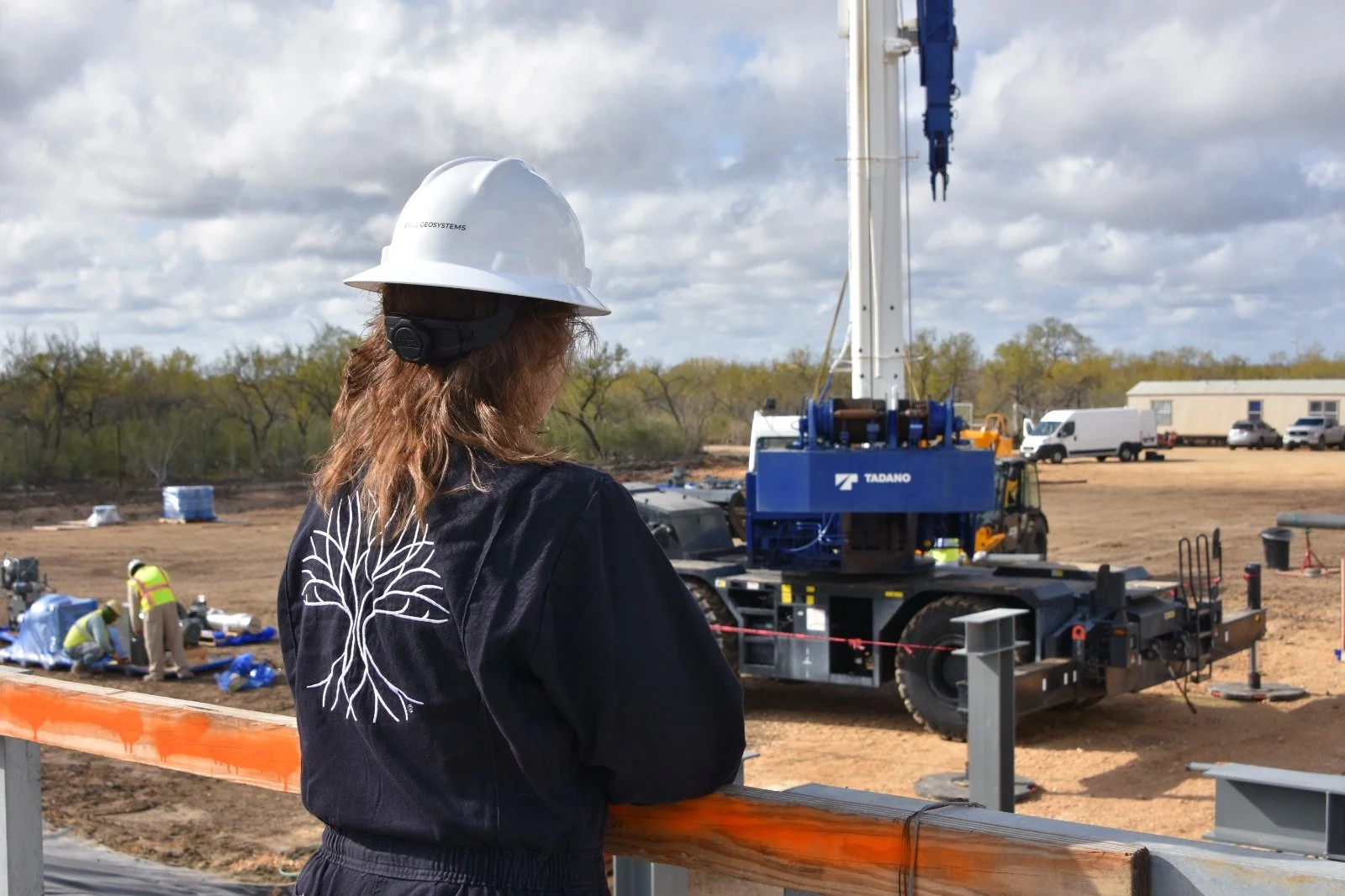
Cindy overseeing a drilling project
6. There is a concern in Hawaii about 1) maintaining the purity of island water and 2 earthquakes. How does Sage plan on dealing with these issues? => Sage performs detailed geologic analyses prior to drilling, which includes evaluating potential water sources for the power plant operations and hiring a 3rd party to study and recommend an induced seismicity (i.e., earthquakes and tremors) monitoring and mitigation plan. Monitoring and mitigation operations focus on pre-drill and operational characterization and monitoring for water losses, quality and pressures. Sage's Pressure Geothermal system consists of one fracture network connected to a single well and operated like a 'lung' which moves the water between two wells, but in the surface facility. Earthquakes are activated when water is pumped across a naturally occurring fault, and lubricates the fault enough to make it slip, the slippage is the earthquake or tremor. As Sage operates our fractures like a lung, intersecting a fault would pull the water away from our fracture and result in extremely high-water losses, meaning our subsurface system nor power plant would not function. Sage expects to be regulated in terms of water usage permits, water quality protections and drilling permitting, among many factors that could impact the public and shared resources. Sage technologies have a very low to zero demonstrated induced seismicity risk, as demonstrated in our field operations in Texas since 2021, and as tracked by a 3rd party geological survey monitors (University of Texas Bureau of Economic Geology, with all data published publicly online at TexNet). Sage would pursue a similar monitoring and mitigation program in Hawaii. Sage understands the importance of this issue as a license to operate, and plans continuous baseline and operations monitoring at the < M1 scale that can be assessed in real time with operations to ensure operations continue without seismicity.
7. Does Sage see itself in a race for market share with Fervo and Eavor Loop
technology or are they complementary applications? => The next-generation geothermal Total Addressable Market (TAM) is huge and will have room for several players. With that being said, all three companies (Sage, Fervo, Eavor) are currently in the field drilling wells and building power plants and using significantly different technology. As an industry, we will have results and know answers in the next 1-3 years. It is a very exciting time to be in next-generation geothermal. We compare it to where wind and solar were on the learning curve 15 years ago. What you will see in the next few years is a rapidly developing ecosystem with startups testing their approaches, and the learnings being leveraged on the next facility, and so forth.
9. What is your projected timeline for work in Hawaii? Since some of your work will be DOD related do you have an idea on how you would like to proceed? => To be transparent, the timeline for a Sage project is governed mainly by two things: (1) an off-take agreement with a credit-worthy counterparty (for bankability of the project) for a project at a reasonable scale (50-100MW or more) and a reasonable cost, and (2) project funding underpinned by the off-take agreement. For some projects, as with the U.S. Department of Defense for example, the next step would be to perform an in-depth feasibility study which examines the project in detail but also enables the building of relationships. The in-depth study covers the geology, drilling site(s), preliminary well(s) design, preliminary power plant design, geothermal system level modeling, permitting, water, and techno-economics. Sage's first commercial 3MW energy storage facility was built near Christine, Texas at a lignite coal plant just south of San Antonio. It was delivered in 12 months from funding to "ready to store," and we're now awaiting the grid interconnection. Geothermal power generation facilities will have a slightly longer lead time of 24-30 months. For Hawaii, the timeline may be longer to enable review of the geothermal development potential, understanding the regulatory environment, assessing the drilling infrastructure in state versus what needs to be brought in, etc.
10. Can Sage energy storage systems be used to store hydrogen fuel for next generation aircraft, bus or ships in Hawaii? If it did this could be a potential game changer for Hawaii's economy. => Sage is partnering with a company called GeoRedox, from MIT. Here is the press release:https://www.globenewswire.com/news-release/2025/03/27/3050605/0/en/GeoRedox-Announces-New-Stimulated-Geologic-Hydrogen-Approach-and-Strategic-Partnership-with-Sage-Geosystems.html
Thank you

The Promise of Geothermal in Hawaii - A conversation with geologist Eric Peterson CEO of Honua Resources. A new energy start-up company.

Eric Peterson, CEO of Honua Resources - As a geologist prospecting in Nevada
Eric Peterson is the CEO of Honua Resources, a geothermal start up. He is interested in prospecting for geothermal energy in Hawaii. He has many years of experience as a geologist in the oil industry. He believes that the future of Hawaii lies with its greatest asset volcanic heat. Here are interview questions and answers Eric sent to me about Hawaii. The interview was conducted April 23, 2025.
Questions:
1. When you look at the Sub Surface world in Hawaii what does it tell you?
The subsurface world of Hawaii reveals tremendous geothermal energy potential due to its position on a geological hotspot. This creates conditions similar to Iceland, where geothermal energy provides 25% of electricity and 90% of heating needs. Iceland is a rift zone generated magma source and Hawaii is a traditional hotspot so a purest might disagree geologically but big picture are they are both islands that have accessible heat from drillable magma chambers (also you don't drill into magma chamber just deep enough down until its hot enough to access the heat but not fry up your well perhaps 300-600 degrees Farenheit roughly.
Current development includes Ormat's Puna Geothermal Venture (PGV) facility with 38MW capacity, but this represents only about 2.5% of Hawaii's estimated potential. Studies suggest the Big Island and Maui alone could support 1000-1500MW of geothermal power generation.
As a volcanic island chain situated over a mantle hotspot, Hawaii has access to high heat flux that could be harnessed for sustainable energy production, potentially reducing dependence on imported fossil fuels while providing reliable baseload power.
2. You have a unique background in Earth Science, having attended UC Santa Cruz and San Diego State for your Master's. What got you interested in going into the energy business, and how has your current Executive MBA experience at New York University's Stern School of Business, particularly the Berkley Entrepreneurship program, influenced your approach to the geothermal industry in Hawaii?
I never thought I'd end up in the energy business - I was actually planning to be a dentist! But after taking an Earth Science class at UC Santa Cruz, I became fascinated with understanding how the earth works, so I decided to drill for resources instead of drill teeth. I was hooked on the idea of exploring national parks like Yosemite or volcanoes like Kilauea and grasping the underlying geology. My master's thesis at San Diego State, sponsored by Chevron/CalTex, took me to Indonesia, where I studied the mountain formation of Java. That experience opened my eyes to the importance of geoscience in energy exploration.
As I transitioned into the geothermal industry, particularly in Hawaii, I realized that technical expertise was just one part of the equation. That's where my experience at New York University's Stern School of Business came in. The program is equipping me with critical business and leadership skills that are instrumental in my success. Being selected as a finalist in the NYU Stern Berkley Entrepreneurship program is a recent highlight of my time at Stern. Out of 150 companies, making it to the top 10 and receiving mentorship and training was invaluable. The program taught me how to turn innovative ideas into scalable businesses, and I've been able to apply those skills directly to my work in geothermal energy in Hawaii.
The combination of my Earth Science background and Stern's business acumen has been a powerful combination. I'm now able to approach the geothermal industry with a comprehensive understanding of both the technical and business aspects, allowing me to drive impactful decisions and contribute to the growth of renewable energy in Hawaii. The skills and network I've developed through Stern and the Berkley program have positioned me well to make a meaningful impact in this field.
3. Where did you do your first drilling?
While I supported drilling at SLB in oil & gas services my first 6 years in the industry the first well I drilled was in Arkansas around 2011 in the Fayetteville Shale that is a Natural Gas field we acquired at BHP from Chesapeake. I gained hands-on experience with the entire drilling cycle, including geologically mapping the location using nearby well data and seismic data, designing the well with 3D visualization software, obtaining permits and approvals from the Arkansas Oil & Gas Commission, directing drilling operations, and ultimately handing the well over to engineers for completion and connection to facilities, bringing the gas to market.
4. What gives you the greatest satisfaction when you do this kind of work?
What gives me the greatest satisfaction in my work with geothermal energy is knowing that it contributes to providing clean, reliable, and sustainable power that improves people's lives. Geothermal energy's minimal environmental footprint makes it an ideal solution for Hawaii's pristine landscapes.
Unlike traditional power plants, geothermal plants harness heat from the Earth's core to generate electricity with virtually no emissions or pollution. With most infrastructure located underground, geothermal plants preserve the natural beauty and air quality of sensitive ecosystems – much like hanging a flatscreen television on a wall while keeping the complex network of wires hidden behind it.
Geothermal energy is also a reliable source of power, operating 24/7. Unlike solar and wind power, which are intermittent, geothermal plants provide consistent baseload power. A 30MW geothermal plant can run continuously, providing stable electricity. In contrast, a solar plant of the same capacity would need to overproduce and store excess energy to meet demand during periods of low sunlight.
Another significant advantage is geothermal energy's cost competitiveness. With costs roughly half that of oil-based power, geothermal energy is becoming increasingly competitive with solar and wind energy. As technology advances, costs are expected to decrease further, bringing cost savings to Hawaiians who currently pay the highest electricity prices in the country.
As the world transitions to a cleaner energy future, geothermal energy will play a vital role. Its reliability, low cost, and minimal environmental impact make it an attractive solution. For me, contributing to geothermal energy's development is a source of great satisfaction, knowing it will improve people's lives and shape a more sustainable future. In Hawaii, geothermal energy makes perfect sense as a key part of their energy mix.
5. How did you get the idea of starting your own company Honua Resources
After BHP sold its oil and gas assets to Woodside Energy to focus on minerals for electrification, I began exploring ways to apply my skills in a more meaningful way. I realized that my expertise could be used to make a positive impact on the environment. In the summer of 2024, I started focusing on Hawaii and discovered the perfect opportunity. I named my company Honua Resources, with 'Honua' meaning 'earth' in Hawaiian. As an earth scientist, it made sense to leverage the earth's natural resources to provide clean energy, and I'm excited to be working towards that goal.
6. What did you learn while working at Schlumberger and BHP about drilling that you could apply to your own company
During my time at Schlumberger and BHP, I gained valuable experience in drilling operations, well planning, and project execution. I learned about the importance of precise well placement, drilling optimization, and risk management. I also developed skills in using advanced drilling technologies and software, such as 3D visualization tools and drilling simulation models. These skills will be crucial in applying geothermal drilling techniques to Honua Resources' projects. Additionally, my experience working with cross-functional teams and managing complex projects will help me navigate the challenges of developing geothermal resources in Hawaii. Oil & Gas workers are the perfect candidates to transition to geothermal workers. It is essentially just exploring and producing heat instead of hydrocarbons. I'm excited to apply these lessons to drive innovation and efficiency in our future geothermal exploration, development and operations.
7. How would you approach drilling in Hawaii - You would bring your own rigs?
I am an early stage entrepreneur. I would first work with the community to educate them on geothermal and show Hawaii that they don't need to rely on the outside world for their energy needs they can produce energy from under their feet - the islands provide for the people. You can use mostly off the shelf equipment to do the whole process. The first step is to prove up potential sites and utilize local knowledge especially from the great work already done at the University of Hawaii. I would collect data and make informed decisions and do the proper permitting. Then a rig would come to drill an exploratory well if it proves a geothermal system you build the plant and this will give clean energy jobs to locals and a source of energy that will be essentially infinite and clean.
8. Why do you think the Trump administration would view this favorably
The Trump administration likes to drill baby drill and the Democrat side likes green so geothermal is the perfect bi-partisan solution. Costs for geothermal and new technologies are also making it more attractive. Geothermal is picking up “steam”!
9. How would you work with Sage Geosystems on this?
We are more early stage than Sage but they have been kind to us and supportive of our efforts. The IEA says that currently <1% of the world's power generation comes from geothermal but that is supposed to increase dramatically to 8% by 2050 so everyone working in geothermal needs to work together because there is more work than people to do it to meet this challenge. Sage has IP that a company like ours which is more exploration and production focused could license if the right geologic conditions exist. Honua Resources is data focused we gather the data to make informed decisions then choose the right well technology for the location of interest.
10. Ideally what would you envision happening - geothermal on each island, on military bases on Hawaiian Homes Lands
Could you describe what would make this a successful business venture in your mind?
Ideally, I envision a future where geothermal energy plays a significant role in Hawaii's energy mix, with potential projects on each island, including military bases and Hawaiian Home Lands. To make this vision a reality, it's crucial that state politicians provide supportive policies and regulations that encourage the development of geothermal energy. Financial support from local investors, state funding, and federal grants will also be essential in helping us overcome the high upfront costs associated with geothermal development.
Education and community outreach are also vital components of a successful geothermal venture. By educating the public about the benefits of geothermal energy, we can build a stronger understanding and appreciation for this clean and renewable energy source. This will enable us to work collaboratively with local communities, ensuring that their concerns are heard and addressed.
A successful business venture would involve developing geothermal projects that provide clean, reliable, and affordable energy to the people of Hawaii, reducing our dependence on imported oil and helping us achieve our goal of 100% renewable energy by 2045, as outlined in Project 2045. By harnessing the power of volcanoes, we can enhance the resilience and energy security of military bases, provide stable sources of power, and create cleaner jobs and cleaner air for the people of Hawaii.
11. Question: Why has geothermal been successful in New Zealand, especially for Māori, and what lessons might this hold for a place like Hawaii, perhaps for a company like Honua Resources seeking to work with local communities?
Answer: New Zealand has a thriving geothermal sector, particularly for Māori communities. The Māori have deep cultural and spiritual connection with their volcanic landscapes and they have maintained these places for generations through kaitiakitanga (guardianship). The success stems from these communities' growing participation and ownership in geothermal assets such as managing geothermal power stations through Māori-owned enterprises and trusts and through royalties and equity which are often reinvested in vital community development initiatives spanning education, health, and cultural programs. Furthermore, these projects generate local employment and foster Māori entrepreneurship across diverse sectors, all while increasingly integrating core Māori cultural values and prioritizing the protection of sacred sites through mandated consultation.
For a place like Hawaii, and a company such as Honua Resources seeking collaboration with local communities, several key lessons emerge from the New Zealand experience. Meaningful active listening to Hawaiian's concerns and aspirations, andincorporating their perspectives into the decision-making processes is critical, ensuring genuine engagement and the incorporation of community perspectives. Facilitating local ownership and co-ownership of geothermal ventures is crucial for allowing communities to directly benefit financially. Establishing equitable revenue-sharing agreements that provide long-term benefits for community well-being is also essential. Furthermore, integrating indigenous cultural values and traditional knowledge into resource management, recognizing the community's role as guardians, and addressing any historical injustices related to land and resource management are vital steps toward building trust and fostering successful partnerships.
Mahalo Eric.
For more information on how the US Department of Energy views geothermal energy - Eric suggests the following link to a DOE report
that was written prior to the last election.
https://liftoff.energy.gov/next-generation-geothermal-power/

Crop X an Energy Start up that saves Water.

Hawaii Farm land on Hawaii’s North Shore - Photo Jocelyn Stara
By Jocelyn Stara RENEW REBUILD HAWAII writer and HPU student.
Hawaii's belief in sustainability and eco-friendly practices is shown daily in Hawaiian
culture and almost all aspects of life on the islands. However, Hawaii is currently plagued by
a water shortage crisis. that is affecting the success and productivity of all farmers on the
islands. This due to the high supply of water needed to cultivate the crops.
Hawaii is home to 1.5 million people and 1 million acres of farmland but is only 6,400 square acres in total. This
imbalance of people to space has created this massive water shortage issue. When looking into
ways to alleviate the water shortage problem while still being sustainable, Nebraska has begun
implementing new farming technology, which may be the solution.
While Hawaii and Nebraska face different agricultural challenges, the new eco-friendly ideas being implemented into
Nebraska's farming can be used as a blueprint to help the success of farming in Hawaii. Nebraska
is not facing a water shortage crisis, but its decades-long drought has caused farmers to deplete
their wells faster and run up water and electricity bills
Using Crop X
To find a way to incorporate sustainable practices into their lifestyle and save water, many farmers in Nebraska began using the company
CropX, https://cropx.com/nz/ which is a cost-efficient and sustainable way to control water usage. CropX is a New Zealand-based company that Nebraskans predominantly began using.
The Way Crop X works
CropX has created a small, 12-inch diameter probe, which is manually inserted into the fields
and can measure different soil variables every two centimeters down to three feet. This device
can be connected to the CropX app, which is downloaded onto the farmer's phones and updated
Could CropX be a sustainable farming solution for Hawaii's water crisis?
If farmers used the probe daily to tell the varying amounts of water in their soil. This would allow the
farmers to accurately tell when the pivots need to be run or if the field can wait a few days to see
if the rainfall can hold over the field instead. Farmers can now be more sustainable and mindful
of their water usage, which inadvertently allows for lower water and electricity bills. The
company allows the farmers to rent the probes yearly instead of having to buy them, which
ensures the devices never start to deteriorate and keeps the cost low. This tiny object has been
able to make big changes in sustainable farming practices in Nebraska and and directly helps farmers cut down on
costs.
While CropX is currently not being utilized in Hawaii, this technology would be a very
simple addition to bring to Hawaii since it does not require a lot of space and would be easy to
transport to the islands. CropX would help the farmers accurately tell how much water is being
used and allow for more sustainable farming since no water is wasted or over pumped into the
soil. With the water crisis problem proving to be more and more prominent in farmers' lives,
CropX can be a small change that aligns with many Hawaiian farmers' sustainability ideals and
at the same time reduce their costs and make their farms more profitable.

Two Days at RE + Hawaii
Energy Panel at Re Plus

This Maui Panel at RE Plus led by former Maui County Energy Commissioner Alex de Roode founder of Ha Sustainability

AJ Perkins - President of Instant On Energy (copyright Michael Markrich photo)
Living in Hawaii one does not often get a chance to meet people from around the United States discussing the cutting edge trends of renewable Energy. RE plus was an oppportunity to meet speakers and vendors of technology throughout the energy world. We caught up with AJ Perkins the President of Instant on Energy.
MM
AJ what is your impression of the RE + Clean Energy Conference that took place January 14-15 in Hawaii 2025?
AJ
I think the biggest thing that I have seen is this idea of collaboration. We have groups from the Continental US coming down here.
They are saying “what’s gong on in Hawaii?” We’d like to help!” We have people from within the local communities. Native Hawaiians.
We have people (from the Mainland) who have been here for a little while and people who have been here a for a long time.
And they are all saying the same thing” We could actually use some help.” The sharing of ideas and tThe sharing of knowledge has
been really beautiful. And we are not talking just about solar, we are talking about hydrogen, geothermal, nuclear. These guys are pushing the bar.
MM
Do you feel that a new generation of people has entered the energy business in Hawaii and is stepping up to meet the
challenge?
AJ
It’s interesting you should say so I was at RE+in Anaheim and we have got everybody. (In Anaheim we have a lot of people with 40 years in the business and are veterans in the industry and you look around here (in Hawaii) and this event and we’ve got (not just young people but people from) all walks of life and we have got the young generation (from Hawaii) that’s not just here because they have to be because they want to be here! They actively participate. They are having active conversations. They are actively involved and want to make sure their children are able to participate in this energy transformation that we are talking about.
MM
During the panel yesterday one of the speakers representing the Native Hawaiians said people 'come to us all the time and they want to bring us all these complicated expensive renewable energy projects and after a while (we are overwhlemed and ) we don’t even want to listen anymore”.
AJ
Yes. That’s a true statement
MM
Are people trying to sell too much? Is it too much to absorb?.
AJ
This is what I have experienced. I was talking to the new Big island Mayor (Kimo Alameda) last week and he said, :"You know AJ, all these people
Are talking about solar and batteries and hydrogen and all this stuff!” The challenge I see is that (all the vendors) are myopic in
their view points.. They say I sell hydrogen, I sell solar , I sell batteries…” I think we are always going to be facing that issue. ( I understand) Everybody is trying to sell a product or sell a service. The problem is
we don’t need individual pieces we need (somone to see whats needed as a whole), a group that can come over and say 'I see your problem and here’s a holistic approach'.
For example: "This problem requires solar and battery;
"That problem requires something different;This needs structure and communications.;This needs water." So unfortunately because (things are bought and sold piecemeal) (communities in Hawaii) are going to be stuck with a lot of different stuff that maybe doesn’t fit (their needs) in the big picture. “
Aloha
Story # 3 - The New Hydrogen Industry and Stars Technology by Jocelyn Stara

Stars Chemical Process Technology to turn gas into Hydrogen
STARS Technology Corporation is based in Washington State, and was formed in 2016 with a current team of five people, the President of the company being Robert Wegneg, who had previously worked with NASA and the Pacific Northwest National Laboratory (PNNL) along with other current STARS team members. STARS specializes in creating microchannel chemical reactors that work in chemical intensifications. STARS stands for Solar Thermal Advanced Reactor System. The original system they created in effort to make hydrogen from gas holds a world record Solar to chemical energy conversion efficiency of 72% as measured by PNNL.”We are not directly using the sun to heat the reactor now as was done initially but in honor of our founding, we decided to keep the STARS anagram.” When interviewed, Dennis Walters, the Chief of Staff at STARS, stated the purpose of the company is “ To demonstrate a sustainable and scalable business model with the potential, in the near-term, to make affordable and clean hydrogen available with onsite production.”
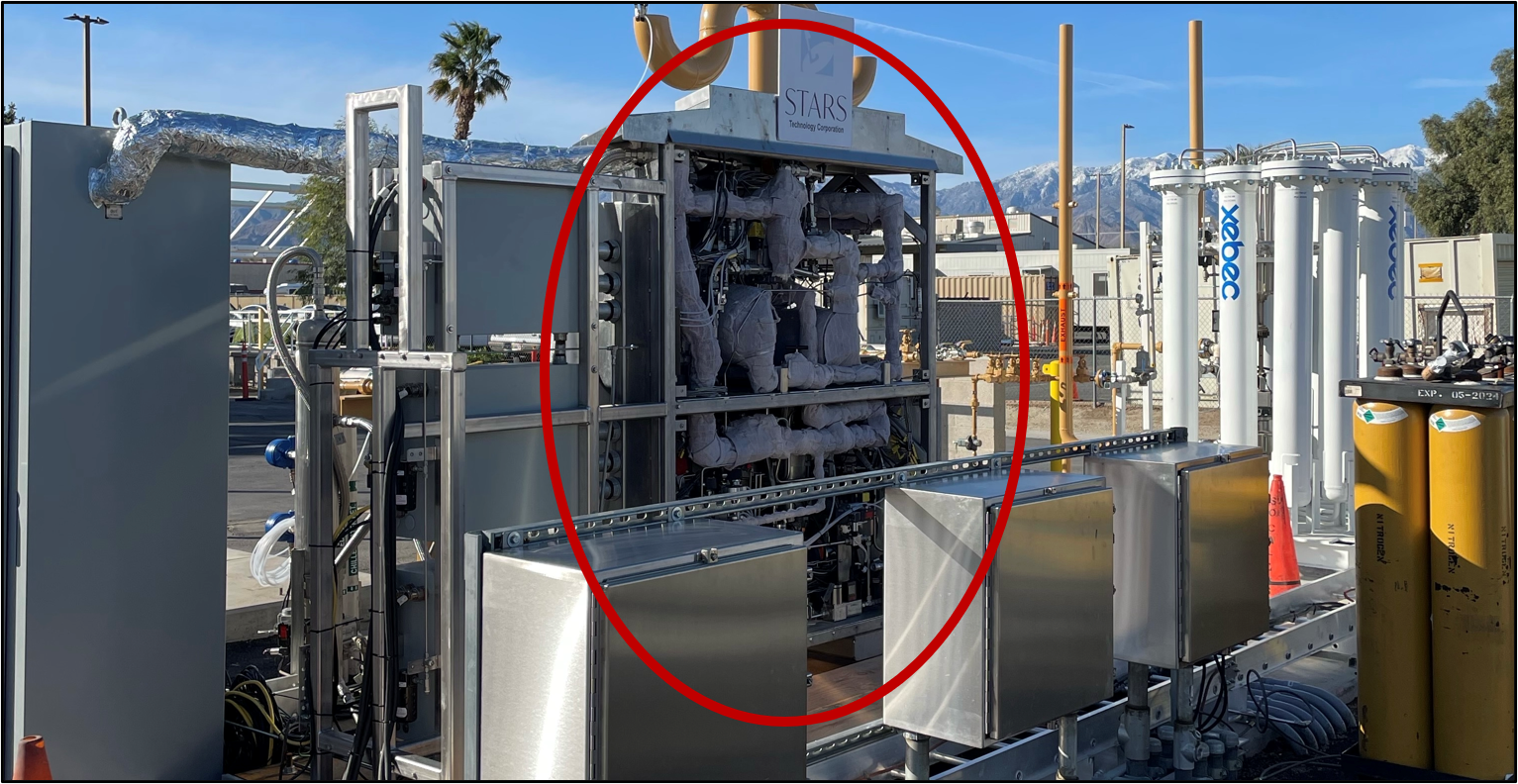
STARS Technology Corporation's advanced Steam Methane Reforming (SMR) technology enables production of hydrogen from water and methane in components that are 1/100th the size of competing technologies
STARS technology has created a state-of-the-art hydrogen generator, a steam methane reformer ( SMR), which can be added to the natural fuel lines to produce hydrogen fuel. Walters states the system works by “Transforming the natural gas to hydrogen onsite in a modular system that has an input from water and methane at the front of the system and an output of hydrogen at the back end of the system.” This technology requires no additional drilling or piping, and the generator can be attached to the already present natural gas grid. What makes STARS technology different from other hydrogen reformers is that STARS technology uses,“ 1/100th the volume of conventional hardware” explained Walters. It also takes only milliseconds compared to together models, which take tens of seconds.

This is a hydrogen generator at a strategic location where natural gas is turned into hydrogen to power buses. Similar generators
could be used power hydrogen buses in Hawaii.
By producing the same amount of hydrogen as conventional system that are 100x larger, the STARS hydrogen generator provides an alternative to large central production plants. Because hydrogen can be produced on site to charge buses and other verhicles there is no need to transport the hydrogen,. This cuts hydrogen costs down by over 50%.
The bottom line is that this state-of-the-art technology can completely change the renewable energy field because it is the first of its kind to be eco-friendly and has comparable costs to fossil fuels. After a successful two year trial run of using STARS technology to supply hydrogen energy for public buses in California, the company is hopeful that mass production and delivery of the generators can begin in 2026 and commercial use of the technology will soon follow.

Dennis Walters, STARS Technology Corporation Chief of Staff
A system like this hydrogen generator could be a game changer in areas of limited space, such as Hawaii. Hawaii has been pushing for clean energy practices and after severe backlash from the wind farms on Oahu, hydrogen energy could be the solution. While Hawaii predominantly uses propane for its energy, small changes can be made to incorporate the production of methane in Hawaii, such as hemp farming, which has methane as a byproduct. If methane was accessible on the island, the hydrogen generator could be incorporated on the island at a low cost and would help Hawaii reach its goal of 100% clean energy by 2045.
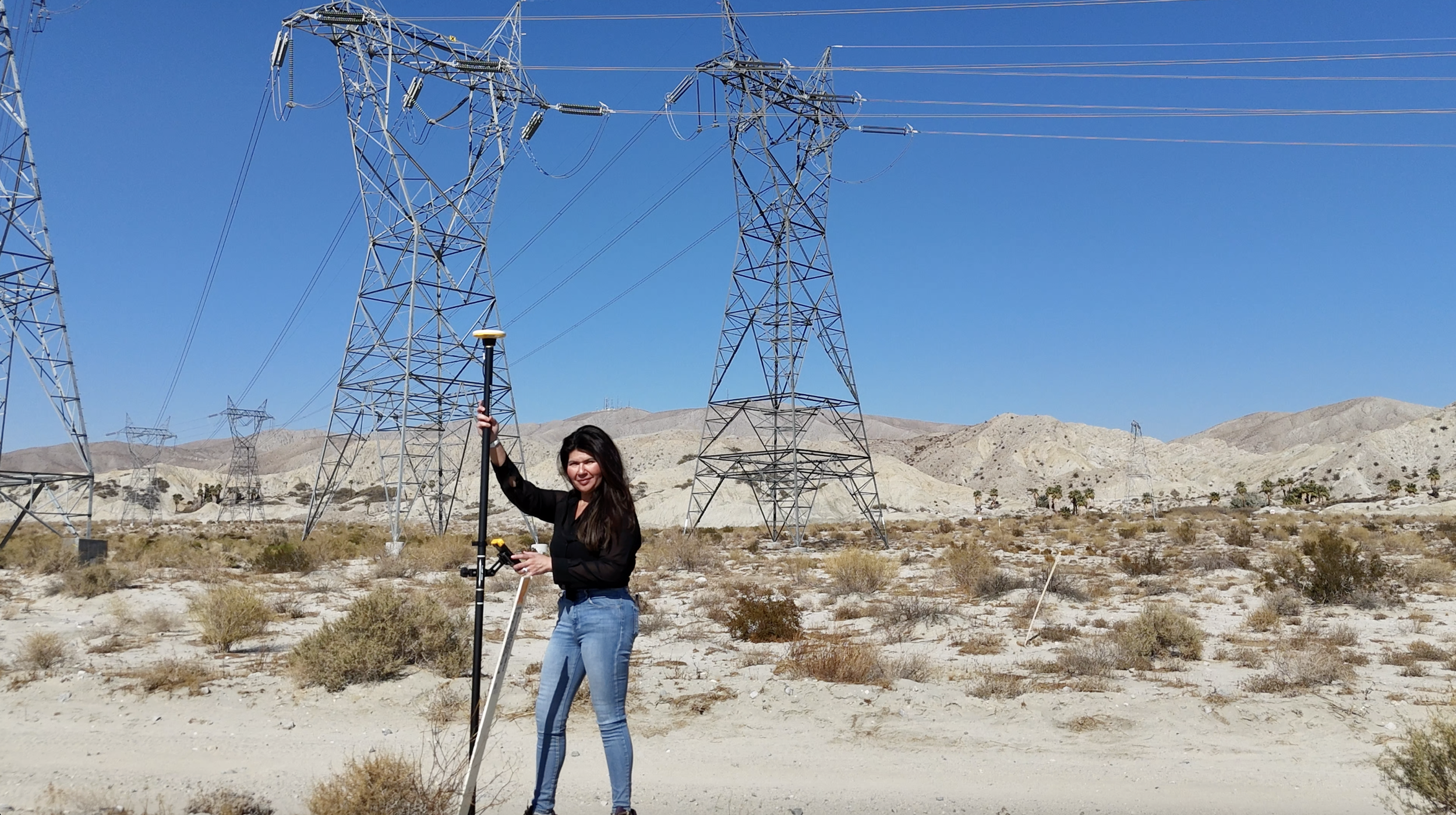
Jacky Bainum, president I-NALYTICS setting up a GIS measuring point in a utility easement near the San Andreas fault in California
I-NALYTICS - A valuable new tool in renewable energy management
By Jocelyn Stara
I-NALYTICS is a company created to take Geographic Information System (GIS) mapping and utilize its many applications to benefit local communities. As Jacky Barnum, company president and owner says:“You cannot put solar panels in an area with insufficient sunlight or a wind turbine in an area within insufficient wind coverage. The planning and data needs for new energy plants need to be recorded on on-line maps to find the optimal locations. It can be a long and tedious process. With their technology and data, collection tools (Trmble units (https://utilities.trimble.com/en-us/products/mobile-devices), heat sensors, drones etc), I-NALYTICS staff can collect data and portray where resources should go.”

Biofuels plant at Kawaihae, on the Island of Hawaii, which was measured using GIS technology
Barnum became interested in using GIS technology while a student at Hawaii Pacific University (HPU). She later received a degree in business management from Texas A and M University. “The introduction to the GIS class I took at HPU in 2003 opened my eyes to the power of data visualization for individuals and organizations. The Tribal government I have been working for is Cabazon Band of Cahuilla Indians and I was both the Director of Planning and Operations and the Interim General Manager for the Cabazon Tribal Utility Authority. When I began working with Tribal governments and resource management, I noticed the inefficiencies of using paper log books, notes, and maps. High turnover rates resulted in work products within Tribal governments being lost during transitions, leading to constant recreation of these materials. This situation causes critical information to be unavailable or poorly communicated to Tribal Councils, who depend on staff-provided information to make decisions. It also results in wasted funds. Many of these Tribal programs are grant funded.To address these issues, I founded I-nalytics. My goal was to deliver cost savings and mitigate the impact of employee turnover by digitizing assets and data points. We consolidate these vital pieces of information into a database and analyze the data spatially. This allows us to create maps that help decision-makers visualize data and make informed choices.”

Jacky Barnum president and founder of I-NALYTICS. Former director Director of Planning and Operations and the Interim General Manager for the Cabazon Tribal Utility Authority
I-NALYTICS has used GIS mapping and data analysis to benefit communities in different ways, such as creating a central data base for all utilities in a Native American community and performing wetland assessments. The usage of GIS tracking would be valuable in the renewable energy field due to its ability to map prime locations for different energy sources whether it is solar, wind, or wave energy. Once inputted into GIS maps, the information allows energy planners and developers to to better explain in the clearest possible way the optimal ways to plan for renewables in every community; specifically by showing people quickly where and where not renewable resources should be located. As Barnum says I-NALYTICS can collect data and portray it in a way that tells a story, whether it is through a heat map, spatial interpolation, or other styles of visually representing data. The implications and uses are almost infinite”
How I-NALYTICS could benefit Hawaii.
As Hawaii moved towards making the Islands 100% renewable by 2045 community engagement is key, One of her clients is a group of Hawaii businessmen developing a biomass plant on the the Big Island which plans to grow industrial hemp and burn it as biomass to create electricity. As Barnum says,
“When thinking of mapping and its utilizations, most companies only think of mapping in its literal sense such as portraying aerial ground footage or land masses. With modern-day technology and its advancements, the implications of mapping are so much more than an x-y coordinate map and would highly benefit the renewable energy field. A prime example of this would be if the city of Honolulu partnered with I-NALYTICS o take the highly dense populated area of Honolulu and create a map showing which areas would benefit the most from solar panels and which locations would create the most efficient solar energy. They would be able to create different visual maps showing potential layouts for the solar panels and show which allow for the highest rates of efficiency. Solar energy is not the only form of renewable energy that could benefit from using the technology and data analysis from I-NALYTICS, wind energy and wave energy could also benefit.”
The wide range of data collection tools allows I-NALYTICS to be widely versatile and work in many different scenarios. Hawaii could also use the technology to help map the different invasive species in Hawaii to help the removal and restoration process currently being done on Island. By using the power of community engagement and technological advancements, I-NALYTICS allows communities the opportunity to make more informed decisions and future plans through data analysis. As Barnum says “ It is the ability to breathe life into the data, so it is not static , that allows it to tell a story."
End


Can Coconut Trees Save the Big Island Economy?
Michael Markrich Photo

Hawaii Coconut Tree - Michael Markrich Photo - Copyright
Michael Markrich Copyright 2024
The Big Island economy has recently elected a new mayor, Dr. Kimo Almeida. He takes over an economy that has spent much of the last four years recovering from the impacts of COVID 19. The local cost of living is high, affordable housing is difficult to find and there are few jobs paying enough for people to support a family. In a trifecta of problems; the Hawaii Supreme Court ruled 5-0 against the operation of the 520 million dollar - Hu Honua biomass plant in Pepeekeo (1) leaving the state-of- the- art plant a stranded asset, large numbers of families out of work and 20,000 acres of flammable eucalyptus trees standing with no place to go.

AJ Perkins - Instant On Energy - Native Hawaiian renewable energy specialist
A New Vision
But where some see problems Native Hawaiian Entrepreneur and microgrid/hydrogen specialist, AJ Perkins sees opportunity. Perkins proposes replacing eucalyptus trees with coconut plantations to produce Sustainable Aviation Fuel (SAF), a sector experiencing a significant surge in demand. According to a report from the US Energy Information Administration (EIA) (2) demand for SAF has grown 1400% in the last year to meet the new demand for SAF in which coconut oil could be a key ingredient. Perkins believes that reviving coconuts, one of Hawaii's original canoe crops, could be one of the components to economic revitalization, alongside other promising sectors such as renewable energy, hydrogen production, and geothermal power. SAF is a drop-in fuel in which green waste products, such as restaurant waste, wood chips and other bio fuels are mixed with aviation fuel as a ‘drop in’ ingredient to reduce CO2 There is a shortage of these products and coconut with its high burn rate is highly sought after (3). “I have a client in the Philippines who supplies coconut shells to two power producers in Japan. He recently signed a SAF off-take agreement with a manufacturer," Perkins says. "He tells me that he will buy all the coconuts I we can grow.” (4). There are cavaeats however. In order for this vision to be realized in Hawaii, potential growers must deal with the uncertainty of whether the new Trump Administration will support SAF fuels and whether the growing the coconuts as a crop will be possible without making worse the existing coconut rhinoceros beetle problem.
The Coconut Advantage
Perkins pecifically mentions that 40,000 acres of agricultural land in Hamakua could host 115 million coconut trees, maturing in just four years. With global demand for sustainable aviation fuel (SAF) surging, this initiative could bring more jobs and revenue to the Big Island than any crop since the sugarcane era. “The potential for Hawaii to lead in SAF production is extraordinary,” he says. "This isn’t just about economic growth; it’s about aligning our islands with global sustainability goals." Coconuts offer a unique advantage. They’re tough, thriving in conditions where other crops fail—saline soils, dry landscapes, even barren hillsides. They need minimal water and care, yet they provide a wealth of products: SAF feedstock from husks, coconut milk, and oil.
Beyond agriculture, this effort could spark a rise in eco-tourism, drawing visitors eager to see Hawaii’s innovative sustainability practices in action. It’s an opportunity to revitalize communities like Hamakua while showcasing a model of green development to the world. This is our chance to lead, to solve today’s challenges, and to inspire the world. (5)

Global Context and Challenges
Hawaii is of course not alone in this. Millions of acres of Coconut trees in the Philippines, Indonesia and Vietnam are also heavily involved and invested in SAF. The reason for this is a recent decision by the International Civil Aviation Organization (ICAO) to include non-standard coconuts (coconuts with cracks and mold) as an internationally accepted biofuel feedstock. There are an estimated 1.5 - 5 million metric tons of non-standard coconuts produced per year. This is considered insufficient to meet present world demand for renewable jet fuel. The estimated global demand from mandated SAF is anticipated to reach 16 million Mt or more by 2030. (6)
Japan alone anticipates that its SAF demand will reach 10.8mn bl/yr (nearly 460 million gallons) per year by 2030. This is because Japan’s ministry of trade and industry Meti) is in the process of mandating that 10 percent of all airlines in Japan by volume be SAF.)

US Energy Information Administration Short Term Energy Outlook
The reason for the shortage is the lack of sustainable sources of sources of feedstock for renewable green jet fuel to meet demand. Used cooking oil does not exist in enough quantity to meet demand and palm oil is not suitable because it does not meet ICAO standards as a “sustainable” crop.
The first flights using sustainable aviation fuel (SAF) were successfully refueled in Vietnam on Oct. 17 and departed from Tan Son Nhat International Airport in Ho Chi Minh City. (8)
Two flights using SAF operated by Vietjet have departed from Vietnam to Melbourne (Australia) and Seoul (Incheon, South Korea), with the sustainable fuel provided by Petrolimex Aviation. They estimate that SAF can reduce carbon emissions by up to 80% compared to traditional fossil fuels. (9)
Caution is warranted though. Some aviation experts such as Stan Osserman believe that people should be aware that this is not a simple process and the chemical standards for SAF are still being determined.
Others have questioned whether Hawaii, as a sub-tropical climate, is a good place for coconut tree crops and raise concerns about exacerbating problems with the destructive rhino beetle. The rhinoceros beetle, which was first found on Oahu in 2013 and in Waikoloa ten years later is already a significant pest. In Samoa where it has been for more than century it has been successfully contained through integrated pest management. The beetle can be controlled but not eradicated. (10)“I have talked to coconut experts in the Philippines (the Philippines is the world leader in coconut production) and they tell me that Hawaii is an ideal place for growing coconut trees. They also have dealt with the coconut rhinoceros beetle issue (CRB)” says Perkins, who has been in communication with the Dean of the University of Hawaii College of Agriculture.
The rhinoceros beetle issue has been dealt with extensively where ever coconut trees are grown and are generally kept under control through insecticides or biological controls. According to Greg Takeshima , Acting Plant Administrator, Hawaii Department of Agriculture, Plant Industry Division the CRB is presently under control in Hawaii (10)
However, media outlets and environmental organizations have expressed concern that the CRB is seriously threatening Hawaii’s ecosystem. (11)
The other issues are whether if to control the CRB, pesticides need to be applied to the trees, can they be safely incinerated. At least one report bty the USDA there is no danger of this at high temperatures. 12
Lastly there is the question of whether the incoming Trump administration will support the production of SAF. Will they continue the Biden
Administration popular Clean Fuel Production Credit (CFPC) that supports Bio-fuels. There is some thought they will because many ethanol producers in the Midwest have been significant supporters of President Trump.13 https://adi-analytics.com/2024/11/20/policy-shifts-in-trumps-second-term-could-threaten-u-s-saf-and-biofuel-progress/. However it must be stated that if tariffs on foreign biofuel feedstock goes into the effect, the value of Hawaii grown coconuts in the US market could be very advantageous,
Advantages to Hawaii
The advantage of raising coconuts in Hawaii, according to AJ Perkins, is not only a great return but the process is fairly benign. Coconut trees use relatively small amount of water, they actually can grow in salt water, they can be grown on barren hillsides, and they don’t require a lot of capital or labor to maintain. The husks for SAF do not have to be picked from the trees; they can be collected from the ground. There is a market for the husks, the coconut milk and the coconut oil.
Eucalyptus trees are known for their high flammability due to their oil-rich leaves, loose bark, and flammable litter, making them a significant fire hazard in many areas. In contrast, coconut trees are believed to be less fire-prone due to their higher moisture content, lack of volatile oils, and different bark structure, potentially offering a safer alternative in fire-susceptible regions.
This is why this may be the ideal crop to replace eucalyptus in Hamakua says Perkins.
Coconut shells offer significant advantages as a biomass fuel source, including sustainability as a waste product, carbon neutrality due to their growth cycle, and the reduction of agricultural waste. By utilizing coconut shells for energy production, power plants can contribute to a more circular economy while potentially providing additional income for coconut farmers. With coconuts as a feed stock the Hu Honua plant can likely meet more exacting environmental emission standards because it burns hotter and people on the Big Island employed as the economy goes to work to satisfy the demands of this new SAF era
A Path Forward
While Perkins is on a mission to help make the Big Island the "First Hydrogen County in the US", he also remains optimistic about Hawaii's potential as an ideal location for coconut cultivation. If successful, this initiative could transform idle lands into productive assets, providing employment opportunities and aligning Hawaii with global sustainability efforts.
"Challenges still exist," Perkins acknowledges, "but coconuts could be a game-changer. They offer a real opportunity to revitalize the Big Island's economy by capitalizing on the growing sustainable aviation fuel market and tapping into Hawaii’s unique agricultural potential."
References
https://www.civilbeat.org/2023/03/hawaii-supreme-court-unanimously-rejects-big-islands-hu-honua-power-project/2.(2) (https://www.eia.gov/todayinenergy/detail.php?id=62504) (3) https://www.mckinsey.com/~/media/mckinsey/industries/travel%20transport%20and%20logistics/our%20insights/scaling%20sustainable%20aviation%20fuel%20today%20for%20clean%20skies%20tomorrow/clean-skies-for-tomorrow.pdf 4Personal interview with Al Perkins Nov 12 2024 (4).Ibid (5) ibid (6) https://www.reccessary.com/en/news/id-technology/indonesia-plans-develop-coconut-based-sustainable-aviation-fuel (7)https://www.icf.com/insights/aviation/saf-ecosystem-in-japan,https://www.resourcewise.com/environmental-blog/driving-change-in-aviation-japan-announces-10-saf-mandate (8) https://en.vietnamplus.vn/vietjet-launches-first-flights-using-sustainable-aviation-fuel-post300465.vnp
(9) https://en.vietnamplus.vn/vietjet-launches-first-flights-using-sustainable-aviation-fuel-post300465.vnp 10. Personal Email from Mr. Takeshima Nov 26, 2024 11) https://www.civilbeat.org/2024/10/coconut-rhinoceros-beetles-deal-fatal-blow-to-hawaii-palm-trees/ 12https://www.srs.fs.usda.gov/pubs/ja/ja_bush001.pdf 13https://adi-analytics.com/2024/11/20/policy-shifts-in-trumps-second-term-could-threaten-u-s-saf-and-biofuel-progress/

Should We Take Precautionary Measures to Prevent a Hamakua Fire?
Is it time to look at Hamakua again?
“Eucalyptus is the fire equivalent of the Cane toad. They are growing in places they were never meant to be.”
- Professor David Bowman
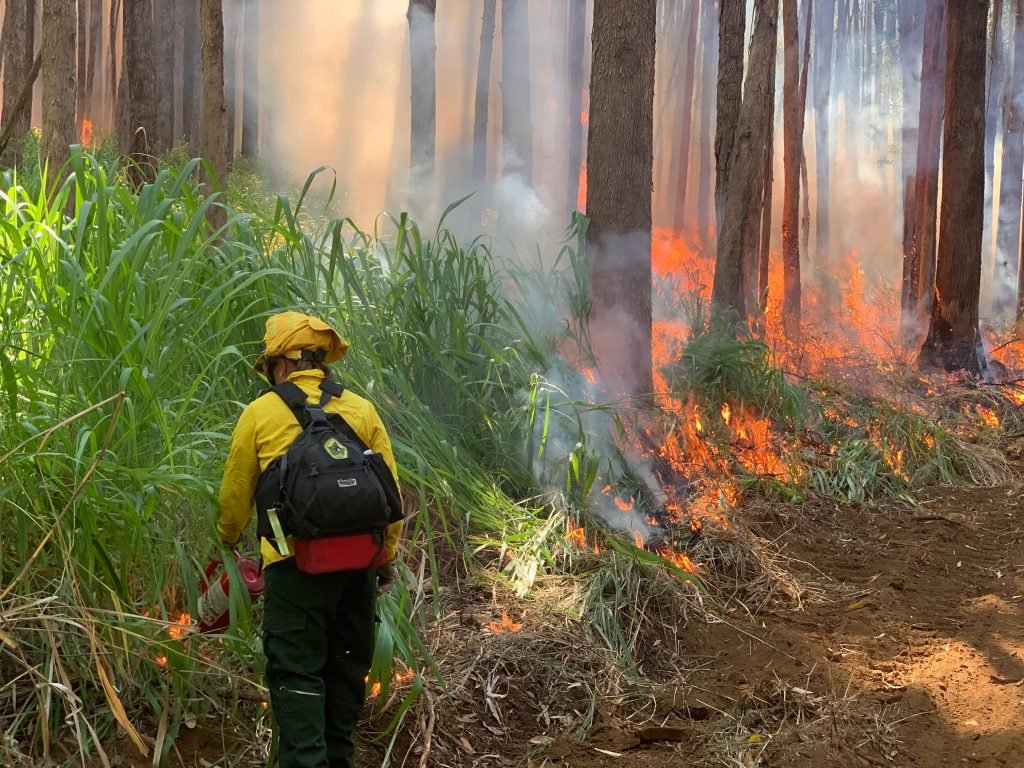
Fire on Hamakua Coast - State of Hawaii Department of Land and Natural Resources photo
Is the danger of a Hamakua fire worth taking the precautionary measures to prevent it?
By Michael Markrich
There were many warnings that preceded the Maui Fire of August 8, 2023. Newspaper articles, scientific journals, and members of the community from 2018 and all expressed their repeated concerns about the flammable dry grasses, eucalyptus groves, and other flammable plants in the open areas where sugar had once been carefully cultivated. All of the warnings demanded the same thing: that state and county governments acknowledge the increasing heat, drought, and risk of fire and take action to reduce the fire risk - but this was done in a meaningful way. No one should have been surprised when the devastating fire occurred. Students of Hawaiian history know this because we have all been here before.
https://www.washingtonpost.com/weather/2023/08/22/maui-fire-2018-lahaina-warning/
On July 3, 1901, it was reported that a Native Hawaiian worker accidentally set dry brush alight, which caused a forest fire that burned in Hamakua for three months. The fire, which took place after a serious drought, was such a disaster that it led to the reorganization of the Territorial Government. (1902 Governor’s Report of the Commissioner of Agriculture and Forestry)
If a Hamakua fire of similar intensity broke out today and spread to Hilo, there is a possibility that the damage and the loss of life could be as great, or greater than, what took place on Maui in 2023.

The specific problem is the 20,000 eucalyptus trees of the species Eucalyptus Grandis in thickly planted tree plantation groves. This is what remains of the 30,000 acres of eucalyptus trees planted in plantation rows since 1995 as a potential biomass crop, in an experiment partially funded in part by the US Department of Energy short rotation Woody Crops Program (https://www.fs.usda.gov/psw/publications/documents/psw_gtr137/psw_gtr137.pdf ).
Eucalyptus contains oils in its wood and leaves that make it extremely flammable and therefore a good candidate for biofuel. Biofuels in the form of sugar bagasse historically played a big role in plantation economics as they covered nearly all of the power costs of the factories, with the remainder sold to the local power companies. It has been more than 20 years since the sugar plantations operated. But the flammable grasses and trees that were once part of the old sugar ecosystem remain. (https://www.sciencedirect.com/science/article/abs/pii/0960852491901195)
Although this eucalyptus variety was said to be chosen for being less flammable than others, no one can be certain what would happen in the case of an extended dry spell.
The potential risk of today’s situation comes to our attention because Hawaii is experiencing an El Nino-related drought. (https://www.governing.com/climate/hawaiis-drought-expected-to-continue-into-2024) Although most of the fire risk on the island is presently thought to be in the dryer areas of the island in Kona - Hamakua could once again suffer from an extended dry spell that would make a dangerous eucalyptus fire possible. Adding to that danger is the presence of flammable grasses and albizia trees. One cannot forget that this summer there have been wildfires on Oahu, Maui, Kauai, and the Big Island.
The eucalyptus tree canopy is abnormally broad because the trees have been growing for many years and the eucalyptus tree’s natural predator, the koala bear, is not present. The koala bears feed off the eucalyptus leaves in the leaf canopy and reduce its size. Because the eucalyptus trees contain natural oils that are very flammable, if a fire broke out among the leaves, it would be difficult to control.
To compound the risk, there is little access in and out. In the event of an intense fire, evacuating more than 16,486 people (US Census 2010), residents, and tourists who live in the small towns, villages, and farms in the area would be very difficult. Were the fire to reach Hilo, the danger could be catastrophic and potentially dwarf the $5.5 billion suffered as a result of the Maui Fire.
Faced with this severe risk, why haven’t the trees been removed? The problem is one of politics and missed opportunity. The original plan to harvest the trees and burn them as biomass in an old but upgraded sugar plantation power plant to generate electricity and sell the power to the Hawaii Electric Light Company grid was turned down by the Hawaii Public Utilities Commission in 2022. The principal opposition to the plan was that the burning wood generated by the company HuHonua Bioenergy LLC was a threat to the environment. It would potentially release 8 million metric tons of carbon dioxide into the upper atmosphere over 30 years. The fire plume from burning wood contains more carbon dioxide than coal or natural gas. It would have also cost the Big Island energy consumers an additional 7 cents per kWh or $10.97 in their monthly bills. This PUC ruling was upheld in a unanimous decision by the Hawaii Supreme Court as the project was deemed not to be in the best interests of the people of Hawaii. (https://www.civilbeat.org/2023/03/hawaii-supreme-court-unanimously-rejects-big-islands-hu-honua-power-project/)
But what would happen if there was a sevrere drought and a catastrophic fire of 20,000 acres of abnormally large eucalyptus trees burned as in California. Wouldn’t the sudden release of that carbon dioxide into the upper atmosphere be worse? This is to say nothing of the calamity; this would result in lost lives and property damage and in the ability of Hawaii residents to get future homeowners insurance.
As a consequence, no action was taken to significantly reduce the number of trees, and the fire risk grows each year.
Critics of this decision would answer that these concerns from a strictly environmental perspective are correct. But there are other things to be considered. After all, eucalyptus as a member of the myrtle family, is important to the local Hawaii flora industry, which is valued at $47 million dollars. Here and on the mainland myrtle plays a key role in floral arrangements. People in the floral industry believe for this reason that a certain amount is necessary for Hawaii’s economy. The issue in Hawaii was compounded by the decision by Governor David Ige in 2020 (https://hdoa.hawaii.gov/blog/main/nr20-07myrtleimportban/) to restrict the importation of plants, plant parts and seeds from the myrtle family (of which eucalyptus is one) to prevent importation of plant fungus and diseases that threaten the ohia trees.. This has meant that local florists are now dependent on small locally grown eucalyptus plants.
How did we get into this complicated situation?
The story of the danger facing Hawaii can be traced back to 1835, when foresters in Australia discovered huge groves of naturally growing eucalyptus. The eucalyptus grew very fast, and because its resin has natural protective toxins and few predators, it was easy to plant. Foresters exported it to areas all over the world that needed reforestation of hillsides so that they could create watersheds on barren hillsides that would help commercial crops like sugar grow. The trees grow rapidly, and because of their toxic resins, they have no natural enemies in the places they were planted. The export of the trees to places like Hawaii, California, Chile, and Portugal was a successful business for 200 years. Then the world got hotter and the problems began. (https://www.abc.net.au/news/2023-09-09/wildfires-portugal-greece-california-hawaii-euclyptus-trees/102760264)
According to Australian Botanist Tim Curran, the following characterizes eucalyptus:
"The first point is that eucalyptus do have inherently flammable foliage," he said. "The second point, and this is probably the more important one in terms of why eucalypts change fire regimes, particularly in other parts of the world, is that they produce a lot of flammable material in the leaf litter layer … known as fine fuels."
"The other thing that eucalypts do, which helps a wildfire run through a landscape, is that they can cast their burning embers ahead of the fire front. The peeling bark that curls up the side of a gum tree can be swept up to 30 kilometers ahead of a fire.”
“All of these things combine to make eucalypt forests particularly flammable parts of the landscape in those environments they've been introduced to." - Dr. Tim Curran
In addition to this, Hawaii lacks the koala bears that live in eucalyptus trees in Australia, reducing the number of leaves in the tree canopy and thereby reducing the risk of fire. When this factor is combined with higher temperatures and the possibility of fire, the danger of strong fires intensifies.
A review of the recent fires in California over the last 20 years points to eucalyptus as playing a significant role. These fires across California have been catastrophic since 1991, and most of these have been made much worse by the rapid burning of eucalyptus. The 1991 fires killed 25 people, injured 150, and burned 2,843 single-family homes and 437 apartment and condominium units. The fires have grown in intensity each year. 2024 is now said to be the worst fire year in California’s history. Efforts to remove the trees, even knowing that they were a potential danger, were turned down in the courts after the Oakland fire of 1991 because of environmental lawsuits. (https://www.berkeleyside.org/2016/09/19/fema-pulls-funding-for-tree-clearing-in-berkeley-hills)
No one had ever intended Hawaii’s eucalyptus groves, which are said to be a less flammable species from South Africa, to grow so large or last so long, but each time a suggestion was found to cut and export the crop, i.e., turn it into pulp for sales to Japan, the deals fell through. Only 10,000 of the 30,000 acres of eucalyptus have been harvested. This leaves the Big Island with eucalyptus trees spread over a vast area with tall trees and a broad canopy of flammable leaves and - presently - no economic way to harvest them. This has already created a fire problem. The Hawaii State Department of Land and Natural Resources has already warned about the possibility of brush fires in the area. (https://www.staradvertiser.com/2021/06/05/breaking-news/multiple-agencies-contain-1400-acre-wildfire-on-hamakua-coast/)
The Alternatives
1) Hold a forestry conference in Hamakua that looks at the future of the forest and weighs all different kinds of possibilities. The Hamakua community would be brought together with land owners, state agencies, specialists from Hawaii Community College, the University of Hawaii, the National Forest Service, the US Department of Agriculture and tropical forest experts from throughout the world, to make a long term plan for the forest. Look for more ways that Hawaii wood craftsmen could make use of local wood for different purposes for art or constuction.
2) Removing the eucalyptus groves in Hamakua would likely cost more than $5,000 per acre. The tree stumps must also be removed, and care has to be taken to remove spores that can regenerate. The vast amounts of wood have to be sold or disposed of. Considering this cost would be nearly more than $100 million, there is little interest in this. It would be unfair to the land owners.
3) Another alternative is to simply cut the trees and leave them to rot on the land in the forest and leave it to the landowners to clear. But this also has potential economic difficulties, as the wood would get wet and rot on the land. If large amounts of the wood dries, it would be fire fuel in the forest and the risk of fire would increase.
4) The other possibility is to resume harvesting the remaining trees and reconsider restarting Hu Honua LLC for a limited time. Perhaps a way could be found to mitigate the pollution through carbon capture of some kind. Forestry professor Orlo Steele of Hawaii Community College has said that the modern stainless steel technology used by the plant, makes use of the stems and not the leafy parts of the trees so less carbon is released. He writes “Basically bio-energy is the only kind of fuel that can be carbon negative as it draws down CO2 during the process of photosynthesis more efficiently than any other system. In the case of trees used for biofuel, carbon is stored in the various plant parts with most of it staying in the soil in the form roots, leaf and twig turn over and after harvest residue. Hu Honua is only chipping the stems, which are burned to run the steam generator where the CO2 is filtered and scrubbed so no smoke and almost no CO2 is released.” (Steele email 2024) If a way also could be found to reduce costs for ratepayers, this would be the cheapest, fastest way to reduce the number of tall eucalyptus trees through a forestry program. It is likely the biomass to fuel process to create electricity - would be less risky than the potential losses that would come from a a catastrophic blaze. However, this is controversial because many people on the Big Island don’t think any burning of biomass should take place.
5) Encourage the growth of controlled stands of eucalyptus for the protection and benefit of Hawaii’s valuable floral industry. But look for alternative woods during a period of agricultural transition. Coconut trees have been proposed for the purpose of creating - high value bio gas from coconut oil. This is currently being done in Indonesia and the Philippines. Coconut plantations have a long history in the Western Pacific.
6) Lastly, the other alternative is to disregard all warnings and hope what happened on Maui on August 8, 2023, and in Hamakua July 3, 1901, doesn’t happen again. In 1901, it was convenient to blame a single Native Hawaiian for the catastrophe. In today’s world, if something were to happen many more of us in Hawaii would be to blame.
Copyright 2024

“Native Americans and Renewable Energy” Program Speakers
Learn about our “Native Americans and Renewable Energy” program speakers!
Meet our May 23rd “Native Americans and Renewable Energy” program speakers!

Keynote Speaker
Dr. Dawn Davis
Dr. Dawn Davis holds a PhD from the University of Idaho and is a post-doctoral researcher in the Energy Systems Department at Idaho National Laboratory. She is presently researching water and power resilience and their impacts on marginalized and rural communities. Twice a recipient of National Science Foundation grants she has done groundbreaking research on the use of Peyote as a sentinel species and work in the Natural and Water Resources space around law, management, and policy in Idaho and across the Nation. She is a citizen of the Shoshone-Bannock Tribes and is the author of numerous publications.
Read some of her work here: https://www.water-alternatives.org/index.php/alldoc/articles/vol16/v16issue2/707-a16-2-10/file
Jacqui Hoover
Jacqui is the Executive Director and COO of the Hawaii Island Economic Development Board. She is of Native Hawaiian and Navajo Nation ancestry and is familiar with how renewable energy projects impact Native peoples in the US.

AJ Perkins
A Kamehameha School and University of Hawaii graduate. He is an author and successful entrepreneur. He is the Director of Strategy and Development at Tech Flow, one of California’s leading microgrid integrator companies. He is also the executive director of the Native & Indigenous Coalition for Clean Earth.
Exciting New Native American Renewable Energy Projects
Courtesy of Bureau of Indian Affairs
The US Bureau of Indian Affairs Branch of Renewable and Distributed Generation provides financing and renewable energy guidance for projects that impact 2.7 million Native Americans. There are 574 recognized tribes in the US in addition to Alaska Natives. The BIA work presently encompasses the efforts of 144 tribes in 25 states to become energy self-sufficient and encompasses everything from geothermal proposals in Alaska to vast renewable solar farms in Colorado and South Dakota. In 2022 alone, they provided more than $10 million to Native American funding projects. They have worked closely with the federal Department of Energy Office of Indian Energy and Programs, which has provided funds to 210 tribal energy projects totaling 46 megawatts.
There is interest in determining what lessons can be drawn from these projects for the Department of Hawaiian Homelands (DHHL). Native Hawaiians do not have the same treaty rights as Native Americans, but they can get support for their projects from federal agencies.
The BIA's renewable and distributed energy branch provides “front-end planning.”
Phase 1: Planning and Feasibility
Phase 2: Detailed Scoping and Refinement
Phase 3: Secure Contracts, Permits, and Financing
Each tribe has a different plan, and the BIA helps them fulfill it. The Mountain Ute Tribe, for example, has solar panel farms that cover the entire electricity costs of their casino. They are proposing, together with Canigou Group, the creation of the Sun Bear Solar Farm near Towaoc, which will have 2.2 million solar panels and be eight miles long and one mile wide. The capacity will be 756 MW. The cost will be $1 billion and it will provide power throughout the Western States.
Other projects have been done in Montana for the Fort Peck Assiniboine and Sioux Tribes, who plan to install and operate a 660-kW wind turbine in Poplar, Montana. It will provide an estimated 2,000,000 kilowatt hours that will be “proportionately distributed between the Tribal Building, Fort Peck Community College (FPCC), and Assiniboine & Sioux Tribal Industries.” The project will provide training and jobs for tribal members and a source of inexpensive power for the tribal building, community college, and tribal industry.
Some of the other projects the BIA has been involved in include the Taholah Village Energy Park in Washington State.
The process can be very arduous, but the BIA and the Department of Energy Office of Indian Energy and Programs can point to a number of successes, including the Karuk Tribe in California, Blackfeet Community College in Northwest Montana, and energy efficiency for the Oneida Nation in upstate New York.

Alaska Geothermal Project - An Example for Hawaii?
Photo Courtesy of Dutch Harbor Visitor and Convention Bureau

Courtesy of Dutch Harbor Visitor and Convention Bureau
Makushin Geothermal: An Example for Hawaii?
By Michael Markrich
In what may be an example for Hawaii, the Makushin Geothermal Project is moving forward again in Alaska. The originators of the project, the Qawalangin Tribe Native Village Corporation, the Ounalashka Corp., and Chena Energy Corp., signed a Power Purchase Agreement (PPA) with the Unalaska City Council in 2020 with plans to provide energy to the town by 2024. In March, however, the four-year-old effort had come to stand still after funding for the effort dried up and their PPA was allowed to expire. To date, the originators of the 30 MW project have received only $2.5 million in federal dollars (from the Bureau of Indian Affairs) and a $5 million commitment from the Alaska Energy Authority towards the estimated cost of the $250 million project. A new push by Unalaska City and funds from the Environmental Protection Agency may finally help bring the project to completion.
The Makushin Geothermal Project is designed to provide power to the residents of Unalaska, which is best known for the Port of Dutch Harbor, an ice-free deep-water port in the Bering Sea that processes more than $190 million worth of seafood per year (mostly high-valued halibut, crab, and herring). About 400 vessels use the port, which is also the largest seafood container transshipment terminal in the US. The power is to come from Makushin Volcano, which last erupted in 1991. The volcano is about 13 miles from the town.
Unalaska has 4,500 permanent residents who, like Hawaii, have relied on diesel fuel to power its electrical grid. At present, the price per kilowatt hour in Unalaska is 57 cents. Once geothermal comes online, if all goes well, that cost is expected to fall to between 16 cents and 22 cents per kilowatt hour, making a huge difference. The town currently uses 16 million gallons of diesel fuel per year. The seafood processing plants pay for their own diesel and electricity. The price of diesel is expected to go up significantly in the future.
This project started in 2020 as a joint venture between Bernie Karl, the owner of the Chena Hot Springs Resort, and the Qawalangin Tribe Native Village Corporation. They signed a 50-year lease on the land and heat resources with the State of Alaska for the use of the resource. After that was concluded, they signed a 30-year PPA agreement with the City of Unalaska to provide power from their 30 MW plant.
The Qawalangin tribal members are part of the 180,000 Native Alaskan community in Alaska, and for that reason, they have been able to draw on funds and support from the Bureau of Indian Affairs (BIA) and the Department of Energy Office of Indian Energy Policy and Programs. Because of the seafood industry, the promise of cheap power offers great financial possibilities for the future and income of the tribe and town.
But planning has not all gone smoothly. Unalaska is a remote place, and there are said to be numerous supply chain and financing issues. The project was to have been finished by 2024, but after four extensions and attempted negotiations to either find outside funding or receive a higher price to cover upfront costs, the Unalaska City Corporation pulled its support. The company had requested three previous extensions, and after the fourth request to change the terms of the original agreement, the town council members balked. A number of people said soon after that despite all the effort, the project was ‘dead’.
The CEO of Ounalashka Corp., Natalie Cale, was quoted as saying that it was difficult to find enough funders to cover the costs of the small facility. “This has always been an expensive project. The fact that most of the costs are upfront, with the real savings and benefits (economical and environmental) in the long term, seems lost on lenders.”
A determined effort by Unalaska City leaders, the Alaska Governor, and Alaska US Senators appears to have saved the project. This year, the City of Unalaska made an agreement with the Qawalangin Tribe Native Village Corporation and the Ounalashka Corp. to apply for an Environmental Protection Agency Climate Pollution Reduction Grant. The EPA has $5 billion in the fund and offers up to $500 million for promising projects to states, territories, and tribes with no upfront match needed. If all goes as hoped, the Chena Corporation will be bought out and the project will go forward as a joint venture between the City of Unalaska and the Ounalashka Corp.
Despite the frustrations and setbacks, there is a great consensus that geothermal projects are what Alaska needs to go forward in the next century. Alaska has more active volcanoes than any state besides Hawaii and vast resources for geothermal power. The costs are front-end-loaded. After the initial contract is paid, the power price could drop significantly in the long term. Promoters say that a cost reduction could result in the location of a regional hospital in the area to take advantage of the lower rates.
There have been efforts to get a geothermal project going in Alaska since the 1980s, but this has been the closest to success. Already, Alaska Governor Mike Dunleavy has proposed a new bill (which did not pass) to increase access to geothermal power in Alaska, and Geo Alaska has signed an agreement with Ignis Energy to search for more active geothermal power sites.
Upon completion, this visionary project could be the beginning of more geothermal projects in Alaska.
Note - There are 4.5 million people under the BIA designation, Native Hawaiians are designated ‘Native Americans’ as are Alaska Natives, Native Hawaiians, Chamorros, and American Samoans. The Department of Hawaiian Home Lands comes under a different federal program.
https://alaskapublic.org/2024/03/01/unalaska-pulls-plug-on-makushin-geothermal-project/
https://www.kucb.org/science-environment/2024-02-29/end-of-geothermal-project-blamed-on-funding-troubles-extended-timelines
https://www.thinkgeoenergy.com/despite-setback-unalaska-intends-to-push-on-with-geothermal-project/

Hilo Raceway Park Adapts to the EV Era

By Michael Markrich
At the present time, only 2.8% of Hawaii’s more than 1 million cars are electric vehicles. The acceptance of electric vehicles by large numbers of people is important to Hawaii's transition away from fossil fuels. One way to increase the acceptance of EV cars is by putting them through trials in drag car races as a means to interest young people in driving and racing them. On the mainland, teenagers become interested in learning how to build and race cars because of their interest in race tracks. As more people become accustomed to EV cars, more will be purchased. The EV car races at local hometown tracks also help create a pool of young machinists and “gear heads” that local companies, the government, and others can look to for future talent as mechanics and engineers. For this reason, it might be a good idea to encourage the Hilo Race Track programs, which are managed by the County of Hawaii Parks and Recreation Department, with electric car races and maybe even demonstration projects with new hydrogen-powered “H-Cars.”
The National Hot Rod Association (NHRA) is the biggest racing association in the world. It comprises 75,000 participants and sanctions races on 86 race tracks throughout the United States, including two in Hawaii, the Kauai Racetrack and the Maui Race Track. There is a third race track in Hawaii that is still used by locals but is little known outside of Hawaii: Hilo Raceway Park. It is organized by the Hawaii Drag Racing League (HDRL), which was founded in 2011.
This year in Hawaii, plans are being made to consider electric cars. Recently, a test was done taking Tesla cars down the track.
On the US mainland Electric vehicles have been raced at NHRA events since 2022. Interest now exists to sanction races on the Big Island as part of an effort to encourage interest by a new generation of racing enthusiasts in electric cars.
Unlike combustion engines that have to rev up to reach acceleration, the E cars accelerate instantly. People who advocate for electric cars call this “instant torque.”
The Hilo Raceway Park idea of using electric cars as a separate category is still in the idea stage, but it holds great potential. The market value of the cars, even on a small and isolated track like Hilo, is potentially high as more and more young people turn toward EV car races. Most are battery-electric vehicles (BEVs).
The Tesla Model S Plaid has been the first production car to ever break the 9-second barrier in the quarter mile. Other BEV cars that are popular are the Porsche Taycan, the Audi e-tron GT, and the Ford Mustang Mach E-GT. People are also excited about the potential of the hydrogen fuel cell car, the Toyota Mirai, a Fuel Cell Electric Vehicle (FCEV).
On the Mainland, similar kinds of EV car events have so intently captured the imagination of young people that in 2021, the NHRA started an Electric Junior Dragster Category. There is even a National Electric Hotrod Racing Association. Part of the reason for the excitement is the billions of dollars being poured into the research and development of both BEV and FCEV cars and automobile companies. Automobile companies encourage young people and colleges to engineer, design, and race their own cars because they see the races as places for recruiting a new generation of engineers. This would be an incentive for the University of Hawaii Hilo and the Hawaii Community College engineering and auto repair programs. The other incentive is for renewable energy educators who are trying to reach new households with information about the benefits of EV cars and solar panels.
Those who are excited about the spread of electric cars in Hawaii see this as having great potential.
However, there are still problems that drivers and organizers have to deal with. BEV cars are heavier because they depend on batteries and the batteries have a limited range and need to be charged. The faster they go, the faster the battery drains. There are also questions from race fans. People who go to raceway parks like the spectacle of engines accelerating, which is typical of combustion engines. Some race car fans wonder “whether without the flames and spectacular noise of combustion engines,” things won’t be the same. As one writer put it, “People don’t go to drag races just for the event; they go for the visceral pounding you get from just being there.”
EV races in Hilo, when broadcast, could bring racers to the Big Island from Japan, China, the Mainland, and Europe as racing teams test new ideas and equipment. The track’s revival could bring great economic stimulus to Hilo during a “race week” that encourages more young people to participate. Hawaii has to find a way to increase the percentage of its EV cars to more than 3%, and this may be a way to reach that goal. The excitement and economic potential of this sport for Hilo and the Big Island could not just encourage the adoption of more EV cars by the public; it could also encourage a new generation of racers, auto designers, and race track attendees of all ages.
High School and Community College EV RACING can make Electric Cars Available to Low-Income Communities - And help build valuable skills. By Michael Markrich

Courtesy University of Maryland
Public High Schools throughout the United States are experimenting with new programs to interest their students in cars. In Sacramento, local students are converting ‘low riders’ in the Mexican American community; a spokesperson says this program not only made EV cars available to underserved communities – (important from the standpoint of reducing the dependence on fossil fuels - but it captured the imagination of young people in the class, and made them as one said, “super excited.” In Indiana, this was taken a step further where 120 high school students with EV go carts were encouraged to race around a track in the “Test and Tune EV Grand Prix.” The students get exhilarated by the adrenaline rush and the companionship of building a vehicle and racing it competitively.
In Washington DC, Maryland, Virginia, and Ohio high school students can show off their fuel cell vehicles and sometimes race around a track in an EV Grand Prix In Wisconsin, there is actually a high school racing association where students between 14-19 race cars with special safety features around race tracks. Colleges pay attention to this and sometimes provide scholarships in mechanical engineering. At the University of Maryland, there are regular EV races.
Although car clinics presently exist at the community college level in Hawaii, there is no reason that this cannot start at the high school level and that the University of Hawaii can be part of this trend. Race tracks and car cultures exist on Kauai, on the Island of Hawaii, and on Maui. Honolulu has not had a raceway since 2014.
But this could change. There is presently talk of opening another race park on city land. One reason is that it would discourage the current problem of street racing. (160 drivers are arrested for street racing on Oahu each year) Honolulu Mayor Rick Blangiardi says he supports this idea. It is thought that a new track could largely eliminate this problem. It could make many high school and community college students happy too.
Could a high school EV fuel cell Hawaii Grand Prix be held in Hawaii and make young people excited about going to school again? (And at the same time promote energy equity by reducing fossil fuel use in communities that do not think they can afford EV vehicles.) It seems like trying this would be a win for everyone.
1. https://www.kcra.com/article/sacramento-high-school-students-convert-lowrider-ev/44259843
2. https://www.wishtv.com/news/education/purdue-hosts-electric-vehicle-go-kart-race/
3https://www.cbsnews.com/baltimore/news/2-all-girl-teams-from-md-to-compete-in-electric-vehicle-grand-prix-at-rfk-stadium/
4. https://www.khon2.com/local-news/could-building-a-new-racetrack-stall-illegal-street-racing-advocates-say-it-will/
5 http://racing.umd.edu/
Your Guide to Navigating the Renewable Energy Job Market

Image via Pexels
By Contributing Author Virginia Cooper | learnaliving.co
The renewable energy industry is booming, addressing both environmental concerns and creating new job opportunities. This sector is where economic growth meets ecological responsibility. This article from Renew Rebuild Hawaii gives you a roadmap for securing a job in this promising field. We'll explore educational prerequisites, essential skills, and practical job-hunting strategies. So, let's help you build a career that's as sustainable as the energy you'll be promoting.
Charting Your Educational Journey: What to Study
When aiming for a career in renewable energy, having the right educational background is essential for gaining a competitive edge. Degrees in disciplines like engineering, environmental science, or business with an emphasis on sustainability are particularly advantageous. Such educational paths equip you with the foundational knowledge and skills required in the industry.
Crafting Your Skillset: Hard and Soft Skills
Skills can make or break your job application. On the technical side, proficiency in project management software, data analysis, and an understanding of renewable energy systems can give you an edge. On the flip side, soft skills like effective communication, teamwork, and adaptability are equally critical. Employers look for candidates who not only understand the science but can also collaborate and lead.
Build Lasting Connections: Networking Tips
Networking can be a game-changer. Attend industry-specific seminars, webinars, and workshops. Utilize social media platforms like LinkedIn to connect with professionals in the field. Don't underestimate the power of a well-timed informational interview. Whether you're networking in person or online, the goal is the same: build meaningful relationships that could lead to job referrals or collaborations.
First Rungs on the Ladder: Internships and Starter Roles
Internships and entry-level positions can offer invaluable experience. These roles can range from research assistant to junior project manager in companies focusing on solar, wind, or bioenergy. Leverage your academic network or use platforms like Internships.com to find these openings. Optimize your resume with this free resume builder, tailored for the renewable energy sector, to catch the recruiter's eye.
Direct Approach: Visiting Company Websites
Bypass the noise by going directly to company websites. Companies like Tesla, Vestas, and SunPower often list job openings on their career pages that you won't find on general job boards. This method ensures you're applying to positions that are both current and directly related to your field of interest.
Specialized Search: Renewable Energy Job Boards
Specialized job boards are dedicated exclusively to listings in the renewable energy sector. Their narrow focus can be a time-saver, allowing you to bypass unrelated roles. Moreover, these platforms often feature jobs that are highly aligned with specialized skill sets and career aspirations in renewable energy.
The All-Encompassing Route: Broad Job Boards
General job boards like Indeed or Glassdoor can be useful for finding renewable energy positions, especially when they offer specific categories or filters for such roles. These platforms provide a wide array of opportunities across multiple sectors. To focus your search, use filters to narrow down listings to 'green' or 'renewable energy' jobs.
Branching Out: Alternative Industry Boards
Don't overlook boards that cater to fields tangentially related to renewable energy, like engineering or environmental science job boards. There are websites that can offer roles that, while not directly in renewable energy, still contribute to the sector. These roles can provide valuable experience and even serve as a stepping stone to a more specialized position in renewable energy. By widening your search to include these related fields, you'll increase your opportunities and gain a more comprehensive view of the industry.
The renewable energy industry offers a plethora of opportunities for those armed with the right education, skill set, and job-hunting techniques. Remember, networking can open doors, specialized job boards can streamline your search, and the right internship can kick-start your career. With perseverance and focused strategies, there's no reason why you can't find your niche in this burgeoning, eco-conscious sector.
Renew Rebuild Hawaii is rebooting to focus on energy savings technologies, strategies and best practices that deliver lower energy costs for residents, in particular, for our lower and fixed income communities. Visit our website to learn more!
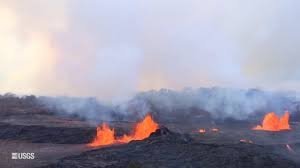
A Look at the Future; A Poem by Dan Gowin

USGS image of Kilauea Volcano
We are at the crossroads. Do we engage in the future and realize what mankind has to offer? Or do we continue the cycle of torment and fear? Mankind has finally realized that we live on a ball of molten rock. That we are but beings living on a crust. A crust in Hawaii that is only 7 kilometers thick. And a World that 70% of its surface is covered by water. If we put together the Heat and Water, mankind can achieve the dream of a infinite power source. Infinite heat, electricity and transportation fuel (hydrogen, ammonia). Or do continue with the age-old battle for the Earths finite resources? Do we continue to battle for the Oil, gas, coal, lithium, cobalt, uranium? Which is it? Continual conflict? Or peaceful existence for the next million years?