Renew Rebuild Hawaii’s Blog
current events, green initiatives, and hot topics
Hawaii Needs More Trees
As Hawaii works to reduce its electrical energy load the emphasis has been on new energy saving technology. The discussion is of more solar panels, batteries and hydrogen. Maybe there is another solution that is equally important: planting more trees. Because Hawaii is steadily losing tree cover.
There are a number reasons for this; an emphasis on the need for new homes to accommodate solar panels. In practice, in some new housing developments on Oahu, trees are deliberately not planted lest they create shade that would reduce their ability to generate electricity. In addition, the practice of building ‘monster homes’ that take up and entire residential lot, and ohana zoning add-ons to existing homes – long established trees are being cut down and removed from older residential neighborhoods. The estimated loss of trees is 5% or approximately 76,000 trees over 4 years. This is affecting our quality of life not just because it affects the beauty of our city but because it increases Honolulu temperatures.
There are a number of reasons for this. As a result of the loss of trees and on going construction on Oahu, our city is getting hotter. This is a result of a number of factors. More than a million tons of oil based asphalt is laid per year. In addition, the construction of the Honolulu rail project and the building of more homes the creation of concrete islands in the middle of streets to slow down speeders, the amount of concrete and asphalt paving has increased substantially. The concrete and asphalt holds heat – creating heat islands.
This is what the State Division of Forestry and Wildlife wrote in its assessment of Honolulu;https://smarttreespacific.net/wp-content/uploads/Tree-Canopy-Report-Honolulu-2016_revised091117.pdf
“Honolulu is losing tree canopy; in fact, we lost nearly 5% of our total urban tree canopy over four years. The majority of losses were in non-public zoning areas. Net Residential losses alone totaled 355 acres representing 39% of all the tree canopy loss; some land use parcels near Kalaeloa Airport saw unprecedented clear cutting resulting in 100% canopy loss. All land use areas saw decreases; even our conservation areas saw a 1% loss in tree canopy. Close to 98% of the losses were less than a quarter acre each and spread widely across the landscape. These losses equate to at least 76,600 trees. New plantings did occur totaling about 230 acres, which is far short of what is needed to keep pace with the losses, especially considering the time required to grow a canopy.”
Maybe before we begin thinking of more dramatic technical solutions to our problems of increasing temperatures in Hawaii, we should take action to restore our tree cover.
Geo-Engineering - CLEARING THE CARBON OUT OF OUR SKY
by Michael Markrich
The problem of global warming is linked to the amount of carbon dioxide in the air. Each year the amount of carbon dioxide in our atmosphere increases. The temperature rises and with every passing day the arctic sea ice melts and the worlds oceans rise. We are now said to be at 1 Celsius level above where the earth was during the industrial revolution and that this is already causing the melting of the arctic ice cap.
The answer scholars say is two fold; emissions reduction and carbon removal from the atmosphere.
There are several methods being taken to reduce the heat by building machines that can either remove (scrub) carbon dioxide from the atmosphere or and or take steps to block sunlight. Ideally both of these things are done at one time.
One technique involves planting billions of trees to suck carbon dioxide emissions out of the atmosphere and then remove them and the carbon dioxide they have absorbed. This is known as Bio-Energy with Carbon Capture and Storage (BECCS). The trees are burned to produce electricity and the carbon dioxide scrubbed out of the air and injected into the earth so it turns to stone. Then more trees are planted, burned and the carbon placed underground.The process is repeated again and again until large amounts of carbon are removed from the atmosphere. Its carbon capture on a large scale. But the problem is so great that even this will likely not be enough.
Each time a volcano erupts and large amounts of sulfur particulates flow into up atmosphere the world cools. Scientist now call the process of cooling the world; solar radiation management. They want to do this now with airplanes in the upper stratosphere that would disburse billions of tons of sulfur into the air and cool the earth
According to the new book ‘Under a White Sky” by Elizabeth Kolbert, people are taking this
So seriously that Harvard University has committed $20 million dollars to the development of geo-engineering projects that do exactly this.
Instead of cloud seeding for rain, we would essentially be blocking the sun with our open air pollutants to block and reflect the sun’s rays. This would cool the earth.
If done correctly this would reduce the melting of arctic ice and make the earth livable again. We would all just have to get used to living under a white sky as people often do when volcanoes release ash in into the atmosphere.
Puerto Rico received $9.6 billion dollars to redevelop its grid. Can Hawaii be far behind?
Puerto Rico suffered such extensive damage to its electrical grid from Hurricane Mara in 2017 that it took 11 months to restore power to the man island. But that was not the end of the challenge. 75% of the grid was damaged beyond repair and thousands died. In 2020 extensive earthquakes caused even more damage. However things are still difficult. On June 10 the grid suffered a power outage that affected millions of people.
In February 2021 HUD approved the release of $1.3 billion dollars to begin the reconstruction of Puerto Ricos power grid. As of June 2021 90% of the $9.6 billion committed to restore the power grid in Puerto Rico has been released.
At the present time only 3% of Puerto Rico’s grid is said to be made up of renewable energy sources. This is in contrast to Hawaii which has an estimated 38% of its power now coming from renewables. HUD is specifying that
The funds be used on renewable sources and there are estimates that if all of homes and buildings in Puerto Rico had solar panels and batteries that the island could reach its 75 % of its 100% renewable goal by 2050.
If the federal government has been willing to invest $9 billion dollars in the upgrading and redevelopment of Puerto Ricos grid is it time to expect a similar commitment to be made in Hawaii?
According Peter Rosegg the HECO spokesman “Puerto Rico's grid suffered vast destruction. Ours needs to be modernized and upgraded. I doubt Puerto Rico and Hawaii are comparable in terms of need. ‘
Information for the above story is summarized from a Miami Herald Story -by Danica Coto from June 16, 2021.
Where will Hawaii be in the Hydrogen Shot?
US Secretary of Energy (DOE) Jennifer Greenholm recently spoke of a ‘Hydrogen Shot” in the way that her predecessors in the 1950s and 60s spoke of a ‘moon shot’ harnessing technology to attain a national goal. But instead of promising a landing on the moon the way that President Jack Kennedy did during the 1960s, her intent is that the US DOE find a way to drop the price of Hydrogen by 80% within a decade. Her stated goal is hydrogen at $1 per kilogram – made by electrolysis from clean energy sources. It is currently $5 per Kilogram.
To achieve this the US DOE is willing to fund demonstration projects in every state and is now looking for proposals. Information from their press lease can be seen below. Its a great time to sending in ideas from Hawaii. Information from the press release regarding the new demonstration program can be found below:
“As part of the launch, at the DOE’s Hydrogen Program Annual Merit Review and Peer Evaluation Meeting, DOE’s Hydrogen Program issued a Request for Information (RFI) on viable hydrogen demonstrations, including specific locations, that can help lower the cost of hydrogen, reduce carbon emissions and local air pollution, create good-paying jobs, and provide benefits to disadvantaged communities. Topics in the RFI include:
Hydrogen Production, Resources, and Infrastructure
End Users for Hydrogen Based on Specific Regions, Cost, and Value Propositions
Greenhouse Gas and Other Pollutant Emissions Reduction Potential
Diversity, Equity, Inclusion (DEI), Jobs, and Environmental Justice
Science and Innovation Needs and Challenges
Responses are due July 7, 2021, by 5 p.m. ET. For more information about this RFI, visit EERE Exchange. For more information on DOE’s efforts to enable at-scale clean hydrogen, visit the Hydrogen Program and the H2@Scale pages.”
NORWAY'S EMERGING HYDROGEN ECONOMY AND ITS LESSONS FOR HAWAII

Aware that it has only limited reserves of oil and the fossil fuels, Norway decided more than ten years ago to pursue an economic strategy of replacing its offshore oil with a modern hydrogen economy. They plan to export both green (made from renewable sources) and blue (made from natural gas). Experts say it is the only reasonable way reduce carbon emissions from transportation because using it with fuel cells to create electricity to power vehicles does not necessitate the use of heavy batteries in uses such as cars, trucks and ships. It produces no carbon footprint - only water and potentially billions of dollars in revenue and hundreds of jobs. Towards this end Norway began to develop a hydrogen fuel cell distribution system along its main roads. Reasoning that when fuel became accessible motorists, truck and bus drivers would follow.
Why should Hawaii with only two or three hydrogen cars be concerned about this? Because hydrogen powering cars, trucks and ships may very likely be "the next big thing". Hawaii can produce abundant green hydrogen with geothermal energy at a low enough price that it could ultimately replace heavy oil and provide fuel not just for Hawaii's transportation system but also provide base power for its grid. However as Norway's experience has shown getting to a hydrogen economy means overcoming obstacles.
Unfortunately an explosion at a UNO-X hydrogen station outside of the capital system of Norway in which three people were injured took place in 2019. Coming soon after a similar explosion at a hydrogen gas station in California, hydrogen plans in Norway were put on hold for six months. Norway's 160 hydrogen powered cars were off the road and their owners unable to find fuel until an investigation was held..
However by January 2020, the problem had been addressed, the company owners fined and a new hydrogen fueling station built outside Oslo. Soon, Norways hydrogen fueling stations were operating again. Norway plans to have 3,000 hydrogen buses and 7,000 trucks on the road by 2030. It is in the process of building a hydrogen fueling network initially through Scandinavia and then gradually through the rest of Europe. If Norway can do this why not Hawaii?
Offshore Wind Presents New Opportunities for Hawaii
The approval by the Biden Administration of the largest offshore windfarm in the United States at Martha Vineyard this week will likely be a game changer for Hawaii. Not only will it green-light the efforts of existing offshore project developers to go forward, if approved it will enable the state to meet its 100% renewable energy goal by 2045, and at the same time provide badly needed jobs and tax revenue.
A discussion on producing offshore wind in Hawaii has been ongoing in Hawaii for more than ten years. By 2015 the Bureau of Ocean Energy Management (BOEM) had reported that two companies had proposed three projects for Hawaii. Although the projects promised the creation of 400 – 800 MW of energy, the effort was shelved during the Trump Administration – which had declared itself opposed to renewables.
The newly approved 3 billion dollar project off Massachusetts with its 62 turbines is estimated to produce enough energy to power 400,000 homes. Eventually they hope to install 3000 turbines along the length of the Atlantic Coast from Maine to North Carolina with 13 projects reportedly under review. The Biden Administration has committed to producing 30 gigawatts of electricity from offshore wind by 2030 powering ten million homes throughout the United States. They hope that the new move to create an offshore wind industry will create 77,000 jobs. It is expected to provide a critical boost to manufacturers, union members and entrepreneurs throughout the United States, including Hawaii.
The proposed Hawaii effort is smaller than the one proposed for Martha’s Vineyard. Both Alpha Wind Energy Hawaii and Progression Hawaii Offshore Wind submitted proposals in 2015 calling for the installation of floating wind turbines, moored to the sea floor to create three large windfarms. These projects, estimated to cost $1.5 billion - $2 billion are planned to be situated off Kaena Point and Waikiki, fully built would be made up of 42 – 50 wind turbines and would be located 12-15 miles from shore. They would collectively generate 800 MW – enough to power 40% all the homes on Oahu. Not only is the technology proven in the US and the North Sea but it is easily transferable to Hawaii’s offshore waters where there are steady winds. The floating platforms would be moored to the ocean floor using technology developed from the offshore drilling industry. The floating platforms on which the wind turbines are mounted - known as Windfloat Technology has been developed in Portugal. Two pilot projects have been successfully installed off the US East Coast so there is a confidence that the offshore technology is sound.
However, approvals will take time as environmental groups gear up to delay the projects for fear of the impacts large open ocean offshore wind farms might have on open ocean fish, birds and marine mammals. There are also likely to be objections from commercial fishermen and from the US military which need freedom of navigation in the area.

An Alpha Wind Energy illustration of what an offshore wind farm might look like in Hawaii

The Park of the Future
Salesforce Park is a green oasis. Some 5 acres in length - or approximately 4 city blocks. It has green walk ways, trees, play grounds, theaters, restaurants, park benches, 600 trees and 16,000 California plants. It boasts dramatic views of the Bay Bridge to Oakland and the blue Pacific ocean beyond.
Visitors to this newest of San Francisco parks never have to worry about dog poop, human waste, dangerous dirty rest rooms, bags of garbage, rats, homeless people, pan handlers or random street crime. My friends tell me it is their favorite park in San Francisco, arguably the US city with the greatest number of beautiful parks.
With professionally paid ambassadors for security on hand, access limited and carefully posted hours of operation, mothers with children, the elderly, and tech people engrossed in conversation never have to fear being assaulted or robbed. It is a private park for the elite – that banishes the ever present problems of urban street crime, pollution, traffic and dogs to a world 70 feet below to the streets of San Francisco.
The enormous amounts of money generated by the tech industry in San Francisco have not gone to any strategic effort to improve, to reform its politics, to make it safer and cleaner. Instead we have this; a city public park as gated community – public space as a visual apartheid.There is no question that this is an enormous technological architectural achievement. However, it is a sad commentary that those with money and influence feel that society will never get safer and those with money must insulate themselves from it.
Hawaii has not yet reached the point of exclusionary public parks, outside of hotels. Our parks are sometimes dirty and dangerous and garbage strewn - despite the best efforts of over taxed parks employees. However, at least they are open to all. San Francisco is often the pace setter for the rest of the country. One can only wonder how much longer it will be until parks here also become like gated communities.

The Park of the Future
The Need For Fire Resistant Lithium-Ion Storage Batteries For Solar Installations by J. Paul Ferreira
Storage Batteries for solar come with certain risks such as overheating, leakage and disposal. In 2019, a 2 MW battery array near Phoenix, Arizona caught fire and later exploded. There have fortunately been no battery fires in Hawaii but the fires at the Utility Arizona Public Service facility have caused solar installers throughout the US and Hawaii to take a second look. Because first responders were injured and the fire took nearly four hours to extinguish, and 9 weeks to fix the problem, the explosion has slowed down the rapid build out of solar battery systems across the US.
In Hawaii of the 6,000 new solar systems installed last year, 80% had lithium - ion batteries.
Proponents of battery usage say that relative to the number of lithium – ion batteries installed in the US every year to store energy they are very safe. Unfortunately, the explosion and the risk of a catastrophic explosion and more than 20 lithium ion batteries in Korea as well as six fires on the US Mainland has caused a reconsideration of the technology.
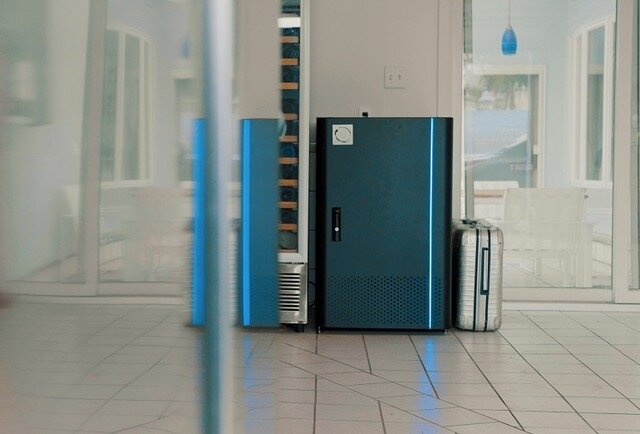
In Hawaii, Blue Planet is now making available lithium-ion batteries (Fire-safe Blue Ion 2.0) that are fire resistant but still enable energy storage from different common energy sources such as generators and solar panels. These new batteries are designed in a multitude of situations, from grid outages to off-grid needs. Blue Planet has done extensive testing with rigorous UL tests, using a lithium ferrous phosphate (LFP) cell chemistry, high quality parts and materials, and according to the manufacturer makes use of “an advanced Battery Management Unit (BMU) integrate additional safety and performance layers into the energy storage system with both hardware and software safeguards.”

Blue Planet fire resistant storage batteries
Creating Virtual Power on Hawaiian Electrics Grid From Home Batteries by Michael Markrich
Hawaiian Electric contracted to begin installing software that links the electricity in home batteries together in 2021. Approximately 6,000 home batteries on three islands will be tied together through a software grid that the Venice Beach California company called Swell Energy https://www.swellenergy.com company, describes as a “virtual power plant”
The software is able to aggregate the estimated energy in the linked stored batteries at any one time. The stored power can then be dispatched by HECOS central control at will into the grid. The more power they are able to utilize from the solar supplied home batteries the less HECO has to generate from a fossil fuel powered generating plant. This is especially advantageous during peak periods when the electric company has to rapidly provide extra electricity on to the system. Instead of having to use a fossil fuel to power the additional electricity so as to avoid a brown out, the company is able to simply redirect the home battery produced energy, to where it would be needed. Swell Energy promotes the idea that its technology can relieve the HECO grid of ‘excess renewable energy as production spikes, reducing peak demand and providing 24/7 fast frequency response to balance the grid.”
Hawaii’s grids usually become saturated with solar power at mid day. Increasing amounts of that power through programs like self supply is being stored in home batteries. Swell is contracted by HECO to produce an estimated number of kilowatts that they will provide. In a program similar to Net Energy Metering, the owners of the batteries will be paid for the power provided to the grid.
In other states such as Vermont the use of this kind of software is increasingly common. Green Mountain Power, the largest utility there, used a special battery incentive to link 2,567 home batteries together. These devices are said to have provided this utility with an additional 13 MW of flexible capacity from batteries.
The expectation is that on the Hawaii system the SWELL virtual grid will generate 25 MW of solar and 80 MW of battery capacity.
Can Hawaii become the Saudi Arabia of Hydrogen by Michael Markrich
Can Hawaii become the Saudi Arabia of Hydrogen? by Michael Markrich
It was recently announced that Saudi Arabia is now investing in solar powered technology that will enable it to sell shiploads of liquid hydrogen to Japan
Stan Osserman, the former director of the Hawaii Center of Advanced Transportation Technologies believes that this is a path that Hawaii, can use as well.
Stan believes that because of Hawaii’s geothermal energy resources it has a natural advantage, not unlike Saudi Arabia, that it could produce liquid hydrogen at such great quantities so cheaply that it could one day transform the Big Isle economy into an energy exporter shipping liquid hydrogen to Japan, China or even the Mainland US.
Only a few years ago such projects would have seemed no more than fantasy:
The idea that Saudi Arabia, one of the lowest electricity costs in the world, would someday produce a product that would compete with oil would have seemed no more likely than Hawaii with the worlds highest
Energy costs would some day have plans to become an energy exporter
But such plans are in active discussion. The key to make them happen is to change our thinking about batteries, says Stan. The large batteries that are used to store energy have drawbacks; they are expensive, leak and can be a source of environmental contamination.
“The bigger picture requires that HECO opens their eyes to see more than batteries. They need to add as much PV as they can to their grid and use all their power to make Green Hydrogen, store it and use that
Stored hydrogen for night time use, converting it back to baseload electricity using MW scale fuel cells.”
Stan explains that once that is done the stored hydrogen can be used to power the local county buildings and eventually -the g fuel can be containerized, shipped by barge to Oahu, where it would be the ultimate power source for Honolulu.
From there it would be a small step to begin exporting liquid hydrogen to Japan, which is a much closer to Asian markets than Saudi Arabia.
Hawaii has been promoting the use of hydrogen as a means of powering cars and buses for the past 30 years. But It only opened the first publicly accessible refueling station in 2018. This is now available at Servco on the island of Oahu. By way of contrast there are 48 hydrogen refueling stations in the entire United States, 43 of which are in California. There are 127 in Japan.
What is the reason that things are so slow in Hawaii? It is not lack of trying. Legislation was passed in 2006 (Hawaii Revised Statutes 196-10) to make Hawaii a show case for Hydrogen. Alas except for a successful military project at Hickam AFB there were no hydrogen refueling stations until 2018 when Servco invested in a hydrogen production and dispensing station on Oahu. Then started bringing in Toyota hydrogen cars (the Mirai). But as Stan explains the problem is primarily administrative. Hawaii’s laws and administrative rules are out dated. Hawaii needs to aggressively update and adapt its energy codes to accommodate hydrogen. But how can this be done.
Stan has an idea for this too. He imagines this scenario. “A local investor purchases 3-6 hydrogen fueling appliances ($750 k) and several used fuel cell cars from California ($15,000 each). He puts the station on vacant land (state or private) and enters into a power purchase agreement to use all of the PV generated electricity too make “green” (clean carbon free) hydrogen. Lease the cars or sell the cars with hydrogen included - like Servco does.
With new vehicles) and as the market grows, add stations and – solar to make more hydrogen.” From there he sees an easy path forward to hydrogen demand and growth.
To a visionary like Stan the market is there to make the dream viable. The only question facing Hawaii is whether Hawaii’s business community and political leaders have the will to make it happen.
Solar Energy in Hawaii by Lukas Motschmann
Hawaii currently generates two thirds of its electricity needs with imported oil. This is bad for the climate and drives up the price of electricity. The island state therefore wants to switch to 100 percent self-produced renewable energy by 2045.
Not only is Hawaii 67.3 percent dependent on imported oil for its electricity production, another 15.1 percent comes from coal-fired power generation. A devastating climate footprint for the archipelago in the Pacific Ocean. And the import of oil also drives up the price of electricity. The 1.4 million residents of Hawaii pay on average more than twice as much for their electricity as people on the US mainland. This is why Senate Bill 2629 became law as Act 23 of 2020, committing Hawaii to a future free of climate-changing coal. The new law prohibits issuing or renewing permits for coal power plants after December 31, 2022, and calls for ceasing all coal burning for electricity generation by that date.
Renewable energies are currently bobbing around in the single-digit percentage range in Hawaii though. While wind power accounts for 6.4 percent, solar energy only contributes 0.9 percent to the island group's electricity supply even though the south-western coasts of the islands in particular have a dry climate with lots of sunshine. But there is already movement in the matter. Seven solar energy projects with an output of 260 megawatts (MW) are being planned and built. Construction is taking place on the three largest islands, Oahu, Maui and Hawaii. Each solar project will be connected to gigantic storage systems with storage capacities of up to 120 MW. Underwater cables and a sophisticated communication and control system are supposed to connect all Hawaiian islands and make them independent from the mainland. The energy storage can provide four hours of electricity, which further reduces the consumption of fossil fuels during peak demand in the evening or at other times when the sun is not shining. In addition, the import of fossil fuels will be further reduced. In the decade since the state founded the Hawaii Clean Energy Initiative, fossil fuel consumption has been reduced by 26 percent. Annually approx. 48 million gallons of oil are used for power generation.
With the rapid expansion of renewable energies, 40 percent of electricity should be renewable by 2030!
The prices for six of the seven projects are the lowest ever for renewable electricity in the country, the Hawaiian Electric Electric Companies said. The prices are between 8 and 12 US cents per kilowatt hour (kWh), well below the current costs of generating with fossil fuels, which are around 15 US cents per kWh. The lowest prices are achieved by the Waikoloa Solar Hawaii AES 30 MW project with 120 MWh storage (costs: 8 US cents / kWh) and the Kuihelani Solar Maui AES 60 MW project with 240 MWh storage at costs of 8 US cents / kWh. Only the Paeahu Solar Maui Innergex 15 MW solar project with 60 MWh storage is 12 US cents / kWh above the 10 US cents / kWh mark.
The energy supply companies in Hawaii, Hawaiian Electric, Maui Electric and Hawaii Electric Light have, in addition to almost 80,000 private solar roof systems, already more than 500 MW of renewable energy under contract. According to them, the cost of renewable energy continues to decline, supported by tax credits for developers.
Furthermore, the utility Hawaiian Electric has now applied for a system made from the new Tesla megapacks with an output of 135 megawatts - and a capacity that gnaws at the giga range with 810 megawatt hours.
This is based on documents published by Hawaiian Electric to assess the environmental impact of the project. In addition, the utility is planning four more storage parks, some of which are significantly smaller, on different islands in the group. The storage with Tesla batteries is planned on the island of Oahu on the site of the Kahe power plant. Together with a storage facility that is about half the size nearby, it will absorb electricity from wind and sun, which is abundant during the day, and release it at night. Whether this part will also be realized with technology from Tesla initially remained open.
Why not solar hot water?
Solar hot water systems are basic technology, A box sits on a roof with a special black coating. Water is pumped by electricity into the box, gets heated by the sun and then flows into a hot water tank. The homeowners use the hot water until it runs out. They don’t have to pay the cost of using electricity to warm up a heating element until the water in the tank is hot. Instead of paying $1200 per year for hot water, thanks to natural sunlight the homeowner pays $120. The basic technology has been in existence since 1909.
A US Navy study found that a typical residence of 4 people would save 7 barrels of oil per household with solar thermal technology. Estimating that there are now nearly 90,000 units installed in Hawaii thats a savings of 160,000 MW a year enough to power roughly 22,000 homes forever.
One would think that this is such simple technology with such clear benefits that everyone would want to make use of it. This is like getting $1000 in additional income every year. And in the beginning people thought so - a state program offered generous tax credit incentives starting in 1977 and demand soared.
The benefits were considered so positive that in 2008 installing solar hot water was made mandatory in the construction of all new homes in Hawaii. The change was implemented in 2010.
So why did the installation of solar hot water heaters then stall so completely that by 2018 more natural gas hook ups were made to heat hot water than solar hot water tanks were installed?
Politics
Builders complained that hot water heaters added $7,000 in costs for new homes when they could have installed natural gas to heat water for under $500. This was why builders lobbied the state government to allow builders to get a variance or exception made from the existing law. Once the variance law was passed virtually all the exemptions were granted.
But there were other reasons as well
* Developers and managers of rental properties complained of bad experiences with leaky hot water tanks. One installer consistently installed systems and then forgot to turn them on.
* For small households with one or two people a solar thermal system is rather uneconomical.
*Many people just want to use solar panels – even though they are more expensive. Because they have been successfully promoted.
* It was hard to find a reliable contractor to put in solar hot water.
The variance meant that instead of saving fossil fuels Hawaii was encouraging the use of natural gas most of which came from fracking.
However, a successful lawsuit brought by Earthjustice in 2020 against the waiver was successful.
The problems with solar hot water adoption could be reversed if there were new tax incentives committed for it and good promotion.
Today solar hot water heaters are once again required to be used on new homes in Hawaii. And there is no waiver. Unfortunately there is not much enthusiasm either.
Does Hawaii Need A Social Justice Fee for Electricity ?
By Michael Markrich
Only 20% of the electrical customers in any area in the US have the credit and means needed to qualify for the financing needed for solar panels that would reduce their cost of electricity. This is also likely true in Hawaii. The unintended result of Hawaii’s push for 100 % renewables by 2045 is that while an affluent minority are able to significantly reduce their energy costs through the installation of energy saving renewable technologies, the majority of people in low income communities continue to struggle with choices between electricity or food. The reason is simple the average household of moderate incomes pays between 4% of their income for electricity. Low income households pay as much as 15%. Its an unfair and untenable situation. Perhaps Hawaii needs a social justice fee to improve the lives of the vulnerable in our society.
Before Covid-19 struck a young millionaire in Honolulu told me that he felt guilty. He had been an early adopter of solar panels and as a result of the generous state tax write off the Net Energy Metering System (NEM) enabled him to pay for the system years ago, he now paid only $18 per month for more electricity than he could use. He and his friends, who also had the income and the means to sign up for the NEM program, represent more than 60,000 people, 15% of HECOS total, mostly living in Hawaii’s most affluent areas. Many of them have added big screen TVs and other amenities because electricity costs them virtually nothing. All have increased the value of their properties by $35,000 just by having solar.
Since then many other programs have taken place beyond NEM and the number of solar panels now reaches nearly 33% of the residential homes in Honolulu. Unfortunately, the many millions of dollars spent to make Hawaii fossil fuel free has made more evident pre-existing problems in Hawaii of energy poverty.
A family of 3 who are renters, without labor income in Honolulu typically pay $223.28 cents per month while the average working family pays $168.63. Because Hawaii has the highest cost of electricity in the US many on fixed income can barely afford access to electricity and hot water. This can sometimes impact public health for those who find themselves unable to wash clothes and bathe in hot water because they can’t afford it.
How bad is this situation?:
According to HECO, in an average year 1% of its customers ,approx. 4,000 people, have their power cut off for non payment. This impacted an estimated 12,000 people- predominately low income including; the elderly, single mothers, their children, and the unemployed.
Since COVID -19, the number of HECO customers unable to pay has reached 4% -16,000 customers – impacting an estimated 48,000 men, women and children.
The problem is made worse since the pandemic because those behind on their payments typically owe at least $1500 in back payments. There is currently a moratorium on payments until May 1. All those who are behind in their payments will be expected to pay some amount of this back.
HECO is sponsoring a Special Hawaii Utility Bill Assistance Program combined with Aloha United Way to help all those customers who have fallen behind. There is $3 million dollars available in this fund – enough to give a little relief to a lot of people or perhaps significant help to a few.
Additional funding is going to be made available from the City and County of Honolulu Office of Economic Revitalization. They will reportedly be offering a one time $500 sum of federal assistance per household. This is being done in an effort to reduce the debt to those who lost their jobs and could not afford to pay for power. However, even after the debt is reduced many customers will still find it difficult to pay their bills.
This is not to say that other efforts are not being made. The Public Benefits Fund (PBF) specifically states that Hawaii Energy deal with these kinds of social equity issues but it has had difficulty reaching those who need help.
On bill financing was introduced through the State GEMS program to make financing of energy saving improvements.
There is the Low Income Energy Assistance Program (LIHEAP) that is able to help home owners. But their resources are limited
But the problems remain:
There is limited access to affordable financing for low income house holds
Community and education programs that promote energy education are not coordinated
The helping of low income communities is said to be the least important metric of success in
their reaching their goals - according to an article published in the Center of for Industrial Ecology
The answer to this problem can be found in several ways:
1)Community solar; The idea behind this is people can pool their resources into a community solar farm to reduce their bills. These projects are much favored by those working to reduce energy poverty for renters and others.. The difficulty is finding land and signing up enough low income customers interested in doing the paperwork for what is typically only a ten percent reduction in their monthly bills.
2) Creating a special social justice fund.
This is a simple solution. An additional fee of a set amount is placed on the thousands of home owners who have paid off their solar panels and now pay only a nominal amount – like a bill for public television on a cable bill - these fees would go into an interest bearing fund to increase access to affordable financing so homeowners and renters qualify for the financing of energy saving technologies that offer greater amounts off energy bills such as solar hot water which can reduce monthly bills by 40%. The creation of this fund would likely be a significant stimulus to local renewable energy companies because it will facilitate eligibility and stimulate demand - thereby creating jobs and opportunities. It will also dispense with the red tape and permitting issues that slow down the implementation of all kinds of improvements
3) Committing to universal basic electricity so that no family needs to go without electricity. Since the utility is a corporation regulated for profit. Why not allow every household at poverty level to be assured by the State Public Utilities Commission they would pay no more than 4% of their per capita income for electricity. This would alleviate enormous stress on poor families and ensure that everyone has access to hot water for bathing and clothes washing. This is essential in a community that has just gone through a pandemic for health purposes. The difficulty with this approach is that critics will say it will encourage “free riders” - people not wanting to pay their bills at all. On the other hand if such a program is carefully managed and limited to those living below the poverty level - it may be a great help for people and help in maintaining community health.
One might ask why it is necessary to eliminate energy poverty in Hawaii. Because fair access to basic electricity for the poor and vulnerable should be also be one of the Hawaii’s energy goals.