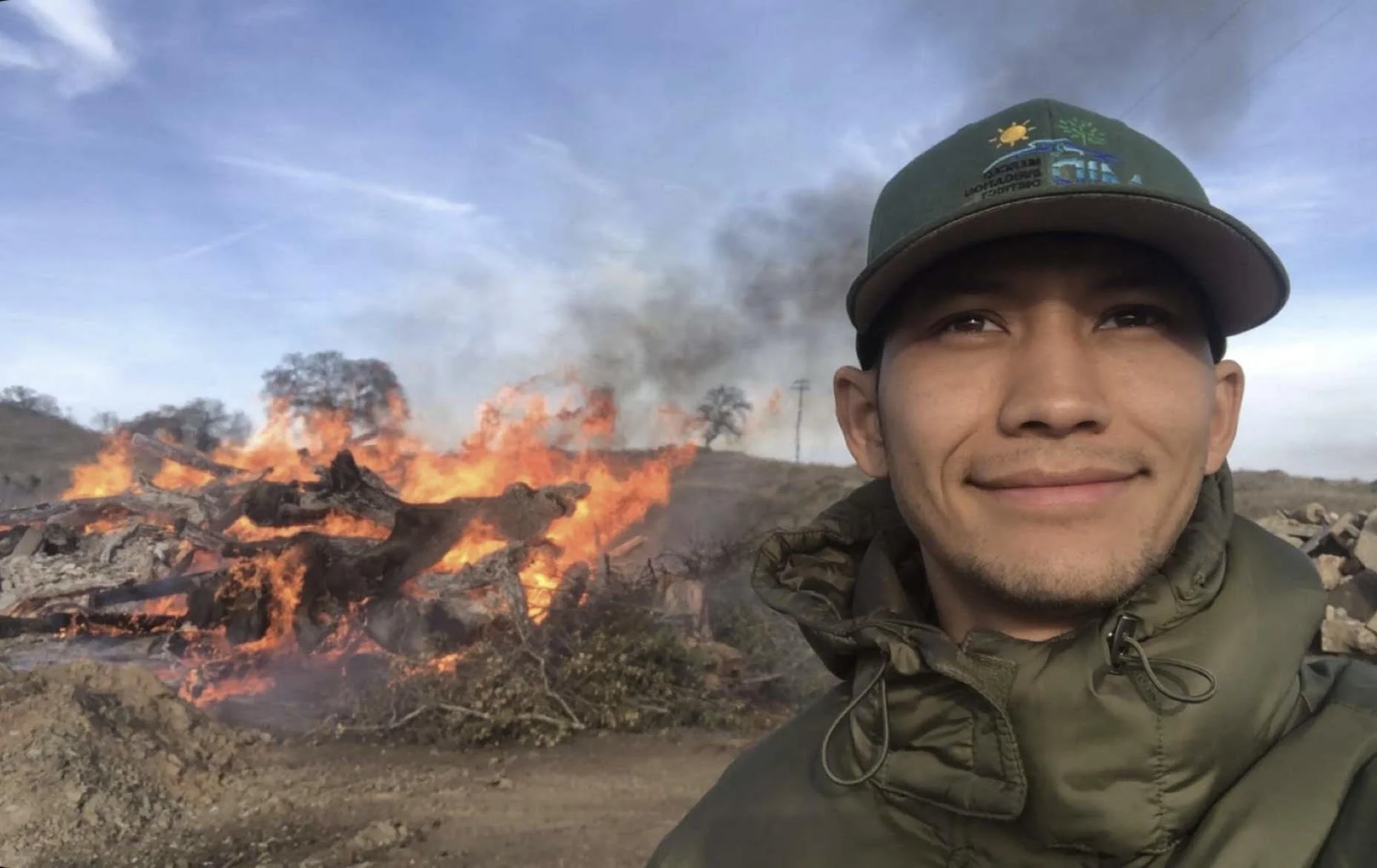
Sage Murakami at Mariposa County, just south of Yosemite national park. “This wasn’t a wildfire but one of our prescribed (controlled) burns. During fire season we collected brush and dead wood from around the parks, the. Burned those fuel piles during the wet season under controlled conditions. The goal was to reduce fuels and help lower risk and intensity of future wildfires.”
I was born and raised in California, but Hawaiʻi has always been an important part of who I am. My family has called these islands home for generations, and throughout my childhood I spent months here each year learning from the people, landscapes, and cultural traditions that have shaped Hawaiʻi for centuries. As I became more involved in sustainability, environmental restoration, and community resilience, I began to see Hawaiʻi not only as a place of incredible natural beauty but also as a place that faces unique environmental challenges requiring thoughtful, long-term solutions.
Those perspectives became even more meaningful during my time working as a park ranger in California's Sierra Nevada from 2020 to 2022. Wildfire was no longer something I read about in the news, it became part of everyday life.
During several major fire events, I watched helicopters repeatedly draw water from Lake McClure and Lake McSwain to support aerial firefighting operations. The constant rhythm of aircraft carrying thousands of gallons of water illustrated both the incredible dedication of emergency responders and the immense resources required once a wildfire escapes initial containment. Every flight represented communities already in danger.
Within that same year, another memory remains impossible to forget. While driving north on Interstate 5, I found myself stopped in traffic only a few miles from the Silverado Fire in Southern California. Emergency alerts began sounding on my phone warning that I was dangerously close to the active fire. Looking toward the horizon, the afternoon sky had transformed into an eerie pumpkin-orange glow as smoke filtered the sunlight. It was beautiful in a haunting way, yet deeply unsettling. Sitting motionless while wildfire advanced nearby demonstrated just how quickly ordinary moments can become emergencies.
Those experiences changed the way I think about disaster preparedness. More importantly, they changed the questions I began asking.
“How do communities prepare before the helicopters arrive?
How do we design neighborhoods that are less vulnerable to wildfire?
How do we proactively reduce risk instead of simply responding to it?”
Today, those questions have become increasingly relevant in Hawaiʻi.
For many years, people viewed Hawaiʻi as being relatively protected from catastrophic wildfire because of its tropical climate. However, changing rainfall patterns, prolonged drought, invasive grasses (guinea & fountain grass), expanding development, and warming microclimates have dramatically altered that reality. The tragic Lahaina wildfire demonstrated that wildfire is no longer simply a mainland problem, but it is now one of Hawaiʻi's greatest resilience challenges.
As our communities continue to grow along the wildland-urban interface, we must begin thinking differently about how we design landscapes. Rather than relying solely on emergency response after ignition, we have an opportunity to invest in prevention through urban forestry, ecological restoration, firewise planning, and community education.
Urban forestry is often misunderstood as simply planting more trees. In reality, it is the intentional planning, management, and stewardship of trees and green spaces to improve environmental, social, and community resilience. A well-designed urban forest can reduce urban heat, improve air quality, stabilize soils, reduce flooding, increase biodiversity, provide shade during extreme heat events, and contribute to both physical and mental health.
When integrated into wildfire planning, urban forestry becomes even more powerful.
Tree selection, species diversity, spacing, pruning, fuel management, irrigation planning, and landscape design all influence how fire behaves. Native species that are adapted to Hawaiʻi's ecosystems can become part of a larger strategy that reduces wildfire intensity while restoring ecological function. Removing invasive grasses that create continuous fuel loads, increasing canopy diversity, maintaining defensible space around homes, and strategically restoring native vegetation can help slow fire spread while improving ecosystem health.
Among Hawaiʻi's native trees, none better represents resilience than the ʻōhiʻa lehua (Metrosideros polymorpha).
The ʻōhiʻa lehua is one of the first trees to establish itself on newly formed lava flows after volcanic eruptions. Where fresh basalt appears lifeless and inhospitable, ʻōhiʻa begins the slow process of ecological succession. Its roots penetrate cracks in hardened lava, helping break down rock into soil while capturing organic material and moisture. Over decades, this gradual process creates conditions that allow mosses, ferns, shrubs, insects, birds, and eventually entire native forests to flourish.
Ecologists refer to species like ʻōhiʻa as primary successional species because they begin the long process of ecosystem development where virtually nothing existed before.
That role carries an important lesson beyond ecology.
Resilience is not simply the ability to survive difficult circumstances. True resilience means creating opportunities for others to succeed after you.
The ʻōhiʻa does not grow because conditions are easy. It grows because difficult conditions require a species capable of preparing the landscape for everything that follows.
Communities can embrace that same philosophy.
Every native tree planted today, every invasive grass removed, every firewise neighborhood created, every emergency evacuation route improved, and every resilience hub established becomes an investment that future generations inherit.
Like ʻōhiʻa, we may never see the full forest that grows from today's efforts.
Yet those efforts matter.
The ecological importance of ʻōhiʻa extends far beyond its role as a pioneer species. It serves as the foundation of many Hawaiian forest ecosystems, providing habitat for countless native insects and supplying nectar for endangered Hawaiian honeycreepers such as the ʻiʻiwi and ʻapapane. For generations, Native Hawaiians have used ʻōhiʻa in traditional medicine, carving, house construction, and cultural practices. The tree appears throughout Hawaiian moʻolelo, chants, and hula, symbolizing strength, love, and the enduring relationship between people and ʻāina.
Today, however, this remarkable tree faces significant challenges. Rapid ʻŌhiʻa Death (ROD), caused by fungal pathogens, has killed millions of ʻōhiʻa trees throughout Hawaiʻi. Climate change, habitat fragmentation, invasive species, and increasing wildfire risk continue placing additional pressure on native forests that have evolved over thousands of years.
Protecting ʻōhiʻa therefore means protecting far more than a single species.
Healthy native forests regulate water supplies, reduce erosion, stabilize soil structure, support biodiversity, capture carbon, cool surrounding landscapes, and provide cultural spaces that connect communities with ʻāina. Every healthy forest strengthens Hawaiʻi's overall resilience.
Urban forestry offers an opportunity to connect these ecological benefits directly with community planning. Municipal governments, neighborhood organizations, schools, businesses, and residents can work together to create greener communities that are both environmentally healthy and wildfire resilient.
This planning may include expanding native tree planting programs, replacing highly flammable invasive vegetation with lower-risk native landscapes, creating shaded parks that double as community gathering spaces during emergencies, and integrating urban forests into resilience hub planning. Community volunteers can participate in restoration efforts, remove invasive species, monitor forest health, and support long-term stewardship projects that strengthen neighborhoods while restoring ecosystems.
Firewise planning complements these efforts by encouraging homeowners and communities to think proactively about wildfire before an emergency occurs. Creating defensible space around structures, maintaining vegetation, using fire-resistant landscaping, developing neighborhood evacuation plans, improving emergency communication systems, and educating residents all contribute to reducing wildfire risk.
No single strategy eliminates wildfire.
But together, these actions create communities that are better prepared, more connected, and more resilient.
As Hawaiʻi continues adapting to a changing climate, we have a unique opportunity to learn from both science and community ‘ike (knowledge). We can draw upon modern urban forestry practices while honoring Indigenous stewardship principles that have sustained these islands for generations. We can recognize that healthy forests are not simply scenic backdrops but living infrastructure that supports water, biodiversity, climate adaptation, cultural identity, and community safety.
The story of the ʻōhiʻa lehua reminds us that resilience begins long before disaster strikes. It begins with thoughtful planning, patient stewardship, and the willingness to invest in a future we may never fully witness ourselves.
Like the ʻōhiʻa taking root in fresh lava, we have the opportunity today to lay the foundation for stronger communities tomorrow.
Renewing and rebuilding Hawaiʻi is not simply about recovering after disaster. It is about cultivating landscapes, neighborhoods, and relationships that allow future generations to flourish long before the next wildfire begins.
Works Cited:
Hawaiʻi Wildfire Management Organization. (2025). Ready, set, go! Your personal Hawaiʻi wildland fire action guide (Rev. ed.). Hawaiʻi Wildfire Management Organization.
M. Markrich, personal communication, June 2026
B. Deis M.S., personal communication, June 2026
Loope, L., Hughes, R. F., Keith, L. M., Harrington, T., Hauff, R., Friday, J. B., et al. (2016). Guidance document for Rapid ʻŌhiʻa Death: Background for the 2017–2019 ROD Strategic Response Plan. University of Hawaiʻi College of Tropical Agriculture and Human Resources