This is generated with AI assistance - calculations available below
Hawaiʻi used more petroleum in 2024 than we did in 2008.
Is it time for a re-set in our thinking? by Mike Markrich
In 2008, Governor Linda Lingle and the U.S. Department of Energy launched the Hawaii Clean Energy Initiative (HCEI) The initiative established an ambitious goal of achieving 70% clean energy by 2030 - 40% from renewable energy and 30% through energy efficiency.
HCEI was so broad in scope and so widely publicized it helped establish Hawaiʻi as a national and international model for reducing dependence on fossil fuels. Over the following years, successive Governors and Hawaii State Legislators supported renewable-energy development through policies and incentives that encouraged the deployment of wind turbines, solar photovoltaic systems, solar water heaters and other clean-energy technologies. Environmental organizations came to Hawaii to learn about our bold actions and success.
Hawaiʻi subsequently made substantial progress in reducing the use of petroleum and coal. In 2008, these two fossil fuels together accounted for more than 90% of Hawaiʻi's electricity generation. By 2024, this percent had dropped to 64 % with renewable energy supplying approximately 36% of the state's electricity generation. By contrast at the peak of Hawaii’s plantation 143 year era, the burning of sugar cane waste generated a significant amount of electricity on Neighbor Islands such as Kauaim Maui and the Island of Hawaai’. This was lost when the last plantation, HC&S, closed on Maui in 2016. Statewide the estimate was about 10% of the electricity was created by burning sugar cane bagasses. Replacing that with renewable energy that generates 36% of our electricity has been a considerable achievement.
Without those efforts, the loss of the sugar plantation produced electricity would have been felt to a greater degree.
In 2015, Hawaiʻi went further by establishing a statutory 100% renewable portfolio standard (RPS) for electricity by 2045.
But despite nearly two decades of clean-energy investment and millions of dollars in spending and tax credits. Hawaiʻi's overall petroleum consumption has actually grown.
In 2008, Hawaiʻi consumed approximately 42.397 millions of barrels of oil. By 2024, consumption had risen to approximately 44.971 million barrels of oil - an increase of about 6%.
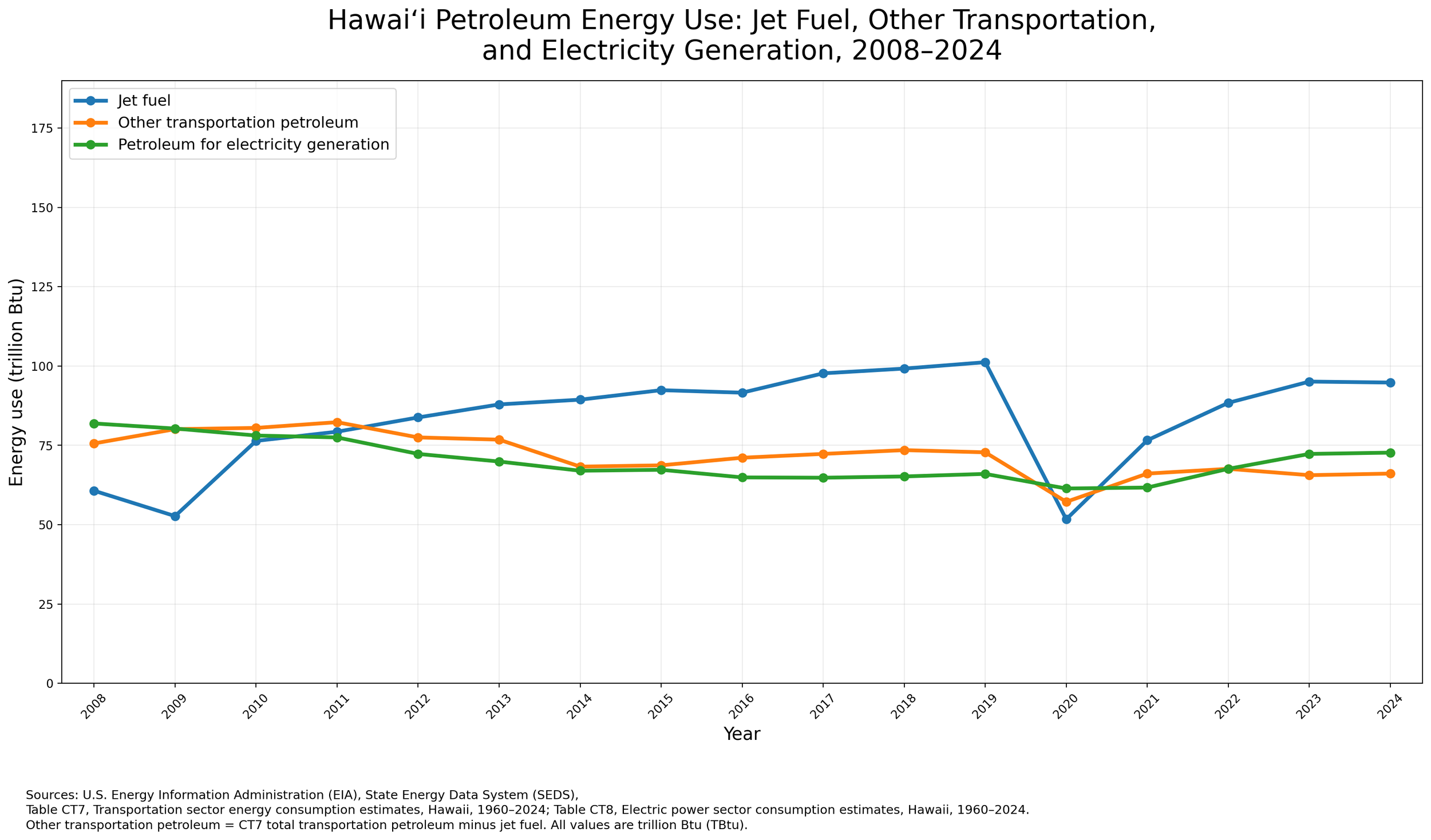
The increase in the demand for jet fuel, needed by the tourism industry- offset progress in renewable energy
Hawaiʻi consumed approximately 1.34 barrels of petroleum per second in 2008. By 2024, that had increased to approximately 1.42 barrels per second. (These figures are calculated from the U.S. Energy Information Administration's annual petroleum-consumption totals using 365 days per year.)
The numbers reveal an important shift within Hawaiʻi's energy system.
Petroleum consumption for electricity generation declined from 13.209 million barrels in 2008 to 11.794 million barrels in 2024 a reduction of 10.7%
But jet fuel consumption rose 56% from 10.7 0 million barrels in 2008 to 16.72 million barrels in 2024.
At the same time the number of cars, trucks, vessels, boats and ships increased.
No matter what was done to reduce the consumption of oil for electricity, the overall demands of oil for transportation offset them.
The challenge facing Hawaiʻi has therefore changed.
The state can no longer focus on trying to reduce the use of oil to generate electricity. It must address the continued consumption of petroleum in aviation and all other forms of transportation to succeed.
Bold new ideas are needed
Sources 1. U.S. Department of Energy — Hawaiʻi Clean Energy Initiative, 2008
Documents the 2008 DOE–Hawaiʻi partnership and the original HCEI goals.
U.S. Department of Energy — 2008 HCEI timeline
2. Hawaiʻi State Energy Office — Hawaiʻi Clean Energy Initiative
Background on HCEI and Hawaiʻi's clean-energy policies.
Hawaiʻi State Energy Office — Hawaiʻi Clean Energy Initiative
3. Hawaiʻi Public Utilities Commission — Renewable Energy and Energy Efficiency Policies
Documents the original HCEI target of 70% clean energy by 2030.
Hawaiʻi PUC — Renewable Energy and Energy Efficiency Policies
4. Hawaiʻi Legislature — Act 97 (2015)
Establishes Hawaiʻi's statutory 100% renewable portfolio standard by 2045.
Hawaiʻi Legislature — Renewable Portfolio Standard legislation
5. Hawaiʻi DBEDT — Hawaiʻi Petroleum Consumption
Source for the 2008 petroleum-consumption figures, including total petroleum, transportation and electric-power consumption.
Hawaiʻi DBEDT — Petroleum Consumption Report
6. U.S. Energy Information Administration — Hawaiʻi State Energy Data
Source for the 2024 petroleum-consumption figures.
EIA — Hawaiʻi State Energy Data
7. U.S. Energy Information Administration — Jet Fuel Consumption
Source for the 2008 and 2024 jet-fuel figures.
EIA — Jet Fuel Consumption Data
8. U.S. Energy Information Administration — Hawaiʻi Electricity Generation
Source for the historical dependence on petroleum and coal for electricity generation.
EIA — Hawaiʻi Electricity Generation
9. Hawaiʻi State Energy Office — 2025 Annual Report
Source for the 2024 renewable share of electricity generation.
Hawaiʻi State Energy Office — 2025 Annual Report
10. Hawaiʻi Department of Taxation — Renewable Energy Technologies Income Tax Credit
Source documenting Hawaiʻi's renewable-energy tax incentives.
Hawaiʻi Department of Taxation — Renewable Energy Technologies Income Tax Credit